


New Brunswick’s economy is projected to fully rebound and grow 1.2 per cent beyond its pre-pandemic levels by next year, the second best rate of recovery in Canada, according to the latest economic outlook from the Bank of Montreal.
The bank updates provincial economic projections weekly and in its latest edition suggests five provinces are likely to see their economies get back to 2019 levels by 2021 although only Prince Edward Island and New Brunswick are picked to move more than 1 per cent higher.
It’s a development the bank’s chief economist Douglas Porter is crediting largely to the provinces’ successful handling of the COVID-19 crises.
“I put it down mostly to the better performance with the virus in general,” said Porter.
“The Maritimes have fared much better than the rest of the country to the point where they can almost operate close to normal now, certainly closer than much of the rest of the country.”
National economy won’t bounce back until 2022
By contrast the national economy is not expected by the bank to get fully past its 2019 gross domestic product levels until 2022.
Nevertheless the handling of New Brunswick’s economy has become a central issue in the province’s provincial election campaign with Liberals contending not enough is being done to support recovery.
We’re doing well right now in comparison to other provinces. I am not going to promise you things with your tax dollars to buy your vote.– PC Leader Blaine Higgs
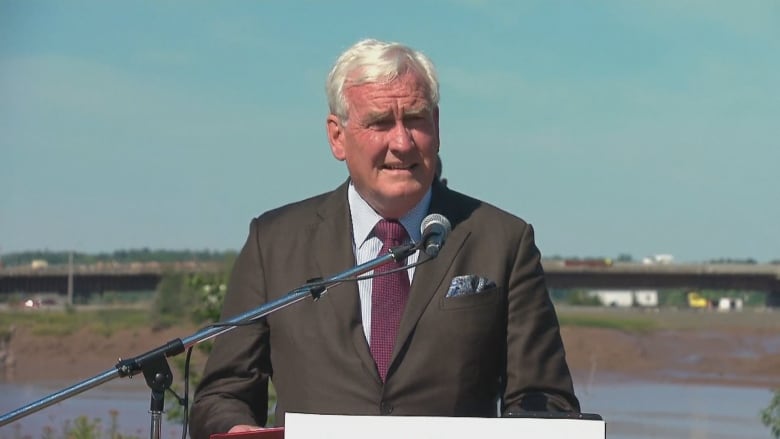
On Monday Liberal Leader Kevin Vickers continued his attack that PC Leader Blaine Higgs should be accessing more infrastructure money from Ottawa, matching it with provincial funds and spending it on needed projects to stimulate more growth.
“We need to stabilize our province’s situation. Right now New Brunswick is headed for the wall.” said Vickers.
“If we continue at this pace it will take decades to recover.”
COVID-19 pushes budget into the red
Roger Melanson, Liberal campaign finance spokesperson and the province’s former finance minister, said even if New Brunswick is projected to weather the current economic downturn better than other provinces, that does not undermine Liberal election messaging that Higgs is mismanaging the recovery.
“If our provincial government would want to partner with the federal government and some municipalities our growth would be even more significant,” said Melanson.

Melanson said he could not give an exact figure on how much more money the province should be spending.
The pandemic has pushed New Brunswick’s budget into the red although the province has kept a tighter lid on its finances than all other provinces.
Last week the New Brunswick’s Department of Finance, released an updated fiscal outlook projecting a budget deficit of $304.9 million this year.
At $390 per person, it will be the smallest per capita deficit in Canada among the ten provinces, which as a group are spending an average of $2,400 per person more than they are raising in revenue. The federal government’s deficit this year is more than $9,000 per person

But even with a lower deficit than other provinces this year New Brunswick still has the second highest debt level as a percentage of its economy after Newfoundland and Labrador.
On Monday Higgs said the province will be better served by not spending more.
“We’re doing well right now in comparison to other provinces,” he said.
“I am not going to promise you things with your tax dollars to buy your vote.”
Economist advises to ‘stay flexible’
Porter said governments around the world are debating how much to spend on recovery and how much to hold in reserve in case the virus mounts a return this fall or winter.
“My advice would basically be stay flexible and see how things develop,” said Porter.
“New Brunswick is in better shape (than other provinces) and there’s probably a little less immediate requirement for government to step in at this point.”

Follow Canada News Media
Get the day's top Canadian stories and our two daily 60-second news videos wherever you scroll.
X Threads Facebook Instagram LinkedIn TikTok YouTube Pinterest Reddit Substack Flipboard Newsletter RSS