





Many bleary-eyed political watchers in London went to bed late Tuesday — or early Wednesday — not knowing whether Donald Trump will get a second term in the White House with too many votes in key swing states to be counted to declare a winner.
U.S. elections are always closely watched in Canada but Trump’s turbulent first term combined with the COVID-19 pandemic amped up local interest in this race.
However this morning., the results were not decisive in enough to name a winner in the presidential race, though some Democratic party supporters weren’t feeling good about their chances with Trump having won Ohio and Florida and holding leads in crucial states including Pennsylvania, Texas, Wisconsin and Michigan.
Many of the early results could change due to the record number of absentee ballots cast as voters tried to avoid crowded voting centres. Some states may not be able to declare the winner for days, depending on possible recounts and legal challenges.
‘Not looking good’ says Biden supporter

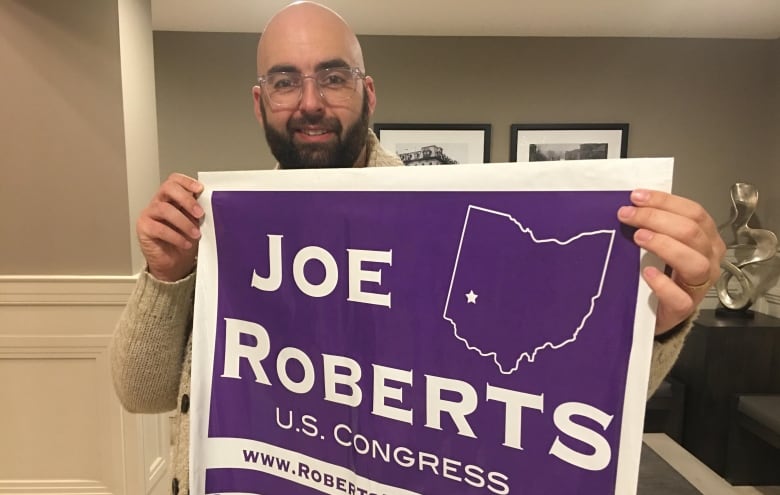
Among the Londoners watching the results closely was Joe Roberts.
He’s the executive director of London’s Jewish Centre, but he’s also a native Ohioan who ran for Congress as a Democrat in what was then the Buckeye State’s Third District back in 2010.
He lost that race to a Republican incumbent but didn’t lose his love of politics. He voted by mail in this election weeks ago.
“I’ve been looking forward to this all year, for four years really,” he told CBC News before results began to come in. “Starting in March, all I could think about was November.”
Early Tuesday evening he believed Democratic Party challenger Joe Biden was heading for a win.
But hours later, after partial results had rolled in, Roberts told CBC News he feared Biden faced a very difficult path to win the 270 Electoral College votes needed to win the White House.
“Looking at the vote total that’s still out and where it’s out in Wisconsin and Michigan, it’s really not looking good for Biden,” said Roberts just after midnight. “You have to flip both Pennsylvania and one of those two states to win and it just doesn’t look likely.”
If political history is any indicator, Trump’s win in Ohio doesn’t bode well for Biden and the Democrats.
Ohio has a good track record of picking winning presidential candidates. Going back to 1944, the state has voted for the losing candidate only once, opting for Nixon over Kennedy back in 1960.
“A Republican presidential candidate, historically, has not won without winning Ohio,” said Roberts.
Trump won Ohio four years ago but the state also has a history of oscillating back and forth between the two parties. In the last 12 elections, Ohio has voted for Republican presidential candidates seven times, Democrats five
London Republican watching Texas

Another London-based U.S. politics watcher, but one on the opposite side of the political spectrum, is Jess McDougall.
A 22-year-old political science student at Western University, McDougall says if she lived in the United States, she’d be voting for Trump, like her family does.
They’re based in the Dallas area and she calls them “hardcore Republicans.” They are religious, gun carrying conservatives who want to see Trump in office for another four years.
McDougall said too many polls that predicted a Biden win failed to capture the voting intentions of so-called “shy” Trump supporters.
She’s predicting a Trump win with an Electoral College count similar to when Trump beat Hillary Clinton in 2016.
“Nothing has changed to sway those Trump voters in my opinion,” McDougall said.
CBC News checked in with McDougall just after 11 p.m. Tuesday. She didn’t want to declare Trump the winner, but said she was happy with what she saw in the early results.
“I’m pretty confident obviously but I don’t want to count my chickens too quickly,” she said. “But the pathways are narrowing for Biden.”
Zoom watching party at Western
McDougall was watching the race with others but not in a crowded pub, restaurant or living room.
The political science club at Western University held a Zoom meeting of politics-watchers to discuss and debate as the results were reported.
Club president Aidan Link organized the event and said more than 150 people joined the chat at once. He programmed a half-dozen student moderators, including McDougall, to take turns leading the discussion as the night unfolded. A few Western political science professors also joined the online discussion throughout the night.
It’s not the same as watching the results and victory speeches among a crowd but it will have to do. This is 2020 after all and politics is often about compromise.


