


Lawyers for former President Donald Trump’s defense rested their case Friday after less than three hours of arguments in which they echoed their client in calling the impeachment case built by Democratic House managers an act of “political vengeance” and alleged that Trump’s speech preceding the Capitol riot was merely “ordinary political rhetoric.”
The defense lawyers said that Trump’s words at the Jan. 6 “Stop the Steal” rally that preceded the violent storming of the Capitol was protected free speech and that convicting him for it would amount to “canceling” him and his supporters.
“This trial is about far more than President Trump. It is about silencing and banning the speech the majority does not agree with,” said Bruce Castor, one of Trump’s lawyers. “It is about canceling 75 million Trump voters and criminalizing political viewpoints. It’s the only existential issue before us. It asks for constitutional cancel culture to take over in the United States Senate.”
Senators are now posing written questions for representatives of both sides for four hours. Sen. Patrick Leahy, D-Vt., the Senate president pro tempore, who is presiding over the trial, will read the questions aloud.
The defense needs only to keep only 34 Republican senators in their camp to avoid a conviction of the former president. So far, few minds of GOP senators appear to have been changed and most still expect Trump to be acquitted.
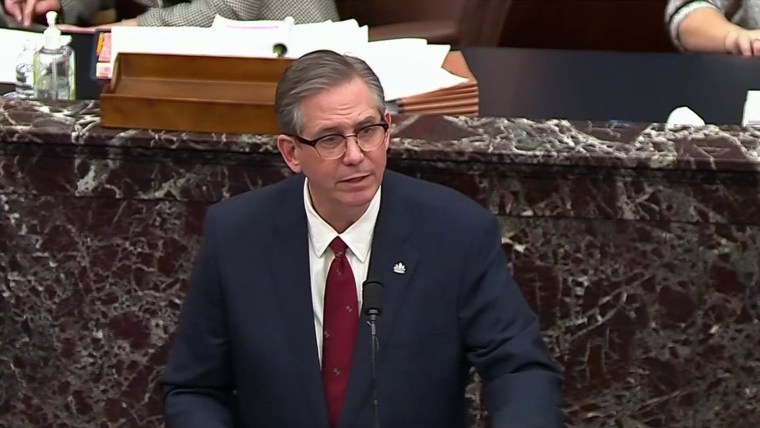
The defense focused mainly on process and lawyerly arguments about the Senate trial and the prosecution’s case, as well as political arguments equating common Democratic rhetoric with Trump’s rally speech.
They did not address some of the prosecution’s core arguments, such as offering a complete explanation of Trump’s actions during the violence at the Capitol and a defense of why he didn’t do more to stop it once it was underway.
Sens. Susan Collins, R-Maine., and Lisa Murkowski, R-Alaska — who are both seen as swing votes — asked Trump’s lawyers when exactly the former president learned of the Capitol breach and what actions he took to stop it, adding, “please be as detailed as possible.”
Michael van der Veen, one of Trump’s lawyer, said he could not answer the question about his own client’s actions, blaming Democrats and saying he could only “piece together a timeline” from Trump’s tweets.
“That’s the problem with this entire proceeding,” he claimed. “The House managers did zero investigation and the American people deserve a lot better.”
Sen. Mitt Romney, R-Utah, another potential Republican vote for conviction, asked if Trump was aware former Vice President Mike Pence was in danger before he sent a tweet saying Pence “didn’t have the courage to do what should have been done to protect our Country and our Constitution.”
Van der Veen said no, and that the question was “not really relevant,” but Alabama Republican Sen. Tommy Tuberville told reporters that he told Trump that Pence had been evacuated from the Senate Chamber and was in danger moments before Trump’s tweet was posted.
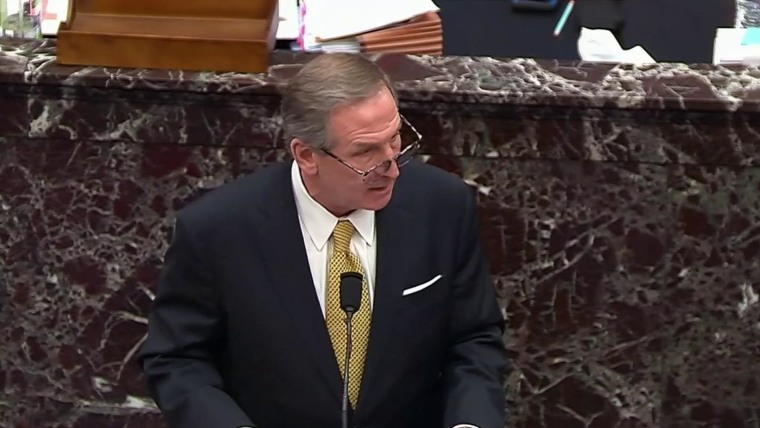
Van der Veen seemed to grow increasingly frustrated with senators’ questions, refusing to say whether Trump lost the presidential election — “my judgment is irrelevant” — and declaring the trial “about the most miserable experience I’ve had down here in Washington, D.C.”
His lawyers also argued that Trump could not have incited an assault on the Capitol because it had been preplanned by extremists. “You can’t incite what was already going to happen,” he said.
And they attempted to equate the influence that Democrats argued Trump has with right-wing extremist groups to the support by some Democrats for largely peaceful racial justice protesters over the summer.
Van der Veen also said that extremists “of various different persuasions” had “pre-planned the attack on the Capitol” and “hijacked the event for their own purposes,” including members of Antifa. Multiple news outlets, including NBC News, have said there is no evidence that any members of Antifa were involved in the riots. On the contrary, as Democratic House managers said during their arguments, rioters were overwhelmingly tied to right-wing extremist groups like the Proud Boys.
Echoing language that was once frequently used by his client, van der Veen blasted the Democrats’ impeachment case against Trump as an “unjust and blatantly unconstitutional act of political vengeance” and a divisive “politically motivated witch hunt.”
And he repeatedly argued Trump was merely encouraging supporters to make sure their lawmakers were faithfully conducting a proper certification of the Electoral College Vote count.
“Far from promoting insurrection,” Van der Veen said, “the president’s remarks…explicitly encouraged those in attendance (at the rally) to exercise their rights peacefully and patriotically.”
Castor said Trump’s pugilistic rhetoric about members of Congress was merely about encouraging primary challenges to Republican lawmakers who he thought weren’t fighting hard enough.
“Nobody in this chamber is anxious to have a primary challenge. That is one truism I think I can say with some certainty. But that’s the way we operate in this country,” Castor said.
The defense played a dizzying and lengthy video montage of various Democrats using the word “fight,” arguing that no one had ever construed those words as literal encouragement to physically fight.
At the start of the lengthy montage, Democratic senators in the chamber were mostly stone faced. But that changed quickly, as more clips played, leading to murmurs, whispering, and some laughing.
Van der Veen said this was not an exercise in “whataboutism,” but rather, that he was making the case that “all political speech should be protected.”
The lawyers repeatedly said the impeachment fell short of the high legal standards expected in a criminal case, even though impeachment is a political process, not a legal one, and the Senate is not a court of law.
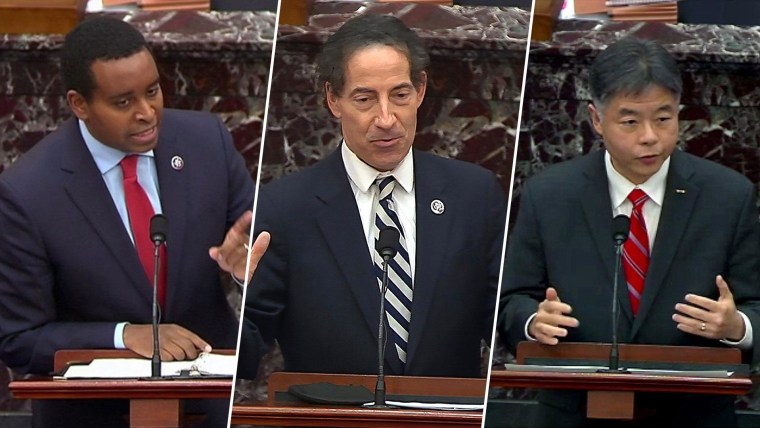
The short allotment used by Trump’s legal team means the trial is likely headed to a quick conclusion.
And because neither side is expected to request witnesses, closing arguments — and a final vote on conviction — could happen before the weekend is over.
Both sides are eager to move on, with Democrats needing Senate floor time to advance their Covid-19 relief bill and Republicans eager to put the trial and the uncomfortable questions it raises behind them.
Trump’s defense came one day after Democratic House impeachment managers rested their case against Trump by focusing on the damage his supporters caused at the U.S. Capitol on Jan. 6 and warning that he could incite further violence if he is not convicted.
That marked the end of two days of methodical and at times emotionally wrenching arguments from Democrats that included the showing of graphic and devastating never-before-seen footage from inside the Capitol during the riot.
It would take 67 senators — including at least 17 Republicans — to convict Trump.
Already this week, 44 of the 50 Republicans in the Senate have voted to declare the entire proceedings unconstitutional because Trump is no longer president, making it unlikely that any evidence would persuade them.
However, the question-and-answer phase of the trial later Friday could indicate more clearly what some Republican senators are thinking.
Trump is the first president to have been impeached twice by the House, and he is the first former president to be put on trial in the Senate. He was impeached Jan. 13 on an article charging him with “incitement of insurrection” for his role in the riot.