

SOPA Images/Getty
Activision Blizzard, the company behind some of the biggest franchises in all of gaming, has been rocked by an explosive lawsuit. The gaming giant is being sued by the state of California, which accuses it of workplace discrimination against its female workforce.
The suit, filed by the Department of Fair Employment and Housing, argues that the company has a “frat boy” workplace culture and alleges several alarming incidents of discrimination and harassment.
The suit didn’t take long to make an impact. Many employees have spoken out in support of the claims, over 2,000 have signed an open letter calling for action by the company, and a walkout protest was staged last Wednesday. After initially rejecting many of the DFEH’s allegations, Activision Blizzard has said it’ll launch a full probe — and its games will be changed to reflect values of diversity and inclusion.
Activision Blizzard is one of the biggest gaming companies in the world. It owns Call of Duty, World of Warcraft, Diablo, Crash Bandicoot and many more hugely popular franchises and last year recorded $2.2 billion in profit. Here’s everything you need to know about this colossal lawsuit.
What is Activision Blizzard accused of?
The DFEH’s suit accuses Activision Blizzard of workplace discrimination. It alleges women are compensated unfairly — paid less for the same job, scrutinized more heavily than their male peers — and subject to considerable harassment. The agency called Activision Blizzard a “breeding ground for harassment and discrimination,” in which women are subject to regular sexual advances by (often high-ranking) men who largely go unpunished.
Illustrative of the claims DFEH is making against Activision is an office ritual referred to as “cube crawls,” in which men allegedly drink “copious” amounts of alcohol, crawl through the office cubicles and engage in “inappropriate behavior” including groping. The lawsuit describes incidents including allegations that a female employee died by suicide during a business trip as a result of a toxic relationship with a supervisor.
“Women and girls now make up almost half of gamers in America, but the gaming industry continues to cater to men,” the suit reads. “Activision-Blizzard’s double-digit percentage growth, 10-figure annual revenues and recent diversity marketing campaigns have unfortunately changed little.”
And then employees reacted?
After DFEH filed its suit, Activision Blizzard responded with a lengthy statement that said the department had filed a rushed, inaccurate report with “distorted, and in many cases false, descriptions of [Activision Blizzard’s] past.” In an email sent to staff, published by Bloomberg’s Jason Schreier, vice president of corporate affairs Frances Townsend said the site presented “a distorted and untrue picture of our company, including factually incorrect, old, and out of context stories — some from more than a month ago.”
These statements evidently didn’t satisfy employees, neither current nor former. Over 2,000 of them signed an open letter to Activision Blizzard leadership in which they criticized the company’s response. (Activision Blizzard currently has around 10,000 employees.)
“To put it clearly and unequivocally, our values as employees are not accurately reflected in the words and actions of our leadership,” the open letter reads, according to Bloomberg. “To claim this is a ‘truly meritless and irresponsible lawsuit’ while seeing so many current and former employees speak out about their own experiences regarding harassment and abuse is simply unacceptable.”
The letter signed by employees made three demands. First, that the company issue statements that acknowledge the severity of the allegations. Second, that Townsend resign from her role as executive sponsor of the ABK Employee Women’s Network. Third, that Activision Blizzard’s executive leadership collaborate with employees to ensure a safe workspace to “speak out and come forward.”
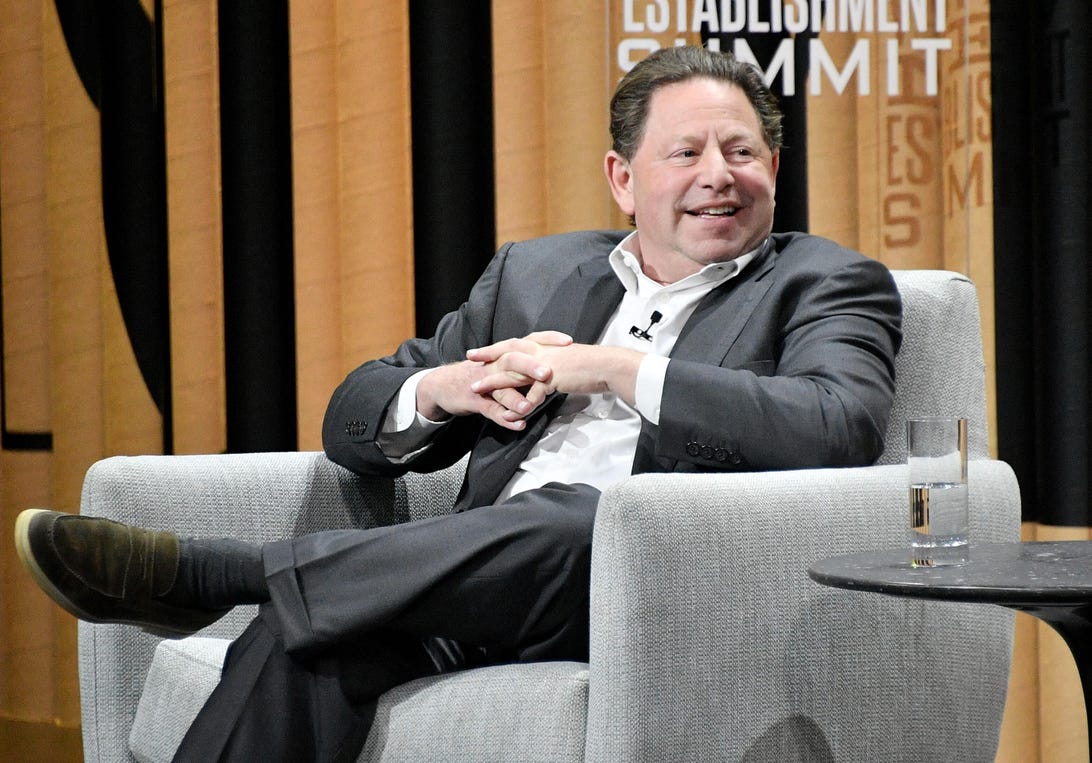
Activision Blizzard CEO Bobby Kotick at the Vanity Fair New Establishment Summit in San Francisco in October 2016.
Mike Windle/Getty
How did Activision Blizzard respond?
After Activision Blizzard’s first statement, along with the one made by Townsend, was so thoroughly rejected by employees, the company appears to be taking the suit more seriously. Last Tuesday the company’s CEO, Bobby Kotick, issued a letter addressing the suit, and the concerns of employees.
“Our initial responses to the issues we face together, and to your concerns, were, quite frankly, tone deaf,” it reads. “We are taking swift action to be the compassionate, caring company you came to work for and to ensure a safe environment. There is no place anywhere at our Company for discrimination, harassment, or unequal treatment of any kind.”
Kotick announced that a law firm, WilmerHale, will be hired to evaluate the company’s “policies and procedures.”
Beyond the probe, Kotick outlined several changes that would be made effective immediately. The company would be investigating “each and every claim” of discrimination and harassment being made, and will host listening sessions to collaborate with employees on how to improve the workplace culture. Activision Blizzard will also be “evaluating managers and leaders” across the company and making personnel changes as appropriate. Finally, changes will be made to in-game content.
“We have heard the input from employee and player communities that some of our in-game content is inappropriate. We are removing that content,” Kotick wrote.
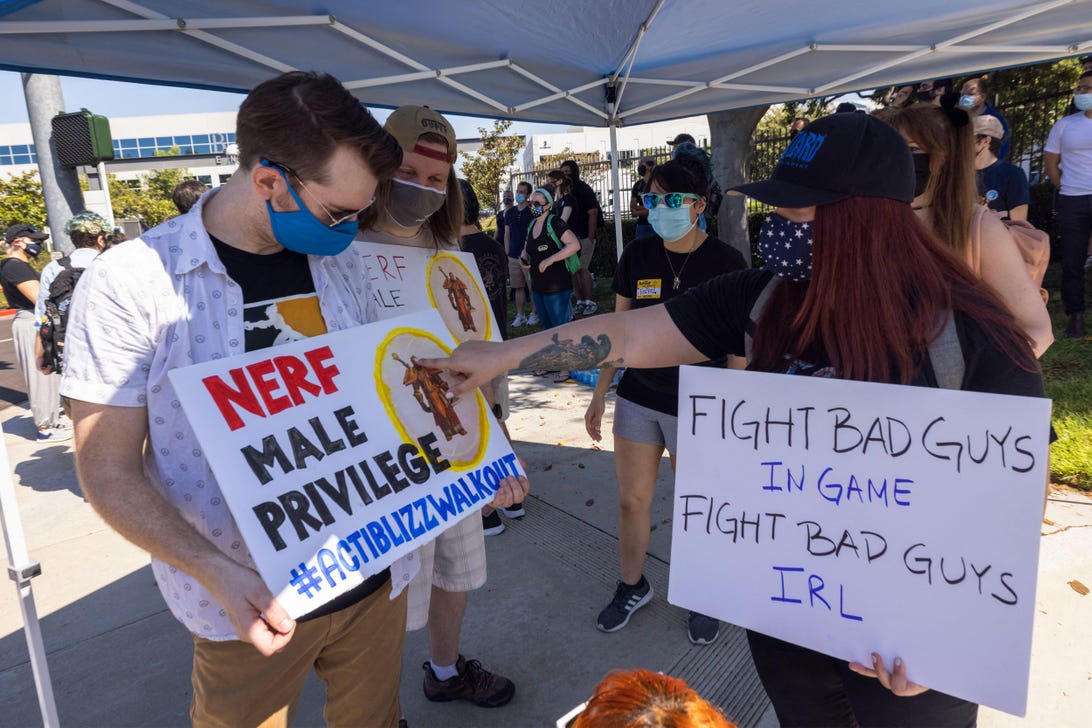
Employees at Wednesday’s walkout.
David McNew/Getty
What about the walkout?
Alongside the open letter signed by over 2,000 employees, workers at the company planned a strike last Wednesday morning. Seeking now to be more collaborative with aggrieved workers, Activision Blizzard sent an email to staff saying they would get paid time off for attending the protest.
Hundreds of employees took up the offer, as they set up a picket line outside of Activision Blizzard’s Irvine, California headquarters. Employees held signs that read “every voice matters”, “fight bad guys in game, fight bad guys IRL” and “nerf male priviledge.” (When developers weaken characters in games like Overwatch it’s known as “nerfing” them.)
Over 350 employees took up the offer, reports The Washington Post. The walkout participants acknowledged Kotick’s letter, but had four additional demands, as seen in the tweet above. These include greater pay transparency and employee participation in hiring and promotion policies.
What has the industry reaction been?
On Aug. 30 Strauss Zelnick, the CEO of Take-Two Interactive, the studio behind Grand Theft Auto and Red Dead Redemption, assured investors that his company wouldn’t tolerate a workplace environment like the one allegedly seen within Activision Blizzard.
“We will not tolerate harassment or discrimination or bad behavior of any kind. We never have,” he said. “Is there more we can do? I’m certain there is. Do we feel like we’re in a pretty good place? We’re grateful that we do feel that way right now.”
Zelnick is the latest industry figure to weigh in on the lawsuit.
“It’s our responsibility to ensure this type of behavior is not tolerated at Bungie at any level,” developer Bungie, owned by Activision Blizzard, tweeted, “and that we never excuse it or sweep it under the rug. While the accounts in this week’s news are difficult to read, we hope they will lead to justice, awareness, and accountability.”
Chris Metzen, a co-creator of Blizzard franchise Diablo who left the company in 2016, said: “We failed, and I’m sorry… to all of you at Blizzard — those of you I know and those of you whom I’ve never met — I offer you my very deepest apologies for the part I played in a culture that fostered harassment, inequality, and indifference.”