


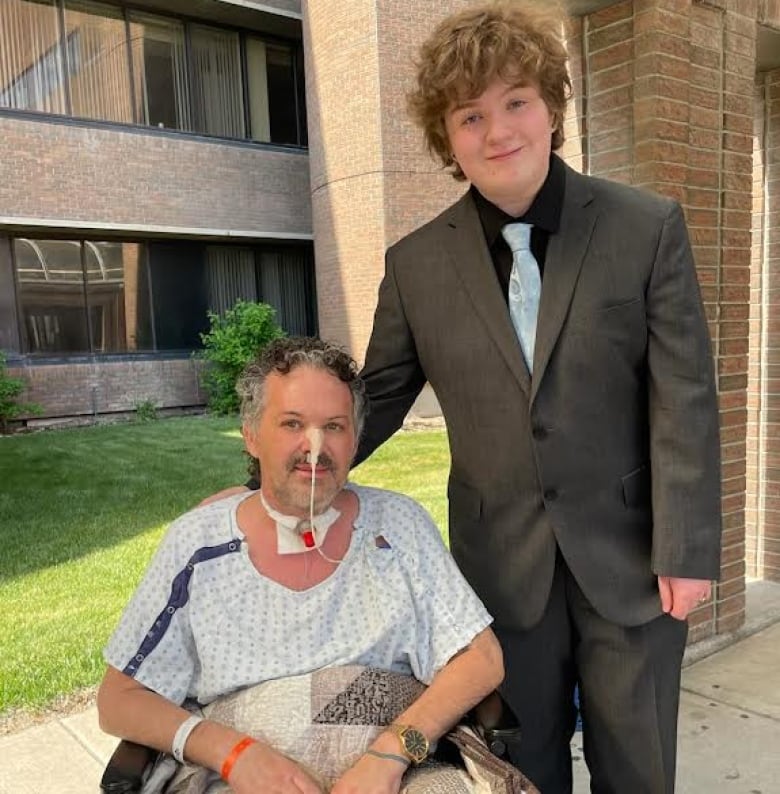
Nearly 40 days on a ventilator. A tracheotomy. Fifty pounds lost. Countless hours of physiotherapy.
And now, PTSD and flashbacks.
COVID-19 ravaged Paul Hemsing’s body and left him with deep physical and emotional scars.
“Frightening, exhausting, scary,” he recalled, struggling to put words to his trauma. “The fear of whether you were going to survive or not or whether you are going to see your loved ones again.”
Hemsing — who owns a hair salon in Medicine Hat, Alta., with his husband — went to the gym three or four times a week and was otherwise healthy. He scrambled to get his vaccination the first day his age group became eligible in April.
But COVID-19 found him anyway.
Hemsing, 51, contracted the virus in May before he could get his second shot. He was rushed to hospital — with dangerously low oxygen levels — nine days after testing positive and was quickly admitted to intensive care.
“I was unresponsive.… They said that I was in such severe shock that I would have passed away.… I was intubated within hours.”

That was the beginning of the nightmare. Hemsing was kept alive in a medically induced coma and on a ventilator for 39 days — the longest any COVID-19 patient has been intubated at the Medicine Hat hospital.
The average ICU stay for a COVID-19 patient in Alberta is 10 to 12 days.
‘I could see the terror in her eyes”
At first, Hemsing had no memories of his time in intensive care.
But there are now dark flashbacks.
At one point, doctors woke Hemsing from the coma as they tried — unsuccessfully — to take him off the ventilator. His 22-year-old daughter was watching anxiously from behind a glass wall.
She recently showed him a photo she snapped at that moment inside the ICU.

“Instantly, the memory of that came back to me.… I remember her waving and smiling. And I could see that her smile was fake and I could see terror in her eyes,” he said.
He saw his husband, Michael, there, too.
“My daughter said, you just kept on mouthing over and over again, ‘I love you, I love you, I love you.’ Because I thought I was going to die.”
Resuscitated twice
Hemsing’s long ICU stay was riddled with complications.
He went into cardiac arrest twice, requiring resuscitation.
It took doctors several attempts to bring him out of his coma and take him off the ventilator.
“You panic. I tried to grab and pull the tube out of my throat,” he recalled.
And the ICU team performed a tracheotomy — a common practice for patients who have been on a ventilator for prolonged periods.
The scar on his neck is a constant reminder
Scary times emerging from the fog of sedation
Once doctors were able to take Hemsing off the ventilator, It took about five days for him to emerge from the fog of sedation.
“You experience very severe hallucinations. That was a really mentally scary time because you were foggy and groggy and you were seeing snakes and spiders. I was very panicked.”
The hallucinations eventually waned and he became more aware of his surroundings.
“That was probably the scariest time because I couldn’t use my arms or my legs. I had lost almost 50 pounds of muscle mass. My vision had changed. Everything was blurry,” he said.
“I couldn’t talk because I had a tracheotomy. I couldn’t use my hands to write or ask for anything. So the only way I could communicate was yes or no with my head.”
At the same time, he experienced intense pain from a large pressure wound he developed while in the coma.
“I had an eight-inch long, three-inch wide, 2½-inch deep pressure wound on my butt. Like a bed sore … I couldn’t sit in a wheelchair I was in such agony, even with the pain meds.”
Plastic surgeons operated three times to repair the wound, which at one point became gangrenous.
“It’s actually only been two weeks now since it has finally closed and left me with a forever, major scar going from the top of my waist to the bottom of my butt.”
His recovery involved weeks of intense physiotherapy to build enough strength to stand, walk and regain the use of his arms.
Sleep was elusive. “I remember thinking that if I fell asleep I might die.… You were scared to close your eyes.”
There were milestones missed while he was hospitalized, including his son’s high school graduation.
‘It’s not like you go home and you’re better’
Hemsing, who nurses and doctors nicknamed “Miracle” because he wasn’t expected to survive, has been home now for two months. But he is not the same.
“[At first] I couldn’t do anything, couldn’t hold anything, couldn’t cut a tomato or lettuce, couldn’t prepare a meal, couldn’t play the piano hardly at all. It was a lot of time in bed,” he said.
“I … couldn’t stop crying. It was very dark because your whole life changes. You lose your entire life.”
He still struggles with PTSD brought on by the traumatic time in the ICU. He is plagued by neuropathy, a condition causing numbness, pain and tingling in his hands, feet and tongue. And he can only work for a few hours a day.

“When you get sick with this, it’s not like you go home and you’re better. You go home and you heal for months and months and months,” he said.
Hemsing, who is now running for Medicine Hat city council, wants unimmunized Albertans to know the terrifying details of his ordeal.
He wasn’t yet eligible for his second shot when he fell ill but with the vaccine widely available he’s urging people who haven’t yet had their shots to do it.
“I’m 100 per cent hoping I can help another one person even, that they won’t have to go through this. And if you’re fully immunized … you won’t have to go through what I did.”