


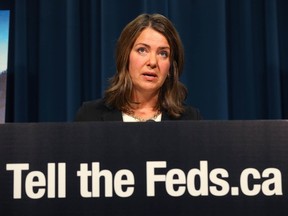
Alberta Premier Danielle Smith claims she is prepared to employ for the first time her government’s sovereignty act in response to the federal government’s proposed clean electricity regulations, though the effect of doing so remains unclear.
Smith made the comments while speaking to reporters at a Thursday news conference, where she reiterated her previous statements the clean electricity regulations were “unconstitutional and irresponsible” and vowed they will not be implemented in Alberta.
The Alberta Sovereignty Within a United Canada Act was the centrepiece of Smith’s successful campaign to become UCP leader and was introduced late last year.
It pledges to give Alberta the power to direct provincial agencies to act against federal laws it considers unconstitutional or harmful to Albertans, though questions remain about how it would work in practice, if at all.
“Hopefully, no one ever has to see it,” Smith said of the motion she claims to be working on. “Hopefully … we’re able to come to a peaceful resolution with our federal counterparts.”
The clean energy regulations remain in a draft phase and are not expected to be finalized until sometime next year pending the results of an ongoing 75-day consultation period.
In their current form, the clean electricity regulations would take effect in 2035, a target Alberta as well as New Brunswick, Nova Scotia, Manitoba and Saskatchewan have all argued comes too soon.
Smith’s UCP government also launched an $8-million multi-platform cross-Canada advertising campaign Thursday in opposition to the clean electricity regulations, calling them a “reckless and costly plan.”

‘A huge economic opportunity’
Alberta has sought to delay the clean electricity regulations by 15 years, arguing 2050 is a more realistic target.
The regulations would establish performance standards to reduce greenhouse gas emissions from fossil fuel–generated electricity, in an effort at decarbonization.
They permit for some use of fossil fuels, including natural gas, to generate power at peak demand times or as a backup to non-emitting power sources.
Environment and Climate Change Minister Steven Guilbeault’s department estimates the regulations would remove more than 340 megatonnes of greenhouse gasses between 2024 and 2050, and would result in Canadians spending 12 per cent less on electricity.
“This is a huge economic opportunity that we do not want to miss,” he stated in an email to Postmedia.
‘A very different position’
Earlier Thursday, the operator of the arm’s-length agency responsible for Alberta’s electric system claimed the clean electricity regulations could leave parts of the province without power if those rules come into effect in 2035 as planned. But, it also declined to publish details of the supply and demand modelling and assumptions that went into its projections.
Speaking with reporters Thursday, Alberta Electric System Operator (AESO) president and CEO Mike Law said that the clean electricity regulations as currently proposed puts a disproportionate strain on Alberta and its electricity grid compared to other provinces, who have greater existing access to low-emission power sources.
“It is not minor shifts that are required,” he said. “It’s a recognition that we are in a very different position as a province than the vast majority of the country.”
More than 84 per cent of electricity in Canadian power grids is generated from non-emitting sources like hydro, nuclear and wind.
Without a cleaner source of generation to fall back on, Law claimed Alberta could face power shortages.
“Our analysis and engineering assessment is that there will not be sufficient supply within the province post-2035 to meet the demands of the province,” he said.
While acknowledging Alberta needs all sources of power generation, Law said AESO is skeptical renewables could significantly close that gap before the clean electricity regulations are slated to come into effect.
“We need to have dispatchable technologies that can meet the demands of the province when the wind isn’t blowing or the sun isn’t shining.”
‘Changes to make’
Guilbeault stated he is “fully aligned” with AESO on balancing decarbonization with affordability and reliability, and encouraged the agency to provide feedback through the ongoing consultation.
University of Calgary energy economist Blake Shaffer doesn’t dispute that it will be challenging for Alberta to meet the current version of the clean electricity regulations but said it could be made more palatable with some small modifications.
“I see changes to make it such that you get the benefits of the certainty (the clean electricity regulations) provides without it binding an operation and raising costs and risking reliability too frequently.”
He was surprised at the political tone taken by the system operator, something he said threatens the perception of the agency’s independence.
“The AESO is about maintaining reliability and saying, ‘This is how we will respond to this challenge,’” he said, noting its use of the term ‘blackout’ echoed the premier’s political message delivered later the same morning.
“That sounded like a government press release.”
Both Guilbeault and Shaffer called on AESO to publish its analysis.
‘There are solutions’
In early August, the Alberta government paused all approvals in the province’s renewable energy industry in response to what it said were rural and environmental concerns.
Law did not answer two questions asking if AESO requested the six-month moratorium.
Opposition energy and climate critic Nagwan Al-Guneid acknowledged the clean electricity regulations need to be improved, but also that the 2035 goal is increasingly becoming the norm across the continent and in Europe.
“There are many concrete steps the government could be taking today,” she said, suggesting as examples ending the moratorium on renewables, and building stronger power-sharing interties with neighbouring jurisdictions.
“The world is trying to figure this out while this government is thinking in the past. There are solutions.”
Of the sovereignty act, Al-Guneid said its potential introduction was “concerning.”
“It adds another layer of uncertainty.”

Follow Canada News Media
Get the day's top Canadian stories and our two daily 60-second news videos wherever you scroll.
X Threads Facebook Instagram LinkedIn TikTok YouTube Pinterest Reddit Substack Flipboard Newsletter RSS