



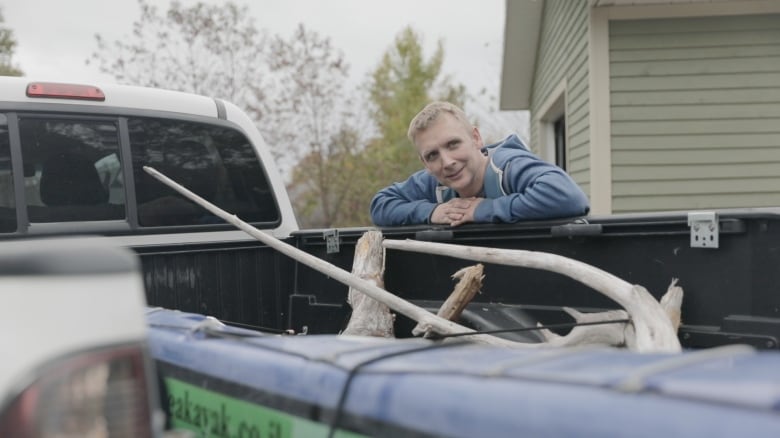

It’s an overcast morning and the waters around the small boat basin at Hodge’s Cove — a small outport in eastern Newfoundland — are glassy and calm.
Garfield Stringer stands in the pan of his pickup truck, pulling his wetsuit up and fastening it tightly. He carries a long, thin kayak down to the water’s edge and looks it over, pointing out the various stickers and markings which detail its strange provenance.
Gesturing to some Hebrew on the vessel’s side, he tells us of how he first purchased it from a German man, who himself bought the kayak from an Israeli woman who had allegedly used it to circumnavigate the island some years ago.
Much like his kayak, Garfield Stringer is an interesting composite of stories: a welder by trade, he has long maintained an artistic streak. He discovered an affinity for kayaking nearly 10 years ago.
Now, Stringer has combined these elements into a new pursuit: sourcing driftwood with his kayak and, through his trade skills, shaping the debris into unique works of abstract art.

“I’ve been to beaches that had a thousand pieces of driftwood, and I just searched through it and didn’t find anything,” Stringer said, “but then I’ll go to a beach and kayak, and there’s just one piece of driftwood on the beach, and that’s the piece.”
Most of the driftwood Stringer sources are root systems, which he prefers for their twisting shape and interesting grain. More importantly though, said Stringer, is that when he’s looking at a piece of wood, he’s looking for its story.
“I’m looking at it and thinking: does this thing have a story, or does it not have a story?” he said. “If it just works right for me I’ll keep it. If it doesn’t, I’ll throw it away.”
WATCH: See how Stringer creates his works of art in this video feature created by Conor McCann and Rodrigo Iniguez Becerril:

Meet Garfield Stringer, who uses a kayak to find unusual pieces of driftwood that he crafts into one-of-a-kind pieces. Video produced by Rodrigo Iniguez Becerril and Conor McCann 4:27
In his basement workshop, Stringer has set up a small light box, and not unlike his other endeavours, he’s crafted it himself out of cardboard and wax-paper. Here he takes photos of his creations for his online Etsy shop, where he said buyers are largely approaching him from outside of the province.
“Abstract art is not for everybody,” said Stringer. “It’s not for most people, maybe.”
That particular quality which he said he looks for in his raw material is a sense of still movement, the guiding theme behind most of his work.
“Still movement is important in a lot of these pieces. To me, I feel like each piece is some sort of character, and I want to give the impression that they’re alive.”

Like many others across the province, the COVID-19 pandemic presented challenges for Stringer and his family. After his wife was forced to shut down her home salon business, she turned to gardening and growing vegetables to keep busy. A welder for the provincial government, Stringer didn’t see too much of an interruption in his work, but said his art helped in those uncertain moments.
“This [art] definitely helped keep my sanity,” he said. “It’s definitely a way to pass away the time if you’re not allowed to go anywhere.
“Either way,” said Stringer, “as long as I’m doing something creative, at least on the weekends, it just gives everything meaning I guess.”
We followed him down to one of his usual spots where he likes to get out for a paddle and see what he can find. With no way to know if the wood he discovers came from the shores of Newfoundland or across the ocean, Stringer thinks that every piece of driftwood he comes across just might have a story to tell.
“Someone could have chopped it down and threw it in the ocean, the tide could have just dragged it out, it could’ve come from England— I mean, driftwood does have a story, it was a tree, it was alive,” he said.
“I just feel like I’m adding the next chapter to that.”

Read more from CBC Newfoundland and Labrador