



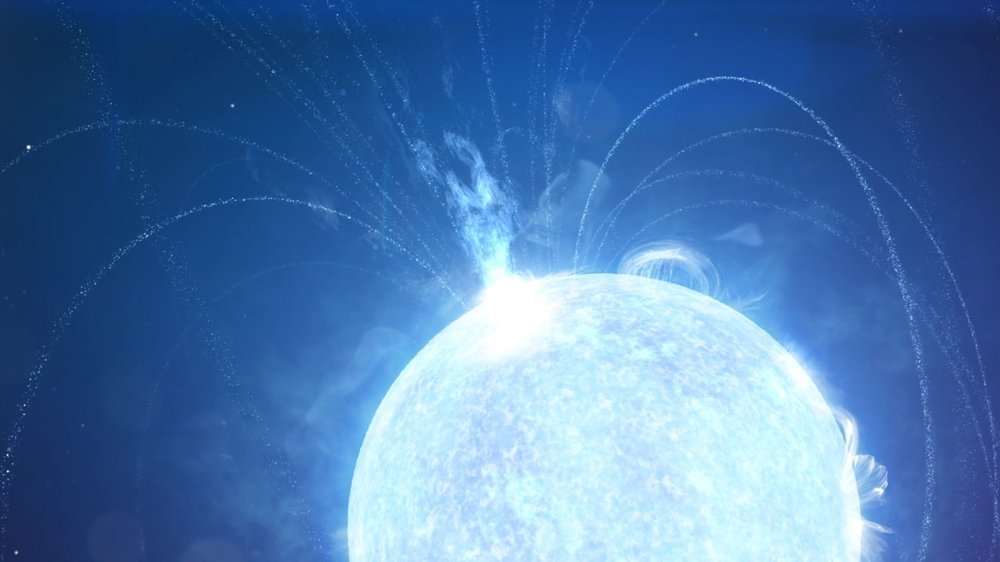

In a flash of luck, astronomers have solved a mystery about weird cosmic radio bursts.
They traced an April outburst to our own galaxy and a type of powerful energetic young star called a magnetar.
Dr. Jason Hessels, astrophysicist at the University of Amsterdam, says cosmic radio bursts can help scientists learn more about our universe.
“Through studying past radio bursts, I think we can really come to a deeper understanding of the formation of galaxies, both in cosmic past and also into the cosmic future, which is really quite important for us as human beings because it’s really fundamental to understanding why are we here in the first place,” he said.
Pulses happen in milliseconds
Scientists have known about these energetic pulses for about 13 years and have seen them coming from outside our galaxy, which makes it harder to trace them back to what’s causing them.
Making it even harder is that they happen so fast, in a couple of milliseconds.
Then this April, a rare but considerably weaker burst coming from inside our own Milky Way galaxy was spotted by two dissimilar telescopes: one a California doctoral student’s set of handmade antennas, which included actual cake pans, the other a $20 million Canadian observatory.
They tracked that fast radio burst to a weird type of star called a magnetar that’s 32,000 light-years from Earth, according to four studies in Wednesday’s journal Nature.
First radio burst from our galaxy
It was not only the first fast radio burst traced to a source, but the first emanating from our galaxy.
Astronomers say there could be other sources for these bursts, but they are now sure about one guilty party: magnetars.
Magnetars are incredibly dense neutron stars, with 1.5 times the mass of our sun squeezed into a space the size of Manhattan. They have enormous magnetic fields that buzz and crackle with energy, and sometimes flares of X-rays and radio waves burst from them, according to McGill University astrophysicist Ziggy Pleunis, a co-author of the Canadian study.
The magnetic field around these magnetars “is so strong any atoms nearby are torn apart and bizarre aspects of fundamental physics can be seen,” said astronomer Casey Law of the California Institute of Technology, who wasn’t part of the research.
There are maybe a dozen or so of these magnetars in our galaxy, apparently because they are so young and part of the star birth process, and the Milky Way is not as flush with star births as other galaxies, said Cornell University Shami Chatterjee, who wasn’t part of either discovery team.
This burst in less than a second contained about the same amount of energy that our sun produces in a month, and still that’s far weaker than the radio bursts detected coming from outside our galaxy, said Caltech radio astronomer Christopher Bochenek. He helped spot the burst with handmade antennas.

Follow Canada News Media
Get the day's top Canadian stories and our two daily 60-second news videos wherever you scroll.
X Threads Facebook Instagram LinkedIn TikTok YouTube Pinterest Reddit Substack Flipboard Newsletter RSS