
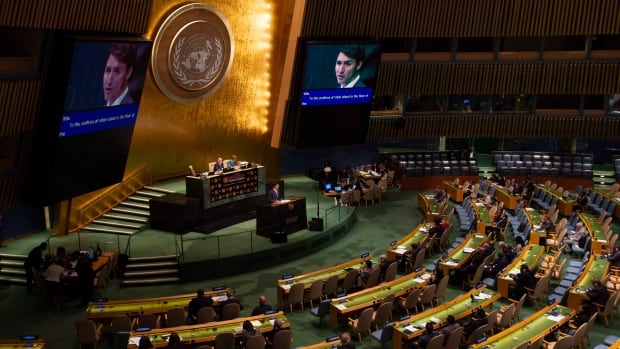

Despite an intense and costly diplomatic push, Canada has lost its bid for a coveted seat on the United Nations Security Council.
Norway and Ireland won the two available temporary seats, with 130 and 128 votes respectively. Canada won 108 votes, falling 20 short of the 128 needed to win a spot at the table.
It’s a heavy blow for Prime Minister Justin Trudeau, Foreign Affairs Minister François-Philippe Champagne and other high-level officials who had been reaching out to political leaders around the world in a campaign to secure one of the two available rotating seats.
The Security Council holds ten seats for temporary members that join the table for two-year terms. The council has five permanent members — the United States, the United Kingdom, France, Russia and China — which have the power to veto resolutions.
Pro-Palestinian groups blame Canada’s Middle East policies for its failure to secure a seat. Canadians for Justice and Peace in the Middle East (CJPME) issued a statement saying the defeat “proves that Canada’s failure to demonstrate leadership on human rights and international cooperation has isolated it from world opinion.”
“In recent months, Trudeau has also been relatively quiet on the threats of Israeli annexation, especially when compared to the vocal and long-standing condemnations from competitors Norway and Ireland,” the group said.
Shortly before the results rolled in, Trudeau cited Canada’s record on combating climate change, promoting peace and security and supporting developing countries and women’s rights.
He said no matter what happens, Canada will continue to fight to reduce global conflict and social inequities.
Exporting Canada’s values
“Canada has continued to be a strong voice on the world stage. Because this is what Canada does well and we will continue to do it,” he said.
“Yes, a seat on the UN Security Council will be an additional lever and an extra way that Canada can make sure that our voice and our values are being heard at the highest levels. But we will continue to make a difference in the world and defend multilateralism, not just because it’s good for the world, but because it’s good for Canadians.”
The federal government has spent more than $2.3 million on its bid for a seat.
Given its relatively smaller contributions to global peacekeeping and international development assistance, many observers argued Canada was facing a tough challenge from its competitors, Ireland and Norway.
Canada put forward its candidacy in 2016, about a decade after Ireland (2005) and Norway (2007) announced they were running.
Countries need the support of at least two-thirds of the General Assembly to get elected to the council.
Watch | Scheer questions Trudeau’s campaign for U.N. Security Council seat

Follow Canada News Media
Get the day's top Canadian stories and our two daily 60-second news videos wherever you scroll.
X Threads Facebook Instagram LinkedIn TikTok YouTube Pinterest Reddit Substack Flipboard Newsletter RSS