



U.S. payrolls shrank at the end of 2020 on a slump in restaurant employment, renewed lockdowns threaten a double-dip recession in the U.K. and India’s economy is staring at its worst annual contraction since the 1950s.
Here are some of the charts that appeared on Bloomberg this week on the latest developments in the global economy:
U.S.
December Diffusion
Hospitality job losses drove down private payrolls, though most industries saw gains
Source: U.S. Labor Department
.chart-js display: none;
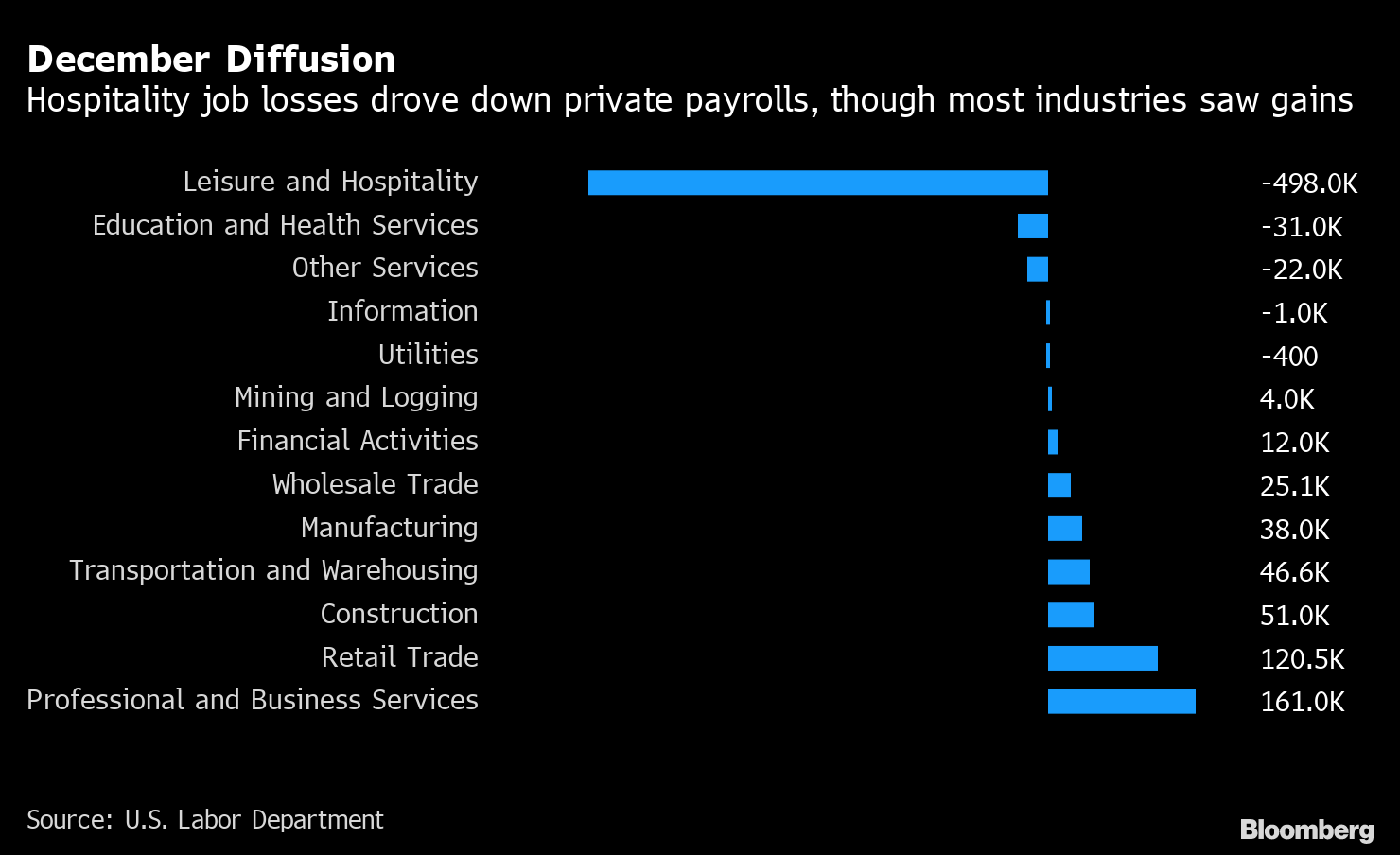
The U.S. labor market in December shed jobs for the first time in eight months, reflecting a plunge in leisure and hospitality employment that highlights how surging Covid-19 infections are taking a greater toll on parts of the economy. The good news is that other parts of the job market held up.
Cumulative Change in Debt Balance
Data: Federal Reserve Bank of New York
.chart-js display: none;
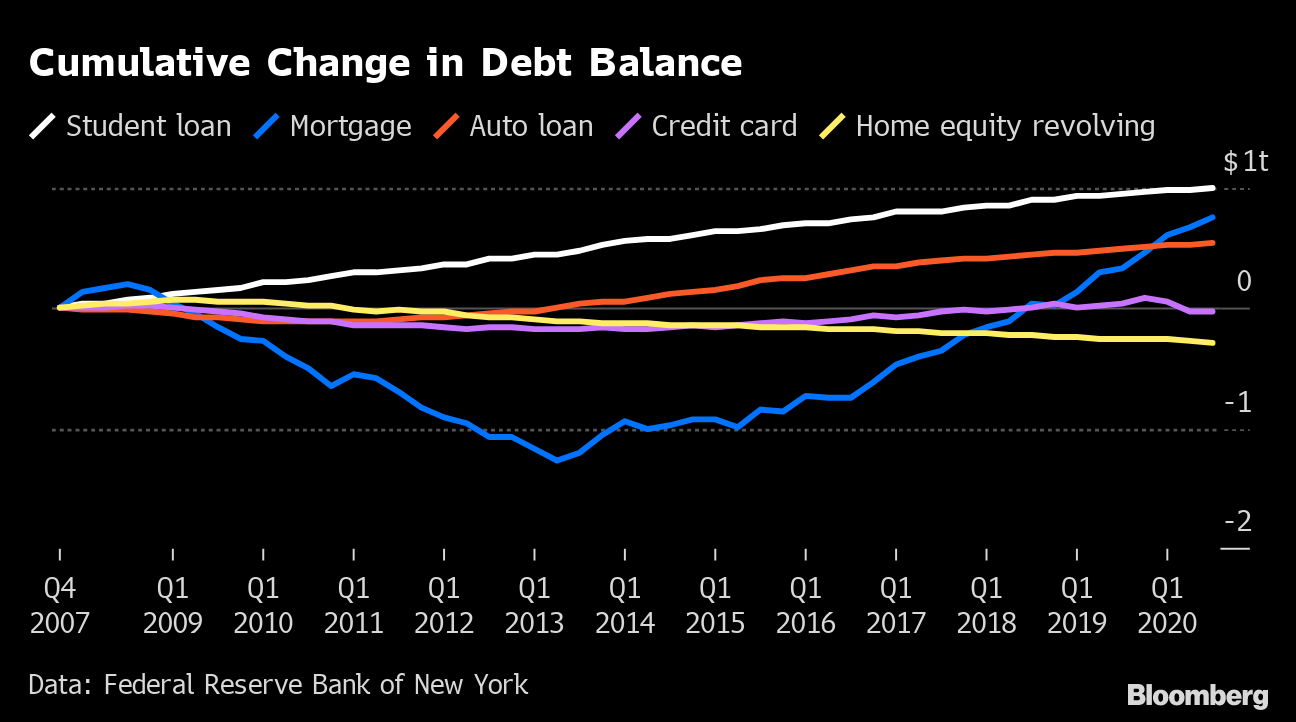
Since the financial crisis, U.S. households have added more student debt than any other kind — almost $1 trillion compared with $760 billion in mortgage loans. Some 43 million Americans owed money for their college education, or a family member’s, as of 2019. A few years ago, writing off large chunks of student debt seemed like a fringe idea. In a few weeks’ time, it could be government policy.

Ranked highest in the Bloomberg Brain Drain Index of population loss of top talent, Kalamazoo, Michigan, has struggled like the rest of the U.S. with the job-crushing pandemic. But the city got some hope when Pfizer Inc.’s factory in adjacent Portage recently became a key distribution point for the vaccine, potentially helping the area’s economy turn a corner.
Europe
Lockdown Fallout
Possible labor supply hit from school closures
Source: Bloomberg Economics
.chart-js display: none;
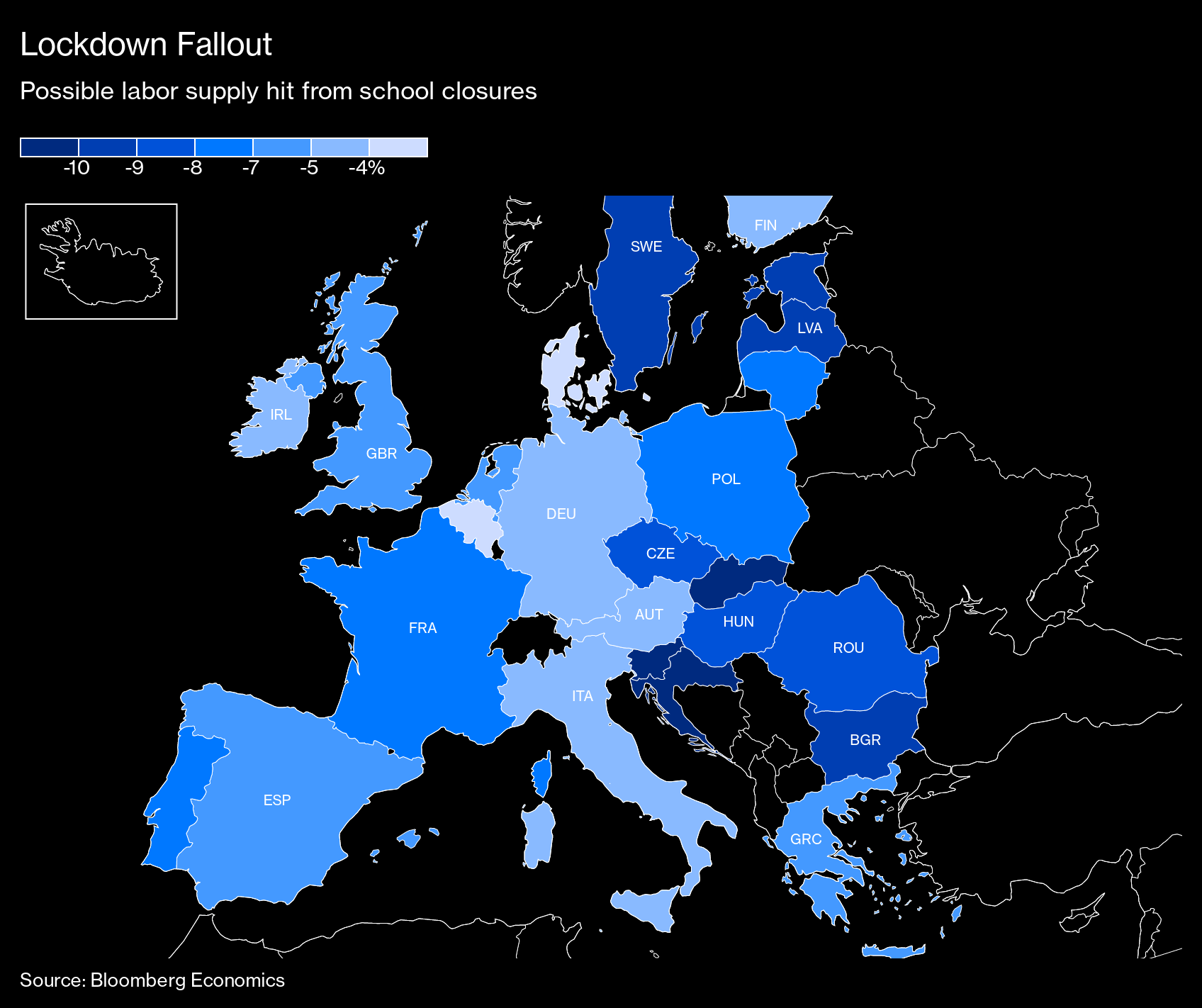
The new strain of Covid-19 that’s forced the U.K. into another lockdown and has been detected across Europe could reduce European Union labor supply by as much as 6% if schools are closed and childcare options narrow.
Double Dip
The new lockdown means the U.K. is almost certainly back in recession
Source: Bloomberg Economics
Note: January 2020 = 100. Bloomberg Economics sees the economy shrinking 1% in 4Q 2020 and 4.5% in 1Q 2021
.chart-js display: none;
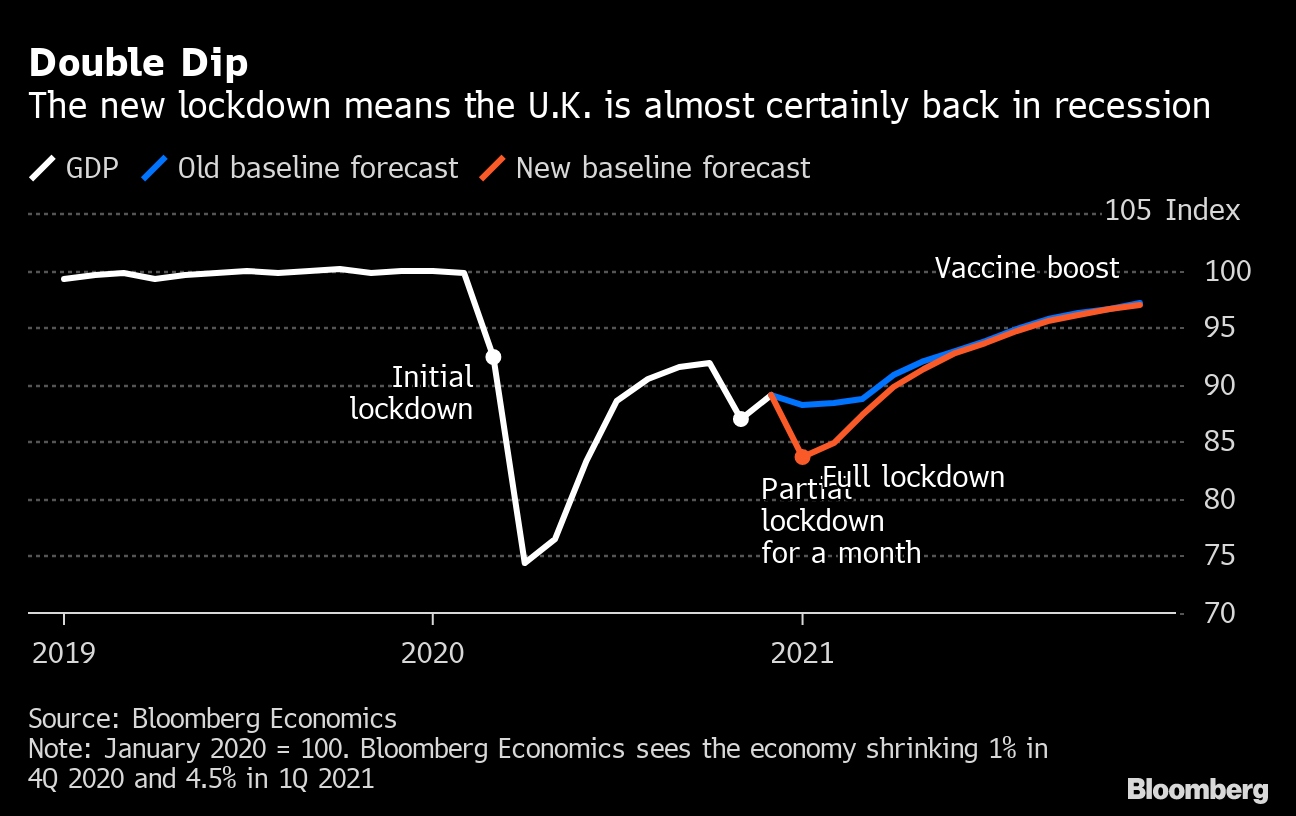
That new U.K. lockdown means the double dip recession is almost certain to be deeper than previously expected. Even if everything goes right and the roll-out of vaccines allows restrictions to be lifted by mid-February, GDP could contract by 4.5% in the first quarter, following a 1% fall in the final three months of 2020.
Asia

Japan’s household spending held up better than expected in November, but slowing gains pointed to a weakening trend even before a recent surge in virus cases and this week’s declaration of emergency for Tokyo.

India’s economy is set for its biggest annual contraction in records going back to 1952 as the rapid spread of coronavirus cases and measures to contain them hurt businesses and households.
Emerging Markets

There isn’t a trade-off between saving lives from Covid-19 and protecting the economy, emerging markets data analyzed by Bloomberg Economics suggest.
World
Post-Holiday Bounce
Activity in advanced economies partly recovered in the first week of January
Source: Bloomberg Economics, Google, Moovitapp.com, German Statistical Office, BloombergNEF, Indeed.com, Shoppertrak.com, Opportunity Insights
Note: Jan. 8, 2020 = 100
.chart-js display: none;
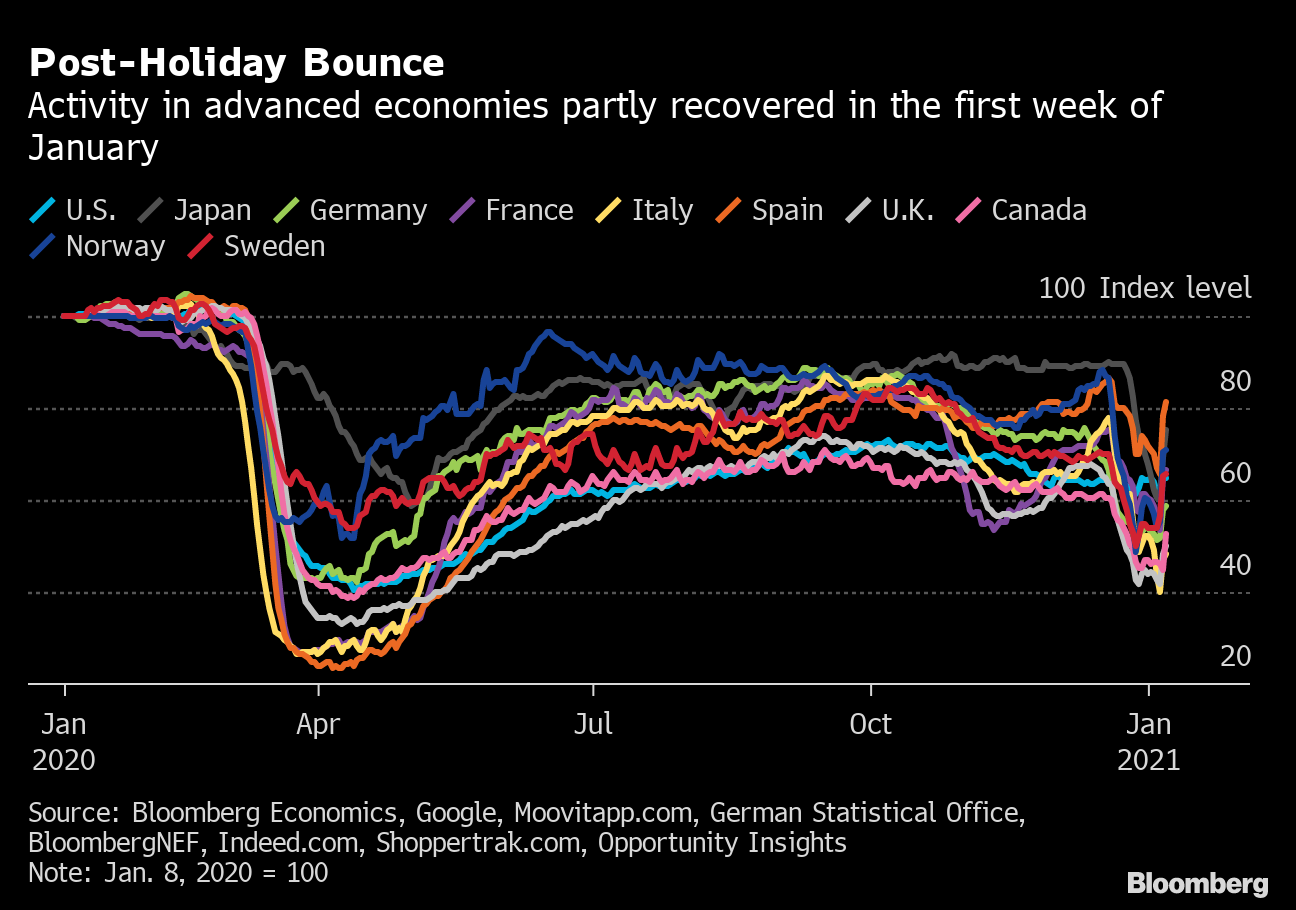
After slumping during the year-end holidays, activity in several of the world’s largest advanced economies partially recovered in the first week of January. Still, it remains significantly lower than at the start of last year, according to Bloomberg Economics gauges.
The Bloomberg Central Bank Outlook
How major central banks will change interest rates by the end of 2021
Source: Bloomberg Economics forecasts, survey of economists for Switzerland, Czech Republic, Poland
.chart-js display: none;
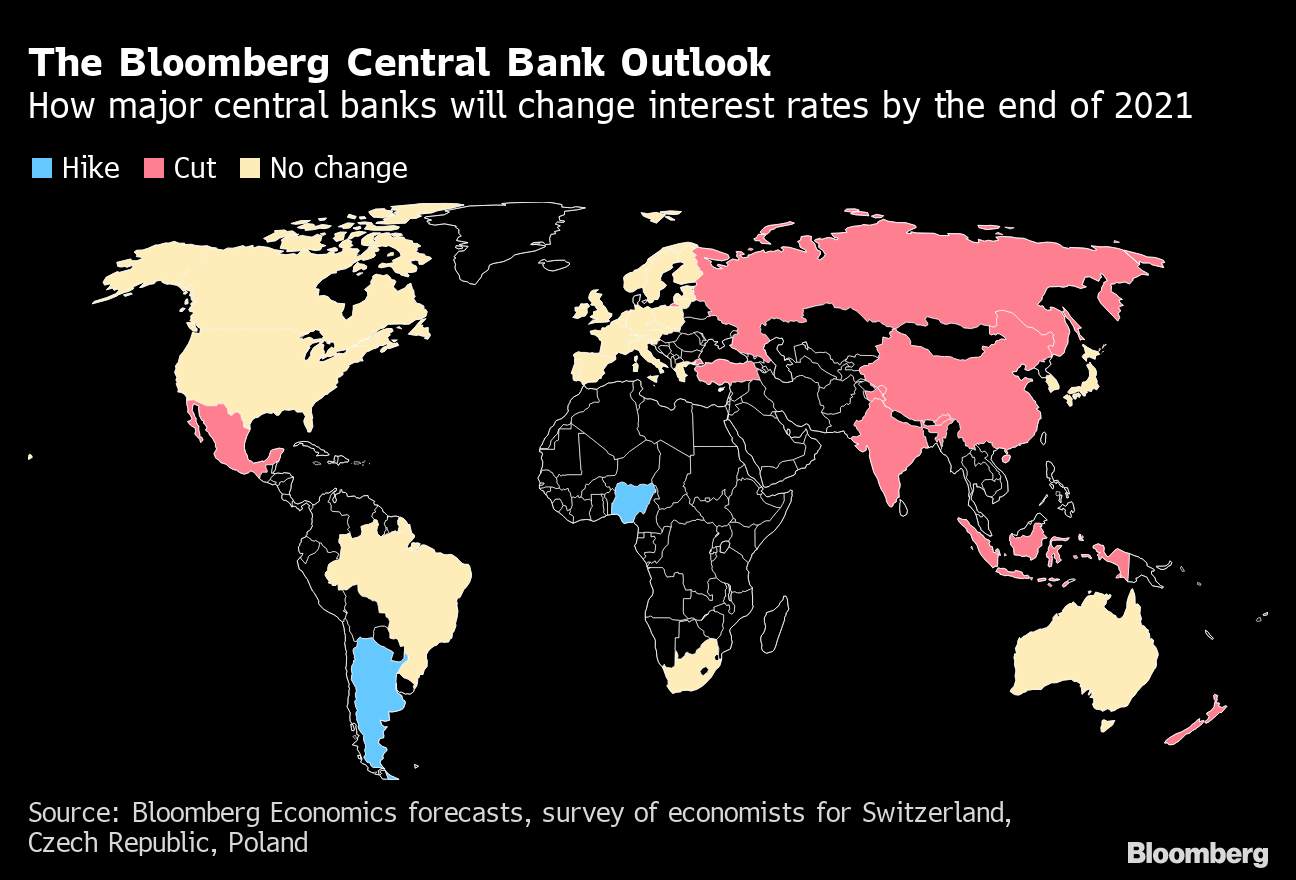
Central banks are set to spend 2021 maintaining their ultra-easy monetary policies even with the global economy expected to accelerate away from last year’s coronavirus-inflicted recession, according to Bloomberg’s quarterly review of monetary policy.
Heavy Load
Global debt topped record $272 trillion in the third quarter
Source: Institute of International Finance
Note: Data for fourth quarter of 2020 is projected
.chart-js display: none;
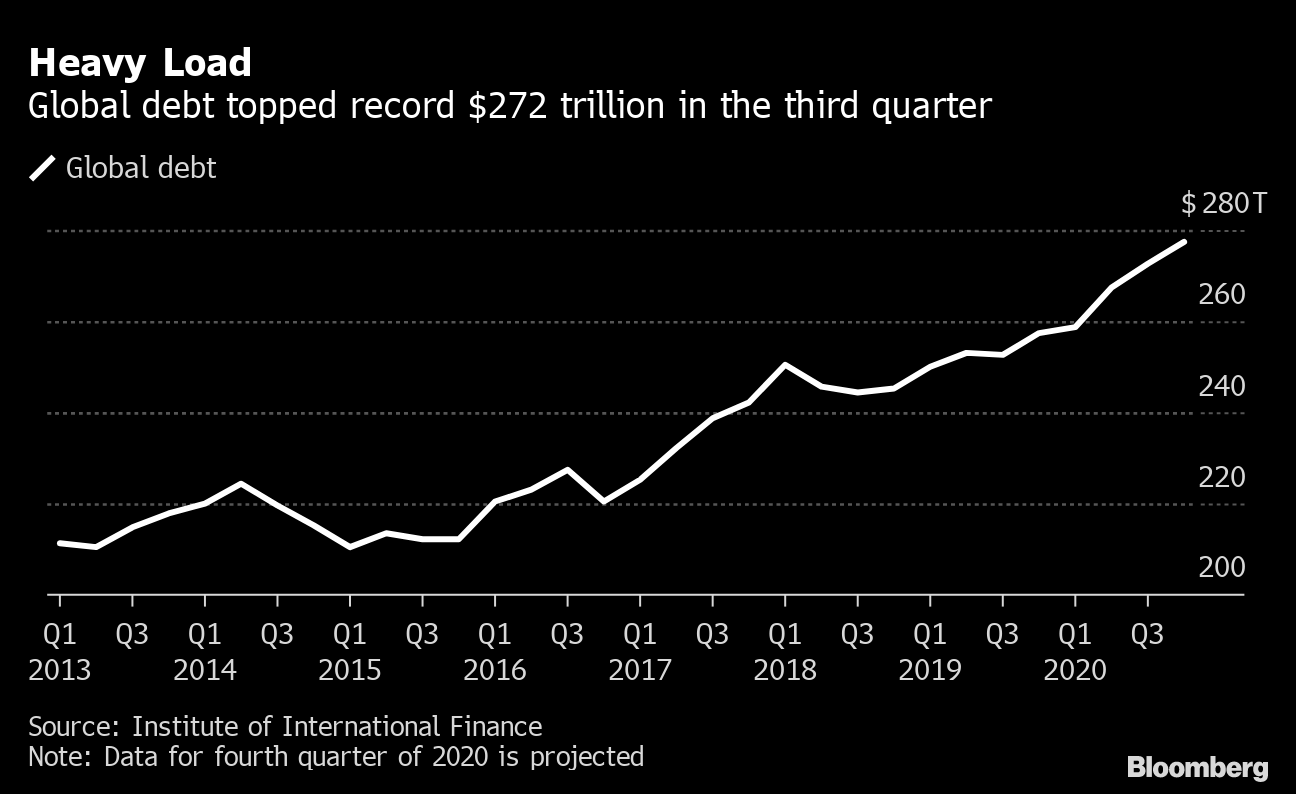
The world economy will be exiting the pandemic weighed down by much bigger debts and increased inequality that could hobble growth in the longer term.
— With assistance by Maeva Cousin, Ziad Daoud, Dan Hanson, Scott Johnson, Tom Orlik, Bjorn Van Roye, Jamie Rush, Vrishti Beniwal, Vincent Del Giudice, Ben Holland, Jeff Kearns, Wei Lu, Rich Miller, Yuko Takeo, and Alexandre Tanzi