

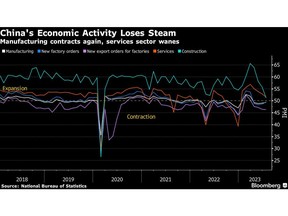
(Bloomberg) — China’s economic activity lost more steam in July with manufacturing contracting again and the services sector weakening, as Beijing promises small measures of support to boost consumption.
The Hang Seng China Enterprises Index rose as much as 3.2% on Monday, outperforming major regional stock gauges. The yuan traded offshore advanced as much as 0.3% to a session high at 7.1329 per dollar.
Concerns about the state of China’s recovery have been mounting in recent weeks, with early indicators for July showing a weakening of momentum. Economists polled by Bloomberg project growth of 5.2% for 2023, lower than earlier forecasts and more in line with the official target of around 5%.
- New manufacturing export orders continued to decline, with the subindex inching down to 46.3 from 46.4 in the previous month
- An employment subindex remained in contraction for a fifth straight month
- A sub-index measuring non-manufacturing employment crept down to 46.6 from 46.8 in the previous month
“What worries me is that the employment sub indexes continue to stay below 50 and show no sign of recovery,” said Raymond Yeung, chief economist for Greater China at Australia & New Zealand Banking Group Ltd. He expects unemployment pressures to remain in the near term as millions of graduates join the labor market.
Companies reported an external environment that remains “complex and grim,” Zhao Qinghe, senior statistician at the NBS, said in a statement accompanying the data. “Reducing overseas orders and insufficient demand are still the main challenges for companies.”
What Bloomberg Economics Says …
“July PMIs suggest China’s overall economic momentum stayed weak at the start of 2H, but the underlying composition is shifting. The gauge tracking services showed unexpected deterioration, with the drag from the property slump outweighing the push from a brisk summer travel season.
— Chang Shu and Eric Zhu, economists
Read the full report here.
Adding to existing strains on the economy is extreme weather, with heat waves baking northeastern cities including Beijing and spreading to central coastal regions, while the southwest has been hit by heavy rain and deadly floods. The weather problems threaten to put stress on the energy grid and disrupt logistics, as well as production.
“While we believe that a great many micro measures will be implemented to improve the functioning of the economy, including a reduction in constraints on the private sector, we aren’t at all convinced that there is a fiscal bazooka waiting to fire up the economy,” wrote Robert Carnell, regional head of research for Asia Pacific at ING Groep NV.
—With assistance from Wenjin Lv and Tan Hwee Ann.
(Updates with market reaction, comments, more context.)