


The latest:
Propelled in part by the wildly contagious Omicron variant, the U.S. death toll from COVID-19 hit 900,000 on Friday, less than two months after eclipsing 800,000.
The two-year total, as compiled by Johns Hopkins University, is greater than the population of Indianapolis, San Francisco, or Charlotte, N.C.
“It is an astronomically high number. If you had told most Americans two years ago as this pandemic was getting going that 900,000 Americans would die over the next few years, I think most people would not have believed it,” said Dr. Ashish K. Jha, dean of the Brown University School of Public Health.
He lamented that most of the deaths happened after the vaccine gained authorization.
“We got the medical science right. We failed on the social science. We failed on how to help people get vaccinated, to combat disinformation, to not politicize this,” Jha said. “Those are the places where we have failed as America.”
Just 64 per cent of the U.S. population is fully vaccinated, or about 212 million Americans, according to the Centers for Disease Control and Prevention.
“We have underestimated our enemy here, and we have under-prepared to protect ourselves,” said Dr. Joshua M. Sharfstein, a public health professor at Johns Hopkins Bloomberg School of Public Health. “We’ve learned a tremendous amount of humility in the face of a lethal and contagious respiratory virus.”
Prediction of 1 million deaths by April
Nor is COVID-19 finished with the United States: Jha predicted the U.S. will reach 1 million deaths by April.
“I think it’s important for us not to be numbed. Each one of those numbers is someone,” said the Rev. Gina Anderson-Cloud, senior pastor of Fredericksburg United Methodist Church in Virginia. “Those are mothers, fathers, children, our elders.”
The milestone came as Omicron is loosening its grip on the country.
New cases per day day have plunged by almost half since mid-January, when they hit a record-shattering peak of more than 800,000.
Cases have been declining in 49 out of 50 states over the past two weeks, by Johns Hopkins’ count, and the 50th state, Maine, reported that confirmed infections are falling there, too, dropping sharply over the past week.
Also, the number of Americans in the hospital with COVID-19 has declined 15 per cent since mid-January to about 124,000.
But deaths are still running high at more than 2,400 per day on average, the most since last winter. And they are on the rise in at least 35 states, reflecting the lag time between when victims become infected and when they succumb.
While public health officials have expressed hope that the worst of Omicron is coming to an end, they caution that things could still go bad again and dangerous new variants could emerge.
–From The Associated Press, last updated at 6 p.m. ET
What’s happening across Canada
WATCH | Ottawa’s top police officer talks about how his force is responding to protesters in the city’s core:
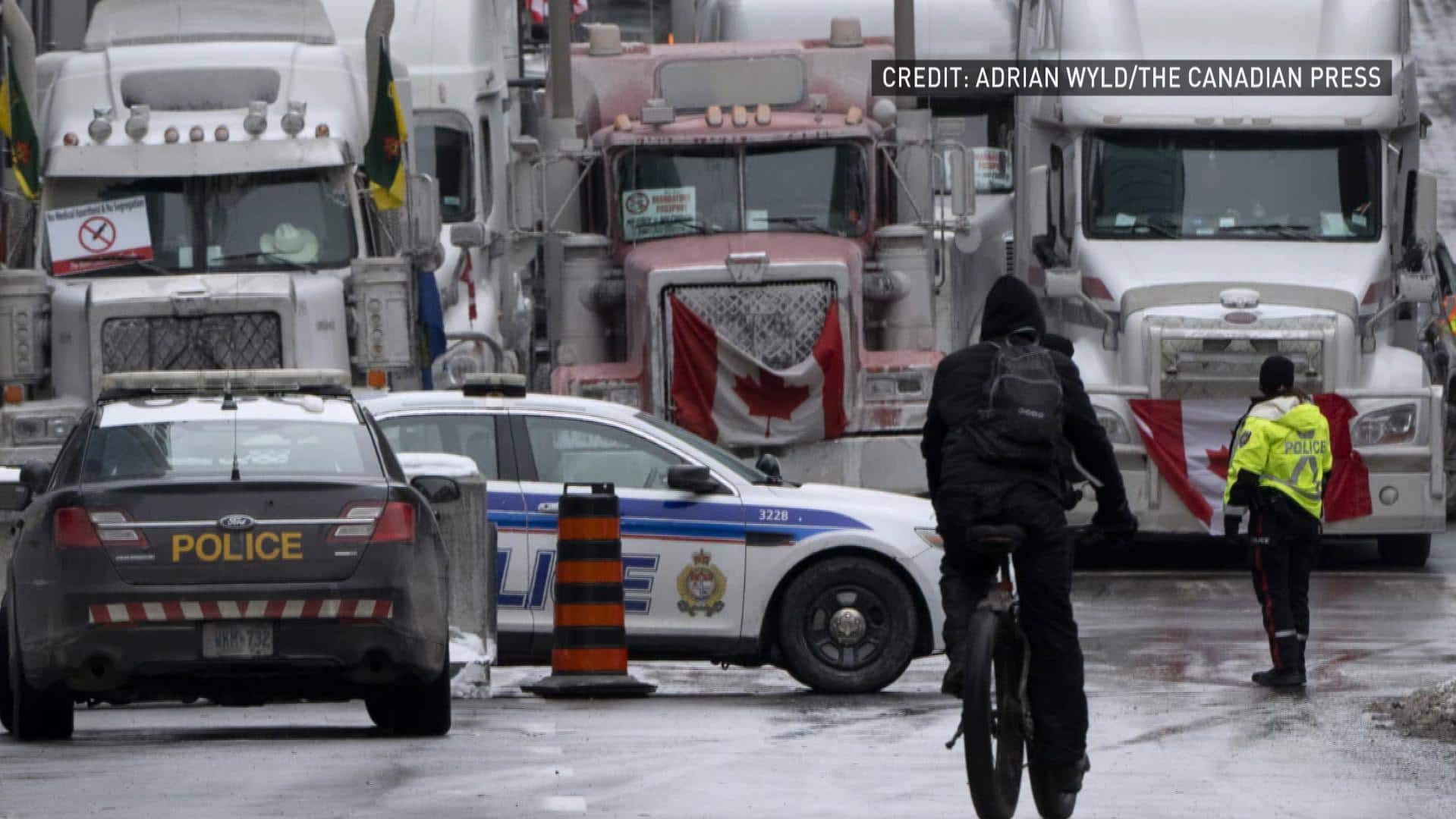
About 150 additional police officers will be on patrol in Ottawa as the city braces for another weekend of protest against COVID-19 mandates. Officers will be addressing ‘unlawful threatening conduct’ in the most affected neighbourhoods, says the city’s police Chief Peter Sloly 1:56
With lab-based testing capacity deeply strained and increasingly restricted, experts say true case counts are likely far higher than reported. Hospitalization data at the regional level is also evolving, with several provinces saying they will report figures that separate the number of people in hospital because of COVID-19 from those in hospital for another medical issue who also test positive for COVID-19.
For more information on what is happening in your community — including details on outbreaks, testing capacity and local restrictions — click through to the regional coverage below.
You can also read more from the Public Health Agency of Canada, which provides a detailed look at every region — including seven-day average test positivity rates — in its daily epidemiological updates.
In Central Canada, officials in Quebec City were reinforcing security measures around the legislature Thursday, as demonstrators opposed to COVID-19 health orders were expected to begin arriving ahead of a weekend protest. City officials in Toronto are preparing for a similar protest at Queen’s Park, officials said this week.
WATCH | Toronto counter-protesters, health-care workers stand in solidarity:

Dr. Philip Berger and a group of health-care workers in Toronto are organizing to stand up for their right to a safe workplace, free from harassment. 6:31
The preparations come as health officials in both provinces said Friday that COVID-19 hospitalizations had declined. In Ontario, a provincial COVID-19 dashboard on Friday showed a total of 2,634 in hospital testing positive — down by 163 from a day earlier — with 517 people in the province’s intensive care units. The hospital cases are down from more than 3,500 a week ago.
In Quebec, a daily COVID-19 report on Friday showed 2,541 hospitalizations — down by 96 from a day earlier — with 184 people in intensive care. The two provinces, which have seen significant strain on health systems amid the Omicron wave of infection, are both engaged in gradual easing of restrictions.
Ontario on Friday reported 60 additional deaths, while Quebec saw 42 new deaths.
In Atlantic Canada, health officials in Newfoundland and Labrador plan to ease some restrictions as of Monday, Premier Andrew Furey said.
WATCH | P.E.I.’s top doctor on easing restrictions and living with COVID-19:

Morrison says P.E.I. will begin easing COVID-19 restrictions in the coming weeks, but will do so safely and in accordance with scientific data. 6:46
In Prince Edward Island, Chief Public Health Officer Dr. Heather Morrison said this week that the province is looking at how it will ease restrictions and a broader reopening.
“For us, certainly, some of the first easing will be around isolation measures, larger gathering numbers, more recreational games,” Morrison told CBC’s Louise Martin, adding that provinces are all moving toward “living with COVID” and that will happen on the Island. More details are expected next week, the top public health official said, noting that mask-wearing won’t be among the first measures to be eased.
In the Prairie provinces, premiers in Saskatchewan and Alberta are moving to ease restrictions, with a roadmap for Alberta’s plan expected next week.
“After two years of this, we simply cannot continue to rely on the blunt instrument of damaging restrictions as a primary tool to cope with a disease that will likely be with us for the rest of our lives,” Alberta Premier Jason Kenney said Thursday during a Facebook live event. Kenney had previously said that he didn’t expect the province’s vaccine pass program to last beyond the end of March.
Alberta’s chief medical health officer, Dr. Deena Hinshaw, said it will be possible to remove restrictions after the latest wave of the pandemic, fuelled by the Omicron variant, subsides.
WATCH | ‘I believe after the Omicron wave has subsided, the risk of our system becoming overwhelmed will be substantially reduced,’ Alberta’s top doctor says:
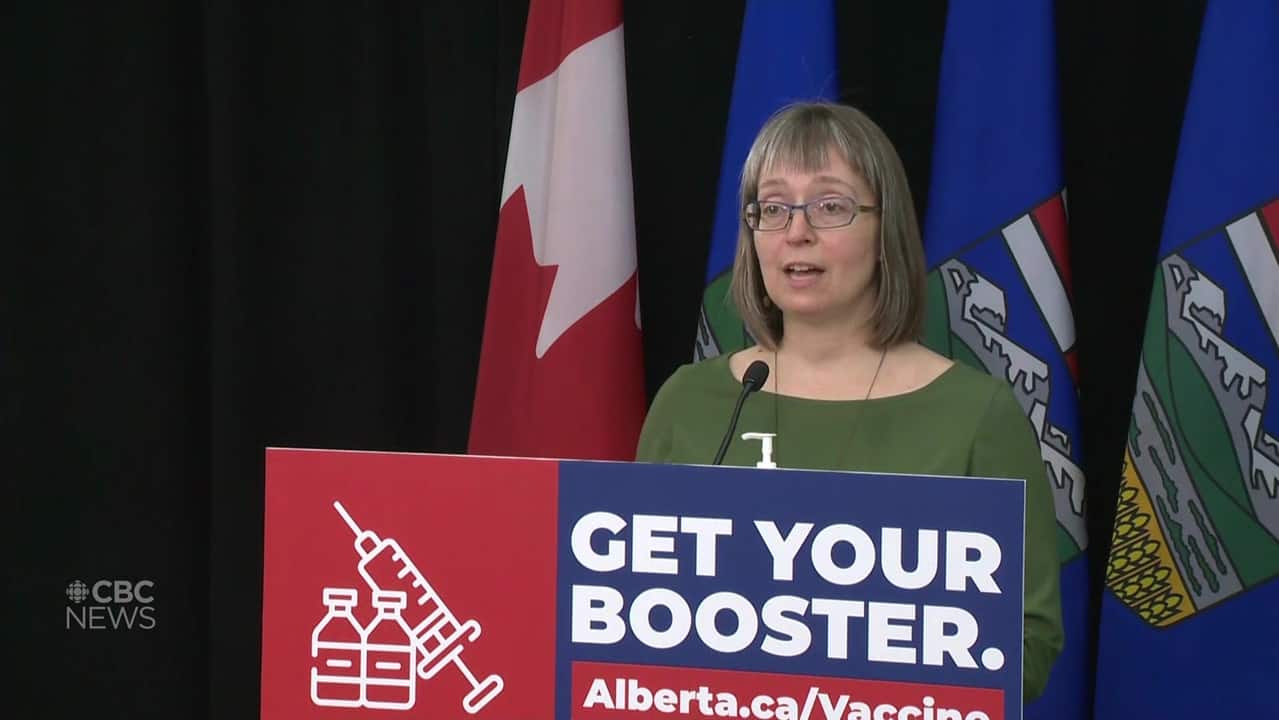
Dr. Deena Hinshaw, Alberta’s chief medical officer of health, says the province will at some point need to move away from a COVID-19 pandemic response into an endemic phase. 2:07
Meanwhile in Saskatchewan, where COVID-19 related hospitalizations are at their highest level since the pandemic began, Premier Scott Moe said he’s committed to ending all COVID-19 restrictions soon. Moe said in a video posted to social media that COVID-19 is not going away, but people are done with having to follow public health orders, so “normalizing” the virus and learning to live with it is the achievable option.
The Saskatchewan Medical Association, however, is warning that loosening health measures would strain the province’s health-care system.
Manitoba officials had previously announced that some restrictions — including rules around private gatherings — will be relaxed next week. The province had 29 fewer cases of COVID-19 in hospitals on Friday, for a total of 707 COVID-19 patients. The number of those in ICUs has dropped by two to 52.
In the North, Yukon Premier Sandy Silver announced a plan to “slowly, carefully” begin easing restrictions, starting this weekend — provided COVID-19 hospitalizations and other key indicators don’t rise. The premier also urged people to do what they can to slow transmission of COVID-19, noting that an uptick could put major pressure on the territory’s health-care capacity.
In British Columbia, health officials said Thursday there were two new COVID-19 outbreaks at health-care facilities in the province for a total of 56, most of them in long-term care homes.
-From The Canadian Press and CBC News, last updated at 3:30 p.m. ET
What’s happening around the world

As of Friday evening, roughly 390 million cases of COVID-19 had been reported worldwide, according to a tracking tool from Johns Hopkins University. The reported global death toll stood at more than 5.72 million.
In Europe, a law requiring most adults in Austria to get vaccinated against COVID-19 is ready to take effect, but the sense of urgency that accompanied its announcement in November has largely evaporated. Few other countries look likely to go as far as Austria as attention turns to loosening pandemic-related restrictions.
The mandate for people 18 and older to get vaccinated — the first of its kind in Europe — cleared its last legislative hurdle Thursday night. It’s expected to become law in the coming days but it will be some time before Austrians notice any practical change. It isn’t clear when or even whether the toughest part of the plan, which was watered down from the initial proposal, will take effect.
The Austrian mandate — which will exempt pregnant women, people who can’t be vaccinated for medical reasons and those who have recently recovered from COVID-19 — was conceived as cases caused by the Delta variant surged amid concern that the country’s vaccination rate was low for western Europe. At present, 69 per cent of the population is considered fully vaccinated.
The decision to move forward with the mandate sparked strong opposition and protest from some in Austria. Officials argue that even with the now-dominant Omicron variant causing milder illness and Austria preparing to ease some restrictions, the mandate makes sense.
“The vaccine mandate won’t immediately help us break the Omicron wave, but that wasn’t the goal of this law,” Health Minister Wolfgang Mueckstein told parliament Thursday. “The vaccine mandate should help protect us from the next waves and, above all, from the next variants.”
Not everyone agrees. “I don’t really see the added value of the vaccine mandate at this point,” said Gerald Gartlehner, an epidemiologist at the Danube University Krems. He argued that Omicron’s highly infectious nature and milder symptoms have changed things and that much of the Austrian population now has immunity, either via vaccination or infection.
In the Asia-Pacific region, India’s official COVID-19 death toll crossed 500,000 on Friday — a level some data analysts said was breached last year but was obscured by inaccurate surveys and unaccounted dead in the hinterlands, where millions remain vulnerable to the disease.
The country, which has the fourth-highest tally of deaths globally, recorded 400,000 deaths by July 2021 after the devastating outbreak from the Delta variant of the coronavirus, according to official data. Some experts believe the figures are much higher.

In the Americas, people enrolled in the U.S. government’s Medicare program can get over-the-counter COVID-19 tests for free starting in early spring, the Centers for Medicare & Medicaid Services said on Thursday.
In the Middle East, Saudi Arabia said citizens will be required to take the booster shot to be able to travel abroad starting Feb. 9, state media reported.
In Africa, health officials in South Africa on Thursday reported 3,266 new cases of COVID-19 and 82 deaths. The update came a day before health officials held a briefing explaining a recent shift in the government’s COVID-19 isolation policies.
-From Reuters, CBC News and The Associated Press, last updated at 2:15 p.m. ET

Follow Canada News Media
Get the day's top Canadian stories and our two daily 60-second news videos wherever you scroll.
X Threads Facebook Instagram LinkedIn TikTok YouTube Pinterest Reddit Substack Flipboard Newsletter RSS