


Czech central bankers are poised to hold interest rates this week amid a rare spat with the government over their independence and the timing of planned monetary tightening.
Prime Minister Andrej Babis urged the central bank to keep borrowing costs low and share some of its profits with the state budget to help fund the economic recovery from the coronavirus crisis. The comments, which come as some central banks face growing political pressure, sent the koruna weaker, and money-market investors trimmed their bets on two Czech hikes this year starting in August.
Governor Jiri Rusnok pushed back against Babis’s suggestion, saying that — by law — the central bank can’t accept instructions from politicians and that policy is based on the main mandate of securing price stability.

All analysts polled by Bloomberg expect the benchmark rate to remain at 0.25% on Wednesday. Investors are likely to focus on the subsequent press conference, in which Rusnok might provide some clues on the economy and future policy, particularly in light of the Czech Republic’s struggle to manage one of the world’s worst resurgences of Covid-19.
“The central bank is now facing even more uncertainty than in February, so I don’t expect it to change its dovish messaging,” said Helena Horska, chief economist at the Czech unit of Raiffeisen Bank International AG. “I’m waiting for the August forecast to get a better picture.”
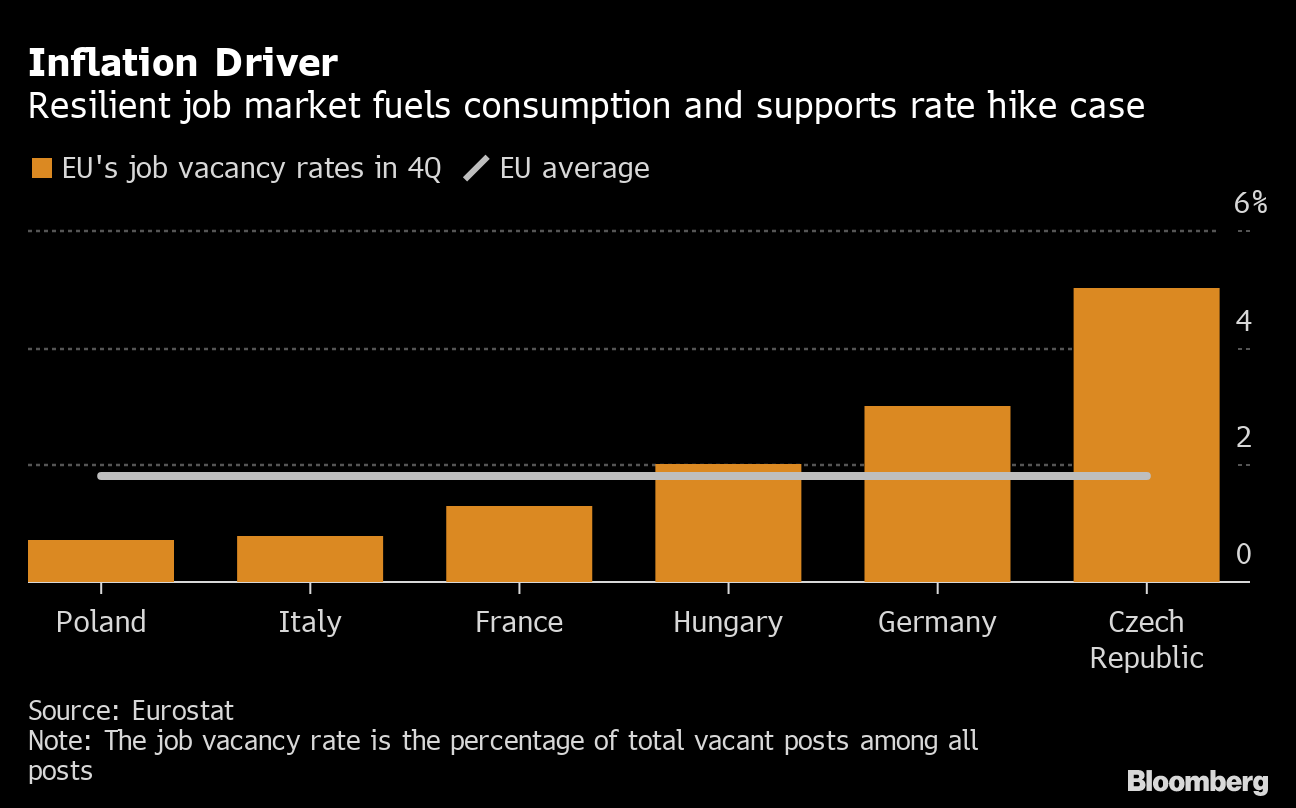
The country of 10.7 million people may be the first in the European Union to raise rates as a tight labor market and fiscal stimulus keep consumer price growth above the 2% target.
Inflation Driver
Resilient job market fuels consumption and supports rate hike case
Source: Eurostat
Note: The job vacancy rate is the percentage of total vacant posts among all posts
.chart-js display: none;
But the Czech National Bank has recently questioned its own forecast for hikes starting around the middle of the year as the country keeps extending a partial lockdown of the economy that shut most shops and services and restricted movement of people.
Although the government has no formal influence over monetary policy, Babis’s tradition-breaking statement came just after Turkish President Recep Tayyip Erdogan triggered a local market meltdown by firing his central bank governor.
“While I believe the prime minister’s comments will have no impact on the central bank’s policy decisions, they could undermine the perceptions of its independence,” said Raiffeisen’s Horska. “They were inappropriate, particularly at a time when global investors are panicking about Turkey.”
— With assistance by Peter Laca