


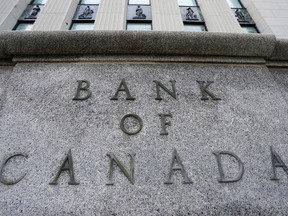
The Bank of Canada pulled an RBA and hiked rates on June 7 with the market mostly (call it 60-40) priced for no move and more than 80 per cent of Bay Street economists believing the central bank would hold its fire. This is the same Bank of Canada that surprised the markets at half the meetings in 2022, so it really is back to governor Tiff Macklem’s modus operandi.
The tone was hawkish as the press statement left the potential for another move at the July meeting wide open: the futures market is now priced 70 per cent of the way for another 25 beeper. This even had an impact on United States Federal Reserve pricing: the odds of a rate hike in June are now up to 33 per cent; these odds were at 22 per cent before the Bank of Canada hike. And the odds of a second Fed rate hike in July are now at 18 per cent … these market-based probabilities were sitting at 12 per cent before the Canadian central bank’s announcement.
In its press statement, the Bank of Canada made a big deal of how the economy is doing just fine, even after accounting for population growth. There was an emphasis on how interest-sensitive spending — especially the recent sharp rebound in the housing market — has been resilient in the face of higher borrowing costs. The commentary on stubbornly high inflation was ubiquitous in the statement (“underlying inflation remains stubbornly high”), and the coup de grâce from a forward-looking perspective was “CPI inflation could get stuck materially above the two per cent target.”
Tack on this — “monetary policy was not sufficiently restrictive to bring supply and demand back into balance and return inflation sustainably to the two per cent target” — and you can see why the markets think the central bank has at least one more bullet in the chamber. The verbiage of “excess demand in the economy looks to be more persistent than anticipated” was just the cherry on the cake.
Modern-day John Crow
Indeed, if Fed chair Jay Powell fancies himself as the modern-day Paul Volcker, Tiff Macklem has surpassed even what John Crow managed to achieve in 1989 in terms of such a massive rate hike over such a time frame.
The lags are important and have yet to play out. The central bank did exercise patience, but not enough. Recession odds have taken a leap forward and putting the final interest rate nail into the coffin will end up burying the debt-heavy Canadian economy, a story we will be reading about later in the summer and fall.
This was the fourth consecutive decline in Canadian productivity and the 10th contraction in the past 11 quarters. The year-over-year trend is minus 1.8 per cent, or twice as bad as it is stateside, so as Bay Street economists and the columnists in the media go hog wild with each passing Canadian employment report, maybe they should be asking “what exactly are they being hired to do?”
And get this: the level of productivity was lower in the first quarter of 2023 than it was in the first quarter of 2017. Nice legacy for the Justin Trudeau government. Too bad the only thing the voting public knows is the unemployment rate — “down is good, and up is bad” — and is otherwise clueless about how productivity is the mother’s milk of sustainable economic growth.
David Rosenberg is founder of independent research firm Rosenberg Research & Associates Inc. To receive more of David Rosenberg’s insights and analysis, you can sign up for a complimentary, one-month trial on the Rosenberg Research website.