


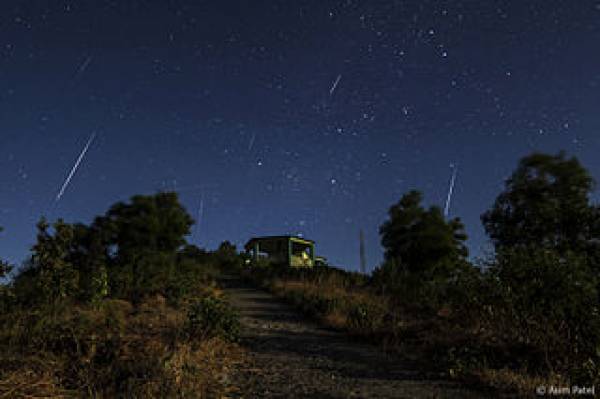
The rocky debris left by an asteroid-type object sometimes called a “rock comet” will hit Earth’s atmosphere this weekend at a speed of about 130,000 kilometres per hour, more than 100 times the speed of sound.
The result, depending on the weather, could mean that lucky watchers in the Northern Hemisphere (that’s us, B.C.) could be treated to as many as 150 bright and colourful meteor sightings per hour, interspersed with the occasional spectacular “earth grazer” fireball.
This annual meteor display, dubbed the Geminid shower, peaks Sunday night and in the early hours of Monday (December 13 and 14), but breathtaking meteors should be visible in dark skies until dawn on all three nights (Friday, Saturday, and Sunday).
The best viewing of these streaky, bright meteors will come after 2 a.m., when the shower’s so-called radiant point, in the constellation Gemini (hence, Geminid), will be at its highest point overhead, toward the east.
Lucky nightbirds blessed with clear skies will rejoice, as this year’s event, which usually offers up almost one meteor per minute (but sometimes produces three times that number), coincides with a waning cerscent moon, so there will be little bright competition to drown out the vapourizing pieces of rock dust.

If you are unable to stay up very late, that actually incerases your chances of seeing a so-called earth-grazer fireball: a very bright meteor that travels for a much longer period of time in a lower, horizontal path close to the horizon. This is because the shower’s radiant point is that much lower earlier in the night.
The celestial fireworks come courtesy of an asteroidlike body named (3200) Phaethon that orbits our sun and sheds debris as it nears the solar furnace. When the Earth crosses the orbital path of this cosmic detritus, the result is a fiery end—about 100 kilometres above our strained necks—for the dust particles and small rocks caught blazing through our planet’s atmsphere.
In June 2009, UCLA astrophysicists David Jewitt and Jing Li observed (3200) Phaethon—with the help of NASA spacecraft STEREO-A—as it swung close to the sun in its highly elliptical orbit, and they noticed sudden “brightenings”. They interpreted these to mean the asteroid-type object was releasing rock dust due to thermal fracturing because of its proximity to the intense heat (up to 1,000° Kelvin, or 1,320° Celsius) and radiation of Earth’s star.

The results of their study, published in a November 2010 paper in the Astronomical Journal, led to the conclusion that (3200) Phaethon was probably a “rock comet” that produced dust through the fracturing and cracking of minerals that were ejected into interplanetary space.
If you head out to a dark place—ideally, away from city lights, but a largish city park will also do (and you can still see the meteors from your backyard or balcony if streetlights don’t interfere)—to hold a late-night viewing party, make sure to bring hot drinks, dress warmly (bring blankets), and give your eyes about 20 minutes to adjust to the darkness.