
For anyone who has clear skies in the early morning hours of Saturday, January 4, look up! You could catch a spectacular show from the Quadrantid meteor shower!
Right now, Earth is passing through a stream of rocky, icy debris in space, left behind by what is likely a shattered comet, as it travels through the inner solar system.
When these bits of rock and ice – collectively known as meteoroids – are swept up by Earth, they plunge into the atmosphere travelling at over 40 kilometers per second! At that speed, they compress the air in their paths, causing the air to glow. This shows up as streaks of light in the night sky known as meteors, and since these meteors are all from the same source, we call it a meteor shower.
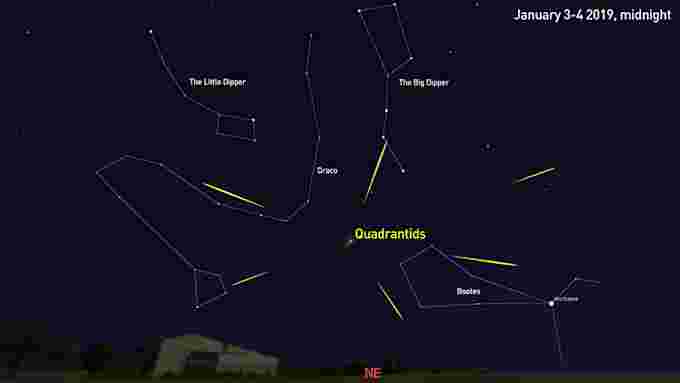
The location of the Quadrantid radiant, on the night of January 3-4, 2020. Credit: Stellarium/Scott Sutherland
For this particular meteor shower, as the meteors streak across the sky, they appear to radiate out from a particular point in the sky – the ‘radiant’ – which happens to be near a defunct constellation known as Quadrans Muralis. Although this particular constellation is no longer used, it still lends its name to the meteor shower.
The Quadrantids is one of the strongest meteor showers of the year, producing up to 120 meteors per hour, under ideal conditions. Most viewers, if they have clear skies and they can get away from city light pollution, tend to see about half that number, as some of the meteors are just too fast or faint to see. Still, catching a meteor every minute is still very good!
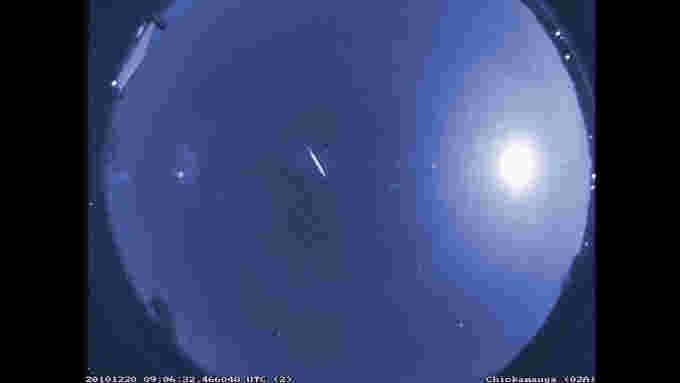 This false-color image of a rare early Quadrantid was captured by a NASA meteor camera in 2010. Credit: NASA/Meteoroid Environment Office/Bill Cooke
One complication for the Quadrantid meteor shower is its very sharp peak.
Most other meteor showers have a peak that lasts all night, or possibly even over a few days. The peak of the Quadrantids typically lasts for only around 6 hours. Thus, the best time to watch the Quadrantids tonight will be in the hours between midnight and dawn.
WILL WE SEE IT?
Although the phase of the Moon is timed well for this year’s Quadrantids – it is a first quarter Moon, which will set around midnight – the sky conditions are just not cooperating for most of Canada.
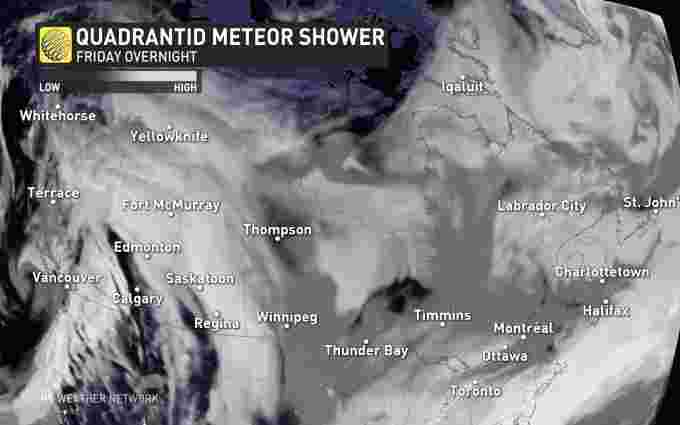
The best places to watch from, based on cloud cover, appear to be a thin swath of Alberta in the lee of the Rockies, as well as in parts of southwestern Saskatchewan.
HOW TO WATCH FROM ANYWHERE
Don’t despair if you are caught under cloudy skies tonight! There are other ways to watch this meteor shower, right from the comfort of your home.
First off, since the early morning hours are best to watch, there may be some clear breaks in the clouds through which to catch a few meteors. For example, there were cloudy conditions across southern Ontario for the 2019 Quadrantids, but the University of Toronto Scarborough all-sky cam still captured several fireball meteors over the area in the early morning hours.
If there are no breaks in the cloud, we can watch via Astronomy Live Stream on YouTube, which broadcasts the view of the night sky from near Denver, CO.
One of the more interesting ways to ‘watch’ the Quadrantids is via meteor radar, as shown below.
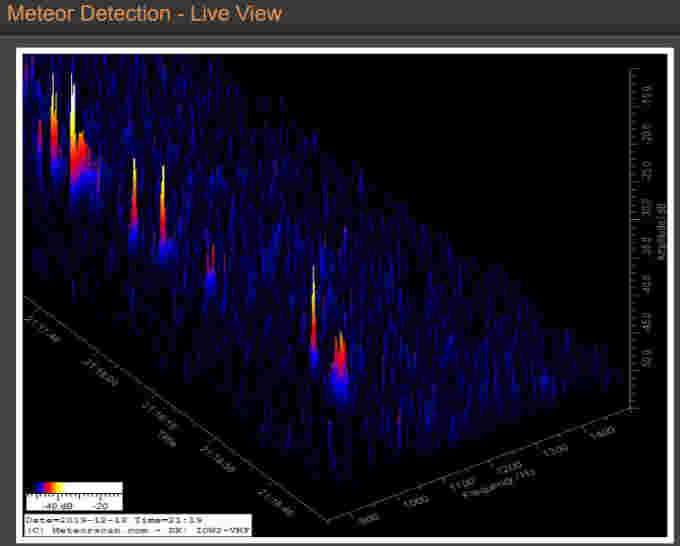 This sample image from MeteorScan.com shows multiple meteor detections at 21:19 UTC on December 13, 2019. Credit: MeteorScan
The coloured ‘spikes’ in the image above show the radar return signal when a meteoroid is detected passing by overhead. Since this radar is located in the United Kingdom, it isn’t the most ideal location during the peak, but will still pick up some Quadrantids during the night.
We can also ‘listen’ to the meteor shower, via the Meteor Echoes live stream, which presents the radar detections of meteoroid hitting the top of the atmosphere as high pitched audio chirps.
SHATTERED COMET?
The Quadrantids are known to originate from an asteroid known as 2003 EH1. That makes this only one of two known meteor showers to originate from a rocky body! The December Geminids is the other, originating from ‘rock comet’ asteroid 3200 Phaethon.
The interesting thing about 2003 EH1 is that it may be an extinct or shattered comet. So, long ago, it was a normal comet – a ‘dirty snowball’ in space, made of rock and ice, with a dark dusty coating. On each pass this comet made around the Sun, it blasted out jets of gas and icy debris, but eventually it either broke apart or it simply ran out of ice and gas.
Now, only the asteroid is left behind, continuing to orbit around the Sun along a trajectory more typical of comets.
Sources: IMO | NASA | With files from The Weather Network