

New Delhi, November 10, 2025 — A devastating explosion in a car near the iconic Red Fort in India’s capital has claimed the lives of at least 10 people and left dozens injured, sending shockwaves through New Delhi and prompting a city-wide security alert.
Here is a full journalistic breakdown — the facts known so far, eyewitness testimonies, the evolving investigation, and the broader significance of this incident.
The explosion occurred at approximately 6:50 pm local time on Monday, November 10, 2025, near Gate No. 1 of the Red Fort Metro Station (adjacent to the historic Red Fort monument) in Old Delhi’s crowded Subhash Marg / Lajpat Rai Market area. The New Indian Express+2India Today+2
According to police and fire-service officials:
-
A slow-moving vehicle (identified in some reports as a Hyundai i20) came to a stop at a traffic signal and then exploded, causing significant casualties.
-
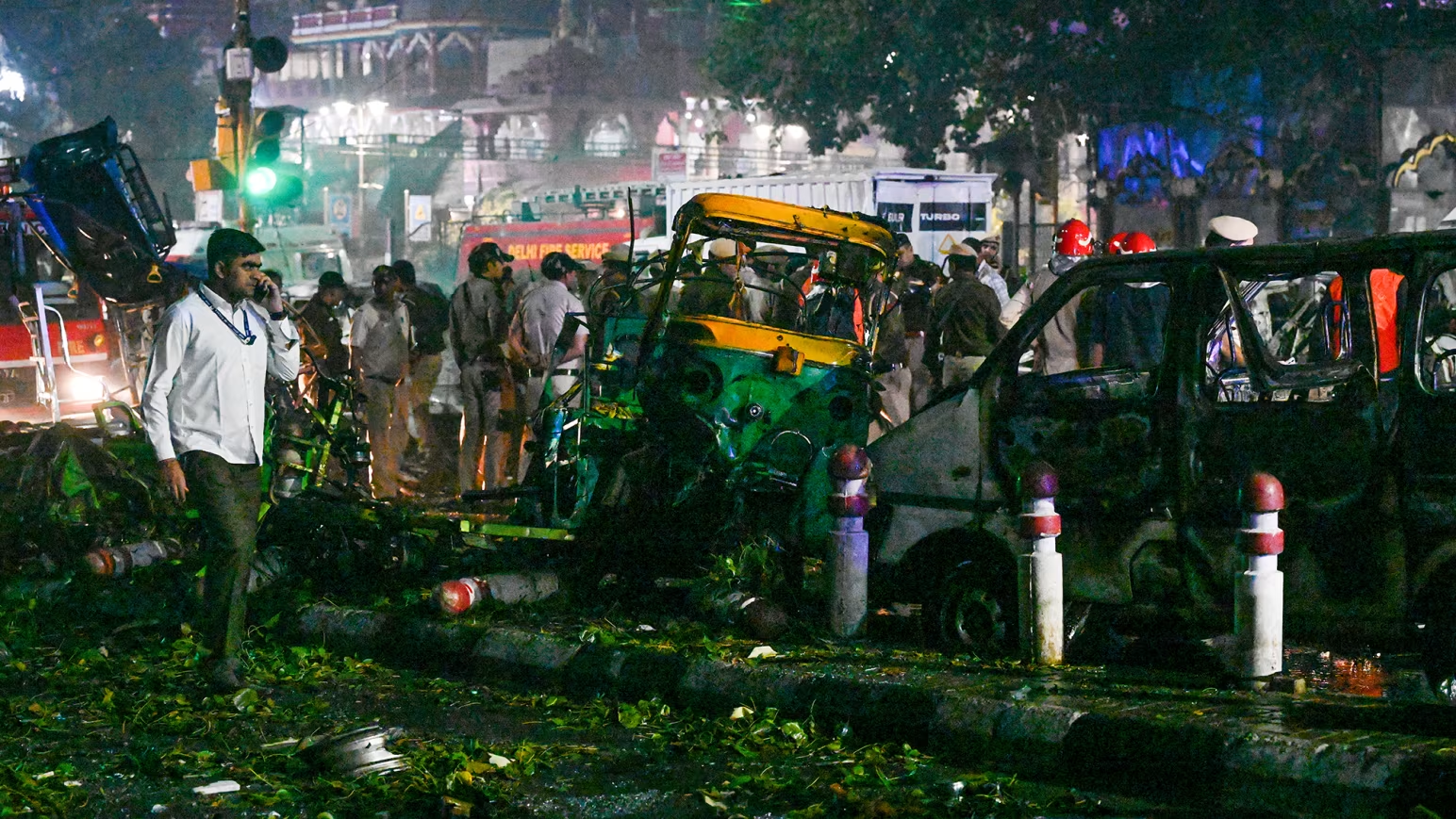
The blast triggered a fire that engulfed multiple nearby vehicles — reported as 3-4 to as many as 6 cars, plus auto-rickshaws and e-rickshaws.
-
The force of the explosion shattered windows of vehicles and nearby buildings; eyewitnesses said the blast felt like an earthquake.
-
Emergency services responded rapidly: fire-tenders, ambulances and forensic teams were dispatched. By about 7:29 pm, the blaze was reported under control in at least one report.
At local hospitals:
-
Dr. Manish Kumar Jha of Lok Nayak Jai Prakash Narayan (LNJP) Hospital stated that “many are not in a position of recovering.”
-
Initial counts of casualties vary: some reports list 8 dead, others 10 or more; injuries reported range from ~20 to more than 30.
Residents and shop-owners in the crowded Old Delhi market area and near the metro station described scenes of chaos:
-
One shopkeeper recounted:
“I never heard such a loud explosion in my life. I fell three times due to the explosion. It felt as if we were all going to die.”
-
Another said:
“The entire building trembled, and people started running in panic.”
-
The blast left visible devastation: charred vehicles, glass shards, scattered body parts and flames at multiple points in the aftermath.
Authorities quickly cordoned off the area, restricted access at Gate No. 1 of the metro station, and diverted traffic. Metro services continued otherwise, but security was heightened.
The cause of the explosion remains under active investigation. Key points being pursued:
-
The vehicle’s registration and ownership are being traced (reports indicate police detained the registered owner).
-
CCTV and traffic-signal camera footage from the traffic junction and metro station area are being reviewed.
-
Agencies involved: the local Delhi Police (including the Special Cell), forensic teams, and national security agencies such as the National Investigation Agency (NIA) & the National Security Guard (NSG).
-
Officials say all possibilities are being explored: mechanical failure, terror attack, explosive device, fuel-tank explosion, etc.
-
A parallel security incident earlier in the day: authorities had recovered a large cache of ammonium-nitrate explosives and weapons from a rented accommodation in Faridabad (near Delhi) — investigation is examining any link.
-
The capital, Delhi, has been placed on high alert. Security has been tightened around sensitive sites, including metro stations, government buildings and historical monuments. The New Indian Express+1
-
Nearby states (for example, Uttar Pradesh, Maharashtra) and major cities have also been issued alerts; security forces instructed to increase patrols and frisking. India Today+1
-
The Home Minister, Amit Shah, visited the scene and pledged a full investigation. The Prime Minister, Narendra Modi, expressed condolences and reviewed the situation with senior officials. Business Standard+1
The blast occurred adjacent to one of India’s most important historical and national symbols — the Red Fort (Lal Qila). This 17th-century Mughal fortress is the site where the Prime Minister addresses the nation every year on Independence Day, and it draws tourists from across the world. Reuters+1
The street in question, near the metro station, is a dense, congested area in Old Delhi — with heavy vehicle and foot traffic, markets, auto-rickshaws, small shops, and narrow lanes. The combination of historic site + high crowd density + major tourist zone increases both the symbolic significance and potential impact of the explosion.
Thus, the incident not only causes tragic human loss, but also strikes a nerve in terms of national security, tourism confidence, and urban safety in India’s capital.
At least 10 people are confirmed dead so far; many others are critically injured and receiving treatment at hospitals such as LNJP. Families and friends of the victims are in shock, and grief is spreading through the local community and across Delhi. Some key issues:
-
Identification of victims may take time, especially if severe burn or blast injuries.
-
Survivors face long recovery: burn injuries, trauma, injuries from debris, possible amputations.
-
Emergency responders and hospitals are under pressure; local fire department and trauma units are working overtime.
-
Business disruption: Local shops temporarily closed, markets evacuated, traffic diverted, tourists suspended.
Such an incident in the heart of New Delhi raises multiple concerns:
-
The possibility of terrorist activity cannot be dismissed, given prior incidents and the cache of explosives found earlier.
-
Urban vulnerability: crowded transport hubs, heritage landmarks and dense markets are soft targets for such events.
-
Impact on public confidence: locals and tourists alike may feel less safe; access to key sites may be restricted.
-
Need for enhanced surveillance, emergency-response readiness, and forensic capability in historic/central zones.
Political and diplomatic ramifications
-
The government faces pressure to demonstrate both transparency in investigation and rapid action in ensuring safety.
-
If a terror link is established, implications could extend to India’s domestic policy, regional relations and counter-terror strategy.
-
Local economy & tourism: damage to the image of Old Delhi, the Red Fort, and connected tourism circuits may affect livelihoods.
Urban planning & crisis preparedness
-
The blast illustrates the cascade risk in dense urban environments: a single explosion ignites multiple vehicles, causing fire, debris, mass-panic and difficulty for first responders.
-
Emergency access, evacuation routes, fire-safety in heritage zones and narrow streets will come under scrutiny.
-
Importance of municipal-state-federal coordination in rapid response and post-incident management.
-
Definitive cause: Was it an accidental fuel-tank explosion, a deliberate improvised explosive device (IED) or something else? Authorities have not yet ruled out any angle.
-
Exact number of casualties: fatalities and injured counts are still evolving; ranges vary across sources.
-
Motive, if deliberate: No group has claimed responsibility (as of now).
-
Connection with earlier explosive cache: While there was a prior seizure of explosives nearby, no official link has yet been confirmed.
-
Full list of victims: Official identification, age/profession of victims and how many were pedestrians vs. occupants vs. nearby vehicles remain unclear.
Timeline of Key Events
| Time (Approx) | Event |
|---|---|
| ~6 : 42 pm local time | Vehicle stops at signal near Gate 1, Red Fort Metro station. WRAL.com+1 |
| ~6 : 52-6 : 55 pm | Car explodes; shockwave experienced; fire breaks out among nearby vehicles. The Economic Times+1 |
| Shortly after | Fire service receives call; dispatches 7–10 fire tenders; traffic and metro station zone cordoned off. The Economic Times |
| ~7:29 pm | Fire reported under control in some official accounts. The Economic Times |
| Post-incident | Victims taken to hospitals; political leaders briefed and arrive on scene; investigation begins in real-time. The New Indian Express+1 |
-
The Delhi Police and NIA will release more concrete findings: vehicle registration, ownership, forensic analysis of blast-site, explosive residue tests.
-
Officials will reveal casualty lists, verify how many were bystanders vs. vehicle occupants.
-
Surveillance footage and witness testimonies will be compiled and may lead to arrests or charges if foul play is suspected.
-
Increased patrols, checks on vehicles, heightened surveillance of metro stations, heritage sites and crowded markets.
-
Temporary closures or restrictions around the Red Fort area and other high-risk zones may be imposed.
-
Public advisories and awareness campaigns for vigilance, evacuation protocols, and reporting suspicious activity.
-
Local businesses (shops, markets) will need support as foot-traffic and tourism may decline.
-
Victim-assistance programmes: hospitals, government relief funds, insurance claims, trauma-counselling services.
-
Urban resilience planning: assessing blast-vulnerability in dense heritage zones, emergency-access limitations, fire-risk protocols for vehicle parking and street design.
The explosion near the Red Fort Metro Station is a tragic reminder of how vulnerable even the heartlands of major capitals can be to sudden, devastating violence or accidents. Beyond the immediate horror of lost lives and injuries, the incident places a spotlight on national security, urban safety, heritage-site protection and the daily realities of crowded city-life in India.
For New Delhi, the shock is deep: a landmark zone, steeped in history and meaning, fractured by a moment that caused tremendous loss and fear. For the country, the incident raises urgent questions: how secure are our crowded public spaces? How ready is our emergency-response infrastructure? And how resilient will we be in the face of such a crisis?
As investigations continue, the leaders and people of India face the difficult task of finding answers — and rebuilding trust. The victims, their families, and the city itself deserve clarity, accountability and action.
We will update further as more details emerge, including definitive casualty numbers, investigation findings and security implications.
Follow Canada News Media
Get the day's top Canadian stories and our two daily 60-second news videos wherever you scroll.