



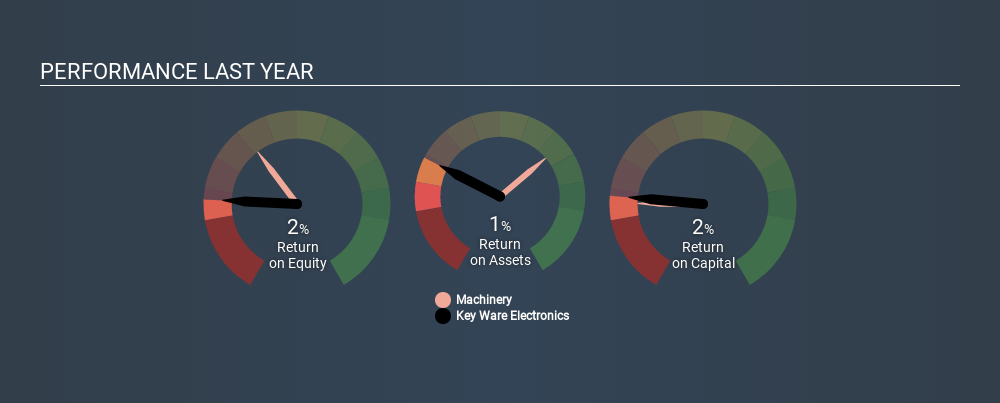
Today we are going to look at Key Ware Electronics Co., Ltd. (GTSM:5498) to see whether it might be an attractive investment prospect. To be precise, we’ll consider its Return On Capital Employed (ROCE), as that will inform our view of the quality of the business.
First of all, we’ll work out how to calculate ROCE. Next, we’ll compare it to others in its industry. Finally, we’ll look at how its current liabilities affect its ROCE.
What is Return On Capital Employed (ROCE)?
ROCE is a metric for evaluating how much pre-tax income (in percentage terms) a company earns on the capital invested in its business. All else being equal, a better business will have a higher ROCE. Overall, it is a valuable metric that has its flaws. Renowned investment researcher Michael Mauboussin has suggested that a high ROCE can indicate that ‘one dollar invested in the company generates value of more than one dollar’.
So, How Do We Calculate ROCE?
Analysts use this formula to calculate return on capital employed:
Return on Capital Employed = Earnings Before Interest and Tax (EBIT) ÷ (Total Assets – Current Liabilities)
Or for Key Ware Electronics:
0.018 = NT$37m ÷ (NT$3.1b – NT$1.0b) (Based on the trailing twelve months to September 2019.)
Therefore, Key Ware Electronics has an ROCE of 1.8%.
See our latest analysis for Key Ware Electronics
Is Key Ware Electronics’s ROCE Good?
ROCE is commonly used for comparing the performance of similar businesses. Using our data, Key Ware Electronics’s ROCE appears to be significantly below the 10.0% average in the Machinery industry. This could be seen as a negative, as it suggests some competitors may be employing their capital more efficiently. Putting aside Key Ware Electronics’s performance relative to its industry, its ROCE in absolute terms is poor – considering the risk of owning stocks compared to government bonds. It is likely that there are more attractive prospects out there.
In our analysis, Key Ware Electronics’s ROCE appears to be 1.8%, compared to 3 years ago, when its ROCE was 1.2%. This makes us think the business might be improving. You can click on the image below to see (in greater detail) how Key Ware Electronics’s past growth compares to other companies.

It is important to remember that ROCE shows past performance, and is not necessarily predictive. ROCE can be deceptive for cyclical businesses, as returns can look incredible in boom times, and terribly low in downturns. ROCE is, after all, simply a snap shot of a single year. You can check if Key Ware Electronics has cyclical profits by looking at this free graph of past earnings, revenue and cash flow.
What Are Current Liabilities, And How Do They Affect Key Ware Electronics’s ROCE?
Liabilities, such as supplier bills and bank overdrafts, are referred to as current liabilities if they need to be paid within 12 months. The ROCE equation subtracts current liabilities from capital employed, so a company with a lot of current liabilities appears to have less capital employed, and a higher ROCE than otherwise. To counter this, investors can check if a company has high current liabilities relative to total assets.
Key Ware Electronics has total assets of NT$3.1b and current liabilities of NT$1.0b. As a result, its current liabilities are equal to approximately 33% of its total assets. With a medium level of current liabilities boosting the ROCE a little, Key Ware Electronics’s low ROCE is unappealing.
Our Take On Key Ware Electronics’s ROCE
There are likely better investments out there. You might be able to find a better investment than Key Ware Electronics. If you want a selection of possible winners, check out this free list of interesting companies that trade on a P/E below 20 (but have proven they can grow earnings).
For those who like to find winning investments this free list of growing companies with recent insider purchasing, could be just the ticket.
If you spot an error that warrants correction, please contact the editor at [email protected]. This article by Simply Wall St is general in nature. It does not constitute a recommendation to buy or sell any stock, and does not take account of your objectives, or your financial situation. Simply Wall St has no position in the stocks mentioned.
We aim to bring you long-term focused research analysis driven by fundamental data. Note that our analysis may not factor in the latest price-sensitive company announcements or qualitative material. Thank you for reading.
Discounted cash flow calculation for every stock
Simply Wall St does a detailed discounted cash flow calculation every 6 hours for every stock on the market, so if you want to find the intrinsic value of any company just search here. It’s FREE.