
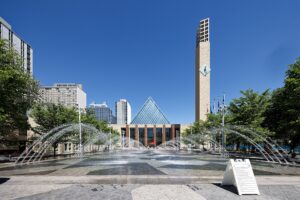


The Kitchener Market will remain open this Saturday, but “future Saturday programming and operations will be re-evaluated in line with the chief medical officer of health’s recommendations,” the city said in a statement.
The Centre in the Square is ceasing event operations until April 5. For more information, visit the www.centreinthesquare.com
Dr. Wang specifically mentioned festivals and markets as the types of events that are recommended to close. “It’s not just the fact that there’s 250 people. It has to be 250 people that are in a very crowded environment. They’re very close together.”
[embedded content]
The recommendation doesn’t apply to workplaces or post-secondary institutions, though she said they should “consider increasing flexibility for their students and/or workers to work from home or work remotely.”
“If you’re in a movie theatre, for example, or you’re in a classroom, you could, if you start to get symptoms, just leave. You’re not in a situation where you have people around you and you’re so crowded you potentially can’t get out of the way,” she explained.
Kitchener Mayor Berry Vrbanovic said it was too short notice to close the market this Saturday.
“The reason we’re open this Saturday is because people need food supplies, and it’d be very difficult to get word out to people,” he said. “Many of the vendors have already gotten their food from the Ontario Food Terminal,” much of it perishable, he added.
Dr. Wang also announced several other measures to attempt to slow the spread of the virus, including that children returning from travel outside Canada not go to daycare or camp for 14 days, and that Waterloo Region residents postpone non-essential travel outside of Canada, including to the United States.
[embedded content]
The region’s new case is a woman in her 50s who travelled to France and the United Kingdom, Wang said. The woman has mild respiratory symptoms and is self-isolating at home. Public Health is monitoring her and her family members, who aren’t showing any symptoms.
As well, one of the region’s previous cases, a man in his 40s who returned recently from Las Vegas, is in hospital in stable condition.
He originally had been recovering at home, but returned to hospital Thursday, Wang said, though she wouldn’t say if he was in intensive care or provide specifics about his condition.
Wang is also recommending that anyone returning to the region after travel outside the country not visit patients in hospital, elderly people or those with chronic health conditions, or long-term care and retirement homes for 14 days from their date of return.
It’s fine for the rest of the population to visit any elderly or medically fragile people, she said. “The risk right now is really with returning travellers.”
Vrbanovic urged people to reach out to the vulnerable and elderly. “We have a long history of being a caring community,” Vrbanovic said in an interview. “It’s important during this time that the community continue to check in with loved ones, especially seniors and vulnerable people who may feel isolated and particularly vulnerable at this time.”
Public Health isn’t recommending that shelters for the homeless be closed, Wang said. “We’re working with the organizations that service these populations to make sure they have our recommendations in terms of how to make the settings as safe as possible.”
She also said the region will be testing fewer people for the virus, in line with new provincial guidelines. Testing will be prioritized for people who need hospital care, and for people such as health-care workers and people in long-term care and retirement homes, as well as contacts of confirmed case who are showing symptoms of illness.
“For most other people who develop fever and/or cough and have travelled to an affected area, testing is not longer recommended,” she said. “They will still need to remain at home in self-isolation until such time as they are no longer symptomatic for 24 hours.”
There are “dozens and dozens” of people in Waterloo Region who are self-isolating themselves at home, Dr. Wang said. “If you have returned from a country that’s been affected and you have symptoms you are to self-isolate.”
The region has had more than 90 tests come back negative, and is still awaiting results on “dozens more” tests administered over the last couple of days, she said.
There were more than 150 confirmed cases of the virus in Canada as of Friday morning, including 79 in Ontario. One elderly man in a British Columbia care home has died from the virus.
Residents are reminded that washing hands with warm water and soap for 20 seconds is the best defence against the spread of germs and viruses. Use alcohol-based hand sanitizer if warm water and soap is unavailable. People who feel sick should stay home.
Twitter: @ThompsonRecord
Twitter: @ThompsonRecord

Follow Canada News Media
Get the day's top Canadian stories and our two daily 60-second news videos wherever you scroll.
X Threads Facebook Instagram LinkedIn TikTok YouTube Pinterest Reddit Substack Flipboard Newsletter RSS