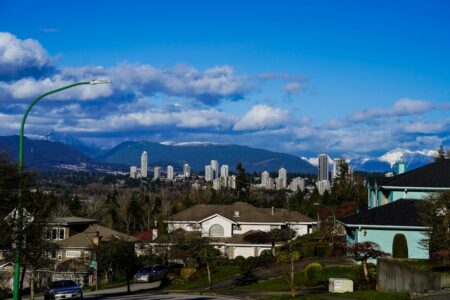

There are 20 development projects with towers over 45 storeys that are selling condo units, under construction or near completion.

Developers are seeking approval for two 50-storey towers in the same block where Surrey city council recently gave the greenlight for what will be its tallest building at 67 storeys.
He added that with increased land and construction costs, developers are motivated to use all the density they can get and build taller towers. However, there is also a point where it stops making sense to push higher “because things like the cost of structural systems increase as you go higher.”
Across Metro Vancouver, there are more than 20 towers over 45 storeys that have been approved by municipal governments, according to data from Zonda Urban market analyst Justin Lee. More than half of these are in Burnaby. Five are in Coquitlam and Port Moody, while Downtown Vancouver, New Westminster and Surrey have one each.
After these, there are 40 more tall-tower projects that have been publicly presented to city councils and are in some stage of seeking approval. Most are in Burnaby and Surrey, followed by Downtown Vancouver and Coquitlam.
“We’ll see if economic conditions allow for them to be built,” said Dikeakos, whose firm is working on the new tall tower approved in Surrey and other projects.
In late 2019, Pinnacle International Development made a proposal for a site near the Lougheed SkyTrain Station. It had three towers including one that would be 80 storeys and 250 metres tall. They would be the tallest buildings in Western Canada. Some more details were presented to Burnaby city council in May 2022 for towers of 80, 76 and 73 storeys, but the project has not progressed further with the city.
Metro King by Anthem Properties is a proposal for a 66-storey tower between Kingsway and Hazel streets across from Metrotown that is nearing a final decision by the City of Burnaby.
This pipeline of potential projects is happening as cities have focused on adding density to sites near transit stations and town centres, according to Dikeakos.
“The taller buildings in these types of developments that you are going to be seeing tend to be real, mixed-use ones, meaning they have a commercial base with significant office or hotel use where the first 15 to 20 storeys are commercial even before you get to the residential portion,” he said.
“One of the interesting changes that we’re seeing is that because these developments are being done near transit sites, cities are requiring less parking,” said Dikeakos. “If we had to do the same amount of parking required a few years ago, the depth of these excavations would make them completely unfeasible. (When) we’re not required to do as much parking, it allows us to do these taller towers and still make some financial sense.”
Even though developers are motivated to deal with increasing land and construction costs by building higher, there is a turning point. It will obviously be different for each project, but Dikeakos said that for the Station Square project, it was somewhere at the 52- to 55-storey height.