

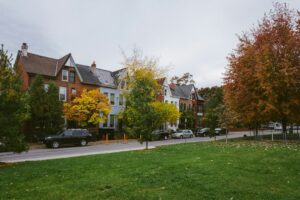

Starting at 5 a.m. transit users will be able to take the LRT between Tunney’s Pasture and uOttawa stations.
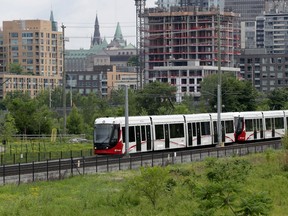
Article content
Partial Line 1 service is to resume Tuesday morning, after a 21-day shutdown, OC Transpo announced Monday.
Starting at 5 a.m., transit users will be able to take the LRT between the Tunney’s Pasture and uOttawa stations. Five single-car trains will be in operation, running every five minutes. Each train can carry 300 passengers.
Single-car trains only use half the platform. Transit users are being asked to board in the area of the platform marked with decals.
R1, R1 Express and Para R1 services will continue to operate with no changes. There’s an additional train available that can be used during peak periods.
“We are very, very confident that with single cars and the level of ridership we have we can easily handle everything,” said Renée Amilcar, Ottawa’s transit services general manager.
The $2.1-billion Confederation Line was shut down on July 17 after excess grease was found on the axle of one light rail vehicle during a routine inspection.
The original plan was to return to limited service on July 31, using single cars. But that plan was cancelled on July 28 to allow for a risk assessment to be conducted to protect the rails and the vehicles.
Last week, the city announced that it would open Line 1 in its entirety on Aug. 14 after the restraining rails, a passive safety device used to prevent derailments, were repositioned to prevent contact with the wheels of the train. The job requires doing this exacting work on 16 curves on the line.
However, the required work between the Tunney’s Pasture and uOttawa stations has already been completed. After trial running in this section to confirm that it is safe, OC Transpo decided to open that stretch, the city announced Monday.
“The decision was made once we knew we had sufficient documentation to support the partial opening,” said Richard Holder, Ottawa’s director of engineering services.
Advertisement 2

Article content
Article content
Typically, at this time of year, 11 double-car trains would be in operation on the system. OC Transpo is working with the Rideau Transit Group to maximize the number of trains available.
Train riders may notice slower train speeds in the tunnel, due to a speed restriction as part of safety requirements.
At the same time, workers will continue to work on the restraining rails on the curves on the eastern portion of Line 1, where there are more curves and more restraining rails to be adjusted, Amilcar said.
It is expected that all of Line 1 — including more trains — will be in service starting Aug. 14.
What about those troublesome tight curves?
Holder said straightening the rails is not in the cards.
“We are experiencing issues right now. But it’s not a case that we need to eliminate those curves,” said Holder. “And it’s not the situation that we could have avoided those curves.”

The restraining rails have to be repositioned a very small amount, between one and two millimetres, so the wheels are not in contact with the restraining rails.
The question of whether the curves are a design flaw has come up a number of times. Holder said the city has received a number of public inquiries about straightening the tight curves.
Advertisement 3
Article content
“If we had a lot of engineers designing a light rail system, we would make it straight. But we had to build a system in Ottawa. We had to connect a lot of infrastructure together,” said Holder.
The stretch on Line 1 with the tightest curves is around the Lees, Hurdman and Tremblay stations, he said.
When the system was being designed, it had to connect a number of significant pieces of infrastructure, including a crossing of the Rideau River and a large watermain pumping station just east of Hurdman that supplies the east end of the city with water, which would have been expensive and difficult to move. East of that is a bridge adjacent to the rail. At one spot, the LRT line runs next to a VIA Rail line.
That meant that the design of the system had curves that are considered relatively tight, said Holder. “But this is well within the realm of a light rail system,” said Holder.
The infrastructure and the specifications for the light rail vehicles were common for light rail systems around the world, he said.
“These systems are designed for urban areas for vehicles to actually run on downtown streets where the radius of the curves is much tighter than the curves we have around Hurdman and Lees,” said Holder.
Advertisement 4
Article content
What about the axle hub assemblies?
In the long run, the plan is to redesign the axle hubs. The process, including creating a prototype and testing it, could take two to three years. In the meantime, the axles will be replaced more frequently. Other measures are also under consideration, including lubricating the rails.
“We’re dealing with maintenance issues right now. And the fixes that we’ve talked about and that we’ve outlined will ultimately resolve those issues,” said Holder.
The restraining rails on the tight curves are a contributing factor, but there are a number of issues to the “root cause” for the problem of the fatigue on the bearings in the hub assembly of the train.
-

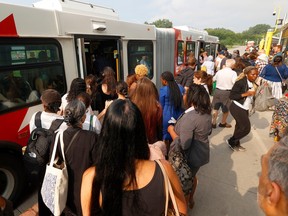
Deachman: How do you spell frustration? Transit riders offer entries for the Ottawa Light Rail Thesaurus
-

The pressure is on to compensate transit users for weeks of frustration. But how?









Comments
Postmedia is committed to maintaining a lively but civil forum for discussion and encourage all readers to share their views on our articles. Comments may take up to an hour for moderation before appearing on the site. We ask you to keep your comments relevant and respectful. We have enabled email notifications—you will now receive an email if you receive a reply to your comment, there is an update to a comment thread you follow or if a user you follow comments. Visit our Community Guidelines for more information and details on how to adjust your email settings.
Join the Conversation