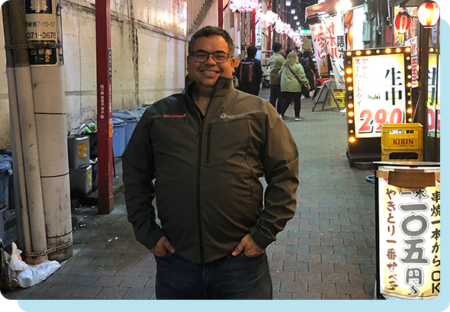




A man who said he developed what felt like “a nasty cold with a cough and runny nose” while on a flight from Hong Kong to Toronto is questioning whether there are adequate safeguards to prevent the spread of the new coronavirus in Canada.
Massie Beveridge, a retired general surgeon, said he was “waved” through Pearson International Airport even after reporting his symptoms to a border services agent.
“My nose is running like Niagara Falls, I’m coughing and feeling pretty miserable,” Beveridge told CBC News.
“So, when I came to the immigration agent, I explained this and he took me aside to a little screened-off area where there was a table and some masks and some hand wash and stuff and [the agent] asked me to sit there,” he said.
“I figured there’d be some kind of public health person coming to interview me. As it was, there wasn’t, and the immigration officer came back a few minutes later and said, ‘Here’s a handout. You can call public health if you like,’ and waved me on through,” Beveridge added.
Beveridge was returning to Canada from Cambodia but changed planes in Hong Kong after flying from Phnom Penh.
He said he was anxious, even though he had not been anywhere near Wuhan, the Chinese city where the outbreak started, and Cambodia has so far reported only one case of the coronavirus.
Additionally, given the concerns over the coronavirus in China and other Southeast Asian countries, he figured he’d better do something on his return to make sure he didn’t spread whatever he had.
Nobody even took my temperature.– Massie Beveridge.
“Nobody even took my temperature. And you know if we’re really trying to keep this out of Canada, it seems that that was not a very thorough screening process,” Beveridge said.
“I could have walked through there sniffling and sneezing and said nothing and nobody would be any the wiser.”
The outbreak of the new coronavirus began last month in Wuhan in China’s Hubei province.
On Thursday, a World Health Organization (WHO) panel declared the outbreak that has killed 213 people a public health emergency of international concern.
Canada currently has three confirmed cases — two in Toronto and a third in British Columbia.

CBC News reached out to the Greater Toronto Airports Authority (GTAA) for comment, but a spokesperson told us the Public Health Agency of Canada (PHAC) is the lead agency responsible for determining the response to the coronavirus.
“We continue to work in close collaboration with PHAC and Canada Border Services Agency (CBSA) to ensure that all proper measures are taken for international arriving passengers,” the GTAA’s Tori Gass wrote in an email.
The Chief Public Health Officer of Canada, Dr. Theresa Tam, says there are enhanced screening measures in place, but says it’s likely Beveridge was not screened using those measures because he was in Hong Kong only briefly, and hadn’t actually been in China or any of the affected areas.
“For the coronavirus, the enhanced border measures, on top of what we have as a foundation, is essentially providing the information on the screen and the kiosk questions and the referral to Canadian border service agents,” Tam told CBC News.
“The entry screening is but one layer of a multilayer strategy … it is not sufficient ever, and it is really important to make sure that our health-care system is alerted in order to diagnose and manage cases. So, that’s how the system works currently.”
Tam said anyone who is sick should declare this to border service agents.
Call for enhanced screening at all Canadian airports
Frank Scarpitti, the mayor of Markham, 30 kilometres northeast of Toronto, says while he has great confidence in public health officials at the federal, provincial and local levels, he continues to press for the federal government to put in more enhanced screening at all Canadian airports.
“I think it would just give Canadians a greater sense of confidence that that additional step is being taken,” Scarpitti told CBC News.
“It’s not going to catch everyone but it’s just another layer of screening, rather than just voluntary screening, and indicating where someone may have travelled.”

Scarpitti also pointed to measures introduced at other major airports in New York City, San Francisco and Los Angeles that involve passengers from China being screened for symptoms.
“You just have to look south of the border, the U.S. airports instituted that,” he said.
“Not only have they put in place enhanced screening, but because of the number of airports that they have, they’re actually redirecting passengers to the airports that have that technology,” Scarpitti said.
Global Affairs Canada said there are 196 Canadians currently seeking consular help to leave China, and Canada has secured a charter aircraft to bring home Canadians stranded in the affected region.
Follow Canada News Media
Get the day's top Canadian stories and our two daily 60-second news videos wherever you scroll.
X Threads Facebook Instagram LinkedIn TikTok YouTube Pinterest Reddit Substack Flipboard Newsletter RSS