

13-year-old’s 2nd big win at Canada-Wide Science Fair
We’re profiling cool kids doing cool things.
Know someone you think should be profiled on our site?
Email us at [email protected] and tell us what makes them so awesome.
Name
Arushi Nath
Hometown
Toronto, Ontario
Age
13
Claim to fame:
What would happen if a massive asteroid was on a crash course directly toward Earth?
Would it hit us? Or could we stop it in its tracks?
Thanks to a 13-year-old from Ontario, our chances of protecting ourselves from such an object just got a lot better.
On May 18, Arushi Nath became one of two top winners at the 2023 Canada-Wide Science Fair in Edmonton, Alberta.
She beat thousands of students from across the country to claim the prize.
And guess what? She did the same thing last year!
Organizers say this makes her the first student in more than 30 years to win a best project award two years in a row.
Falling in love with the stars
Arushi has been interested in outer space since she was just eight years old.
“Back then, I’d go out on my balcony and look through my telescope and try to pick out patterns in the night sky, which I later learned were constellations.”

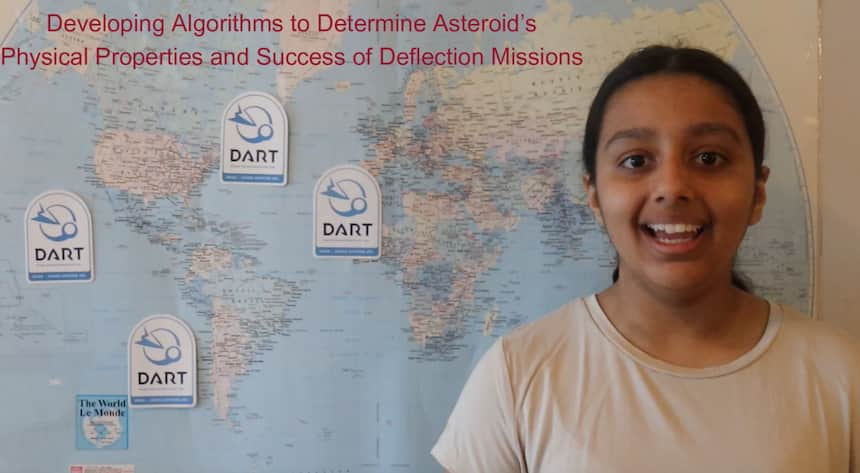
Arushi Nath’s’s award-winning science could one day help protect Earth from incoming asteroids. (Image submitted by Arushi Nath)
She soon joined the Royal Astronomical Society of Canada to get more involved in space science.
“They have a huge telescope in Collingwood, Ontario, which allowed me to look at the sky like never before,” she said.
“This got me fascinated with the subject of astronomy and how I could contribute.”
Defending the planet from asteroids
Arushi began her award-winning project back in August 2022 after becoming interested in the idea of planetary defence.
Planetary defence is the act of protecting the Earth from objects outside our atmosphere.
She learned that hundreds of asteroids that come close to Earth are discovered each month.
But only a handful of astronomers with access to huge telescopes are set up to analyze them.
That’s a problem, Arushi said.
“If an asteroid were on a collision course to Earth, we’d need to know its attributes, like size and strength, to know how to deflect it,” she said.

Arushi was one of two kids who won this year’s top project award at the Canada-Wide Science Fair. They were chosen by more than 239 judges. (Image credit: Youth Science Canada)
Arushi decided to start a project that would allow everyday, amateur astronomers looking through tiny telescopes to analyze asteroids themselves.
This is called citizen science — when everyday people contribute to a project when there aren’t enough scientists to complete it on their own.
Designing the algorithm
Using a coding language called Python, Arushi designed an algorithm.
An algorithm is a set of instructions designed to solve a problem.
The algorithm allows amateur scientists to submit images of an asteroid. Then the program tells them about its size, brightness and other important features.
“I spent around 400 hours designing the algorithm, 200 hours taking images of asteroids and 200 hours plugging those images into my algorithm.”
Once the algorithm was complete, Arushi tested it on a real-world scenario.
A real-world test
In September 2022, the U.S. space agency, NASA, tested its ability to deflect an asteroid.
NASA staff flew their DART spacecraft into a non-threatening asteroid called Dimorphos to see if they could successfully deflect it. The experiment worked.

NASA was able to successfully change the course of an asteroid in September 2022 during its DART Mission. (Image credit: NASA)
Arushi took images of the asteroid before, during and after it was deflected.
She found that her algorithm was successfully able to measure the asteroid’s dimensions at each point.
Why this matters
The good news is, you don’t need to be worried about an asteroid hitting Earth anytime soon.
“Despite what Hollywood movies may lead us to believe, the risk of a collision between an asteroid and Earth is extremely small,” says the Canadian Space Agency on its website.
Still, scientists say it’s good to be prepared. Thankfully, kids can help with that.
The Canada-Wide Science Fair shows “the important role that youth play in developing innovative knowledge and solutions that will help future generations,” said Reni Barlow in a news release. He’s the executive director at Youth Science Canada.

Arushi accepts her top project award at the 2023 Canada-Wide Science Fair for her project that could one day help us deflect asteroids headed toward Earth. (Image credit: Youth Science Canada)
Taking home the big prize
There were nearly 400 finalists from all over the country at this year’s Canada-Wide Science Fair.
Arushi was one of two people who won the award for top project.
“It felt really amazing to see that my work was awarded at such a high level after 800 hours spent on this project,” she said.
This was on top of last year’s win, which was also for a project about identifying unknown asteroids.
Arushi said the win has inspired her even more to keep going further as a scientist.
She said her next step is to represent Canada at the European Union’s Contest for Young Scientists in Belgium in September.
She’ll be competing with other kids from around the globe.
“I’m going to try my best there and see if I can take it home for Canada.”
Have more questions? Want to tell us how we’re doing? Use the “send us feedback” link below. ⬇️⬇️⬇️
TOP IMAGE CREDIT: Youth Science Canada/Instagram