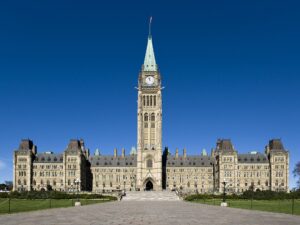



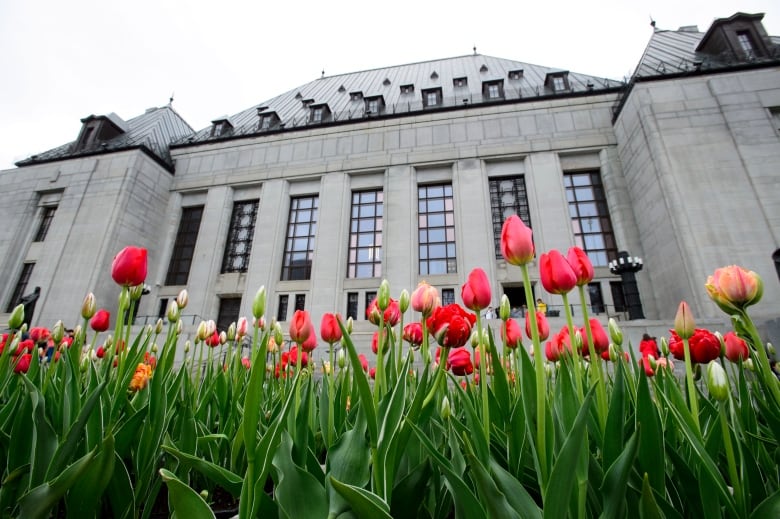
The Supreme Court of Canada will issue a ruling today on the scope of provincial governments’ obligations to fund French-language education systems.
The case revolves around a claim by some parents and a school board in British Columbia. They accuse the provincial government of denying their charter rights by systematically underfunding French-language schools.
Suzana Straus, who lives in Richmond, B.C., said it takes her Grade 9 son an hour to get to a school where he can take French instruction.
Straus said the provincial government’s policies are an obstacle for francophone parents who want their children to be fluently bilingual.
“It means, for many families, they will choose not to send their children to francophone schools,” said Straus, who is president of the Fédération des parents francophones de Colombie-Britannique.
“They will choose to go to the local school and that means assimilation. And that saddens me tremendously.”

Mark Power, a lawyer who works in Ottawa and Vancouver, is representing the parents and the school board — the Conseil scolaire francophone de la Colombie-Britannique. He said the case has implications for governments and minority language school boards across the country.
Minority language rights being tested
The parents and the school board allege the province violated minority language educational rights guaranteed under S. 23 of the Charter of Rights and Freedoms.
Power said the Constitution guarantees the right to publicly funded primary and secondary French education in Quebec, and publicly funded primary and secondary French language education elsewhere in Canada — where numbers warrant.
Approximately 64,325 people speak French as their primary language in B.C — a 21 per cent increase over 2006, according to 2016 data from the Office of the Commissioner of Official Languages.

The parents and school board want the province to change its funding method for French-language education and compensate the board for inadequate funding.
They also want the B.C. government to address infrastructure issues with French-language schools that force them to divide classrooms to make room for all their students.
The parents and school board won a partial victory at the trial level, where a judge ruled some of the province’s procedures for deciding on minority language education funding unjustifiably breached charter rights.
Justice Loryl Russell awarded $6 million in damages for a charter breach based on the school division’s transportation program, which Russell ruled the province “chronically underfunded” for a decade.
But the judge also concluded that the high cost of building new francophone schools in some parts of B.C. justified infringing upon the charter right — and suggested that in some cases it would simply delay inevitable linguistic assimilation.
“That’s hard to grasp,” Power said. “It’s hard to understand exactly how those minority rights can be ignored by the state and what reason could justify that.”
The parents and school board appealed the decision. That appeal was dismissed by the B.C. Court of Appeal, which allowed a cross-appeal by the province. The appeal court also set aside the damages awarded by the trial judge.
Contacted by CBC News, a B.C. government representative said the government would not comment on the case until after the ruling.
No matter how the highest court rules, it will be too late for some parents and children who already have gone through the education system.
Still, Straus said she hopes it will make a difference for others.
“It would bring us all tremendous joy if they do rule in our favour,” she said.
“It will mainly be for future generations, for our culture to be able to thrive, for future parents not to make these difficult decisions that we had to make.”

Follow Canada News Media
Get the day's top Canadian stories and our two daily 60-second news videos wherever you scroll.
X Threads Facebook Instagram LinkedIn TikTok YouTube Pinterest Reddit Substack Flipboard Newsletter RSS