
Quebec regulates the awarding of public contracts, but it imposes no laws, no rules and no standards for the sale of government-owned real estate, an examination by the Montreal Gazette has found.
The Gazette discovered the absence of a legislative or regulatory framework for the disposal of public buildings while examining the sale of the former Montreal Children’s Hospital site.
The buyer sold the air rights on part of the site to another developer for $35 million the day before signing the $25-million purchase from the MUHC at the notary’s office. The buyer, 9333-8580 Québec Inc., later sold more air rights to the developer for another $9 million to build on another part of the site.
Sarto Blouin, the businessman who bought the Children’s through 9333-8580 Québec Inc., said he and his partner’s $25-million offer was the most attractive because it was unconditional, while the competing offers were contingent on obtaining financing or a zoning change.
The MUHC said in a statement that it had sold the Children’s in a “formal public tender process.” The MUHC also called it a “rigorous tendering and analysis process.”
“This process was government-led and complied with all standards and procedures used to govern this procedure,” it said.
Tenders not required to sell property
Quebec’s Act Respecting Contracting by Public Bodies regulates the “public call for tenders” mechanism. The law requires the call for tenders to be published in the province’s electronic tendering system, the Système électronique d’appel d’offres du gouvernement du Québec (SEAO). As well, the bidders’ names and their prices are supposed to be rendered public in the SEAO after the bid envelopes are opened.
No call for tenders was posted in the SEAO for the Children’s, though the Société québécoise des infrastructures (SQI), the provincial department that organized the sale, published several calls for tenders there to sell other government properties at the time of the Children’s sale.
In fact, the Gazette’s examination found that while the SQI regularly publishes public calls for tenders to sell government property in the SEAO, it rarely discloses bidders’ names and prices after the bids are opened.
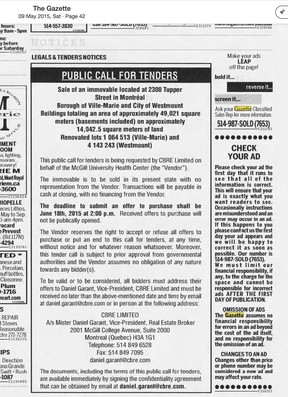
In the case of the Children’s, the SQI published a call for tenders in the SEAO to hire a real estate broker to sell the property. The broker placed an ad in two Montreal daily newspapers to announce the Children’s was for sale. The ad said “Public Call for Tenders,” but also said potential bidders had to sign a confidentiality agreement.
Other bids kept secret
The MUHC and the SQI have never disclosed the prices that were offered for the Children’s or who made the offers.
The MUHC, the Health Ministry and the SQI refused a Gazette access-to-information request this year to obtain the names of the bidders and the prices they offered for the Children’s and for a second former hospital, the Montreal Chest Institute. The SQI claims it’s confidential information. The Gazette has filed a notice to appeal.
The SQI recently hired the same broker that helped sell the Children’s, CBRE, to sell another building belonging to the Health Ministry in Montreal at 90 de la Gauchetière St. E. The public call for tenders notice for the building in the SEAO says CBRE is requesting bids on behalf of the SQI. And despite being in the SEAO, the notice states that potential bidders are required to sign a confidentiality agreement and that “purchase proposals will not be opened publicly.”
“There is no formal rule,” ministry spokesperson Noémie Vanheuverzwijn said in a written response to the Gazette confirming that a public call for tenders is optional to sell a building belonging to the ministry. “However, the Health Ministry makes sure to apply the best practices.”
Despite the absence of rules to govern the process, the Health Ministry “ensures that it demonstrates sound management of public funds,” Vanheuverzwijn said.
The only legal requirement to sell surplus Health Ministry buildings, such as a vacant hospital, is for the ministry and the Treasury Board to OK the decision to sell. As well, the purchaser’s name and the sale price are rendered public.
How Quebec sells surplus property
The premise in the Quebec Civil Code is that public property serving a public use cannot be sold. A government body has to remove the public vocation, declaring it surplus property, before it can sell it.
The clerk or treasurer of a municipality must publish a monthly notice of municipal property worth more than $10,000 that was sold and include the buyer’s name and the price.
However, Quebec has a law governing the sale of certain municipal properties for industrial and research purposes.
The Quebec government offered the Children’s site to other public bodies, including the city of Montreal, before offering it on the market. The other public bodies turned it down.
However, the offer of first dibs to public bodies is optional in Quebec.
Ontario has more strict requirements
By comparison, Ontario requires surplus provincial property to be offered to other public bodies before putting it on the market. In fact, since 2013, Ontario includes not-for-profit corporations “that provide a public benefit” on the list of public bodies to whom surplus government real estate must be offered for purchase at market value before it’s placed for sale on the open market.
However, Ontario doesn’t require a public call for tenders to sell government property.
‘Quite troubling’
Housing activist Éric Michaud, co-ordinator of Habiter Ville-Marie, one of the groups that objected to selling the Children’s for private development, said he’s shocked to learn that Quebec has no legislation or regulations controlling the sale of public property.
“I am very surprised by this and I find it quite troubling because we see all the mechanisms that frame the granting of public contracts, and there’s nothing for the sale of public buildings,” he said.
“Often, government buildings are of great heritage value or financial value because they’re in strategic locations. I find it incredible that there isn’t more regulation.”
Broker better than SEAO, buyer says
Meanwhile, the buyer of the Children’s said he wouldn’t object if the government sold all real estate through the SEAO.
“It doesn’t bother me,” Blouin said. “If it enables getting a better price.”
But the SEAO is unlikely to elicit better prices, he added. The SEAO is more laborious than working with a real estate broker, Blouin said.
“The big players don’t do that. I never go look on SEAO. I wouldn’t even know they’re selling a hospital. If someone like me or like Devimco doesn’t know something is for sale on SEAO, probably you won’t get a better price.”
Major “players” are solicited directly by global real estate companies, Blouin said. “Governments do business with (brokers) for a reason: because they have much bigger databases than SEAO.”
He added that it’s normal practice to sign non-disclosure agreements when doing business with real estate brokers.
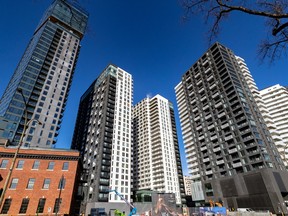
Blouin said he recently used CBRE to sell his stake in one of the towers on the Children’s site, 1111 Atwater. He got seven offers, five of which came from outside Quebec, he said.
“I bid on the Chest Institute, I bid on Radio-Canada, I bid on a bunch of stuff,” Blouin said, adding that the same developers bid on government properties for sale in Montreal.
The MUHC sold the Montreal Chest Institute in 2019 to a numbered company that was represented in the sales deed by Tinel Timu, a developer who was shot and killed this past April. Timu withdrew from the company at the time of the sale.

Follow Canada News Media
Get the day's top Canadian stories and our two daily 60-second news videos wherever you scroll.