



One of the most popular events when it comes to pubic interest in astronomy and stargazing is the ‘Supermoon’. What is this phenomenon and why is it so compelling to us?
We’re just around the corner from another Supermoon, as one will be crossing our sky on the night of Monday, March 9. If it seems like you’ve been hearing about them a lot, these days, it’s not just a figment of your imagination. In fact, in any given year, there are at least six, and as many as eight, ‘super’ Moons.
WHAT IS A SUPERMOON?
A Supermoon is a Full Moon or New Moon that is near or at its closest distance to Earth in its orbit.
It isn’t really an astronomical term. Instead, it was thought up by astrologer Richard Nolle, in 1979.
Nolle defined a ‘super’ Moon as “a new or full moon which occurs with the Moon at or near (within 90% of) its closest approach to Earth in a given orbit (perigee).”
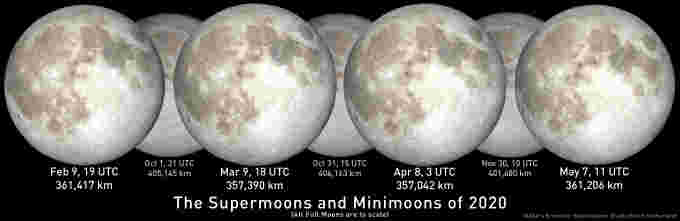
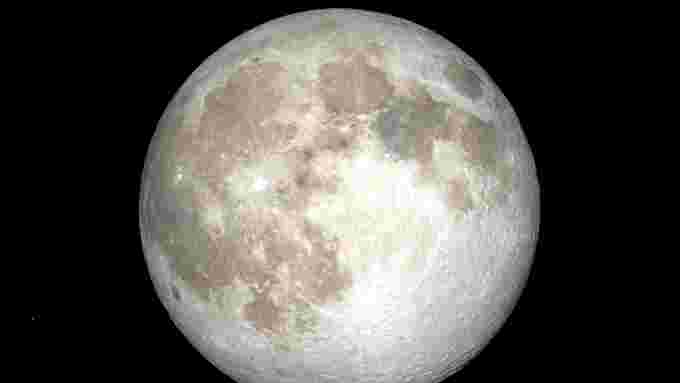 The March 9 ‘super’ Full Moon. Credit: NASA’s Scientific Visualization Studio
With the Moon closer than normal at this time, it translates into a Super Full Moon appearing slightly larger in the night sky. What people tend to notice more, however, is the brightness of a Super Full Moon. A Supermoon can appear up to one third brighter than normal!
WATCH BELOW: SEE EVERY VIEW OF THE MOON FOR 2020 IN LESS THAN 5 MINUTES
ASTRONOMICALLY SPEAKING
To put all of this in astronomical terms, a Supermoon is when the Moon reaches its Full or New phase when it is at a distance from Earth of 361,524 km or closer.
Look it up in a textbook, and the distance between Earth and the Moon is 384,400 kilometres. That is only the Moon’s average distance, however.
As the Moon travels around the Earth, its path traces out an ellipse, rather than a perfect circle. That means on each orbit, the Moon spends roughly half the time closer to Earth and half the time farther away. There is also a point where it reaches its closest distance to Earth on that orbit (perigee) and a point where it reaches its farthest distance (apogee).
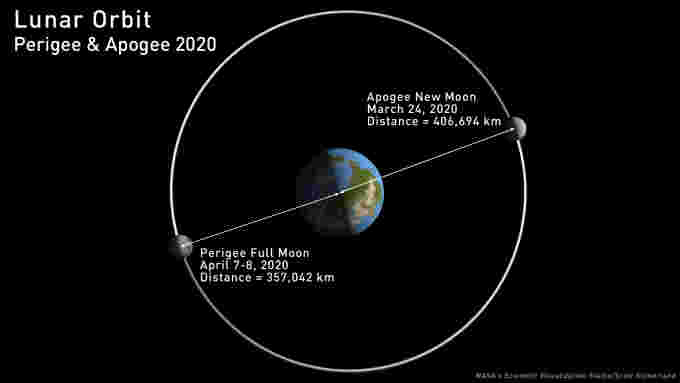
Since Earth and the Moon are travelling together around the Sun and there are other planets in the solar system, this movement and the tug of gravity from all of these other objects skews the Moon’s orbit ever so slightly. As a result, the ellipse the Moon traces is never exactly the same, orbit by orbit.
With the exact shape and orientation of the Moon’s elliptical orbit shifting ever so slightly, month by month, the Moon’s perigee and apogee distances change as well, and the timing of these events is never the same.
The Moon’s perigee distance can vary between about 356,400 – 370,400 km, and its apogee distance varies between 404,000–406,700 km. Even these are just averages, though. The absolute closest perigee on record was on January 4, 1912, at a distance of 356,378 km. The absolute farthest apogee on record will be on February 3, 2125, at a distance of 406,718 km.
In 2020, there are four Super Full Moons, with the closest perigee Full Moon on the night of April 7-8, when it reaches a distance of 357,042 km. For comparison, the farthest apogee Full Moon is on October 31 – Halloween – at a distance of 406,163 km. (If you’re keeping track, although the February Full Moon occurs in the early morning of the 9th, a full day and a half before the perigee Moon, the Moon is still 99.6% full when it rises on that night
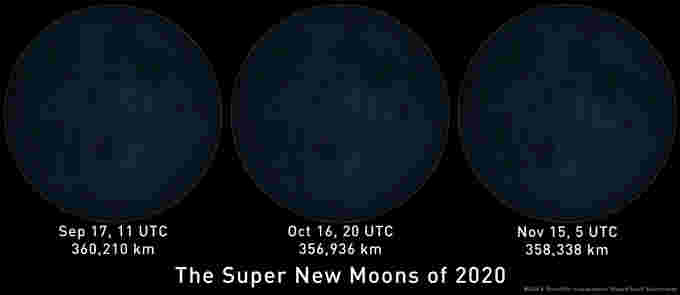
Not that anyone sees them, except during a solar eclipse, but there are three Super New Moons in 2020, as well – on September 16, October 16 and November 15.
WHY THE FASCINATION?
Since there are three of them, at least, every year, Super Moons are certainly not rare. It is often difficult to actually tell that the Moon looks bigger. So, why are Super Moons so compelling to us?
There are definitely more spectacular things to see in the night sky. Meteor showers, lunar eclipses and planetary alignments are just a few that happen on a fairly regular basis. Seeing the full splendour of a glittering sky of stars, with the Milky Way stretching from horizon to horizon, is absolutely awe-inspiring.
Nothing quite compares to the Moon, however.
Besides the Sun, the Moon is our most common and recognizable sight in the sky, day or night. While a Full Moon is a wonder to see, even the thinnest Crescent Moon is still an amazing sight to behold.
Even when we are standing under the brightest lights of the downtown core of a city, where the urban light pollution washes out all the stars and planets in the night sky, if the Moon is in the sky, it will still be clearly visible.
For this reason, the Moon is a very important part of our lives, especially for those who usually miss out on all the other astronomical events in a year. Quite simply, it is our most common point of connection with the universe beyond our planet.
So, when something about the Moon changes, or when it is exceptionally big and bright, it definitely attracts everyone’s attention.
RELATED: WHAT’S ON DECK FOR STARGAZERS AND SKYWATCHERS THIS SPRING?

Follow Canada News Media
Get the day's top Canadian stories and our two daily 60-second news videos wherever you scroll.
X Threads Facebook Instagram LinkedIn TikTok YouTube Pinterest Reddit Substack Flipboard Newsletter RSS