
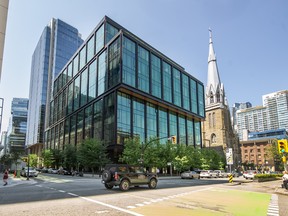
An attempt to sell of a pair of office towers in downtown Vancouver is being carefully watched by the commercial real estate world, and not just because Amazon.com Inc. is one of the primary tenants.
Ray Wong, vice-president of data solutions at Altus Group, a provider of asset and fund intelligence for commercial real estate, said the sale and rumoured price tag are attracting a lot of attention because the prime office complex is on the block as the broader office market across the country struggles in the face of rising interest rates and persistently higher vacancies due to remote work.
“That’s going to be the real test of where the office values are,” said Wong. “It is a brand-new building, right downtown, close to all the amenities, great tenant — so it’s going to be interesting to see what type of sale price that building goes for.”
Sales of premium office buildings have been scarce of late, especially since the U.S. banking crisis brought deeper scrutiny of the commercial real estate sector earlier this year. Publicly traded office holding have already seen their values plunge on speculation that sector is in trouble, but private and institutional investors have yet to take the same writedowns, in part because of a dearth of comparable sales from which valuations can be derived.
The private market is still behind in appropriately valuing office buildings today
Carl Gomez
REITs tend to hold lower quality office buildings in Canada than pension funds, said Carl Gomez, chief economist at commercial real estate analytics company CoStar, but there is nevertheless “a big disconnect” between public and private valuations for the assets when it comes to assessing both the impact of remote work and higher debt servicing costs driven by interest rate hikes.

“I would expect that as sellers they want a fulsome price, but … there are few barometers of what the valuation should be and what potential buyer expectations are for this type of product these days,” he said.
“I think the private market is still behind in appropriately valuing office buildings today.”
Gomez told the Financial Post in April that he is expecting a reckoning in private market valuations since remote work has proved to be a lasting trend rather than a short-term pandemic-driven event, a view he still holds.
But he noted that Canada’s large pension plans are well capitalized, so they have the wherewithal to be patient and flexible when it comes to managing their large real estate portfolios, even if they would like to reduce their exposures to underperforming segments of the market including office towers and retail complexes.
Better to sell your best in this environment than sell your worst and face added scrutiny
Carl Gomez
He said it is noteworthy that Oxford and CPPIB selected the fully leased and upgraded Amazon-occupied tower in what could be a pivotal transaction, Gomez said, adding that Vancouver is a city “where office market performance, while weaker, has been better than the rest of the country.”
“Better to sell your best in this environment than sell your worst and face added scrutiny,” he said.
The societal shift to hybrid and remote work has put hundreds of billions of dollars at stake, according to a July 13 report by international consultant McKinsey Global Institute.
In major cities around the world, office attendance has stabilized at 30 per cent below pre-pandemic levels, and is unlikely to return for decades, the report said, adding that “falling demand will drive down value.”
“The impact on value could be even stronger if rising interest rates compound it,” the McKinsey report said.
The impact on value could be even stronger if rising interest rates compound it
McKinsey Global Institute report
Global real estate advisor Avison Young in a spring report said that while vacancies in downtown Vancouver had climbed above 10 per cent for the first time since 2004, some newer office towers whose higher floors featured perks such as mountain views and private terraces had higher occupancy due to a “flight-to-quality” trend.
However, if the trends in private office transactions follow public market revaluations of office real estate, transaction prices will start to reflect an increase in a closely watched industry metric called the cap rate. Prices for commercial real estate come down as the cap rate, which reflects financing costs and rents coming from occupancy, goes up.
Recent transactions in the U.S., where market fundamentals including for lenders are arguable worse, the cap rate has risen to eight per cent, he said. In a scenario where a seller hopes to get $350 million for an office complex based on past assumptions of a cap rate of four per cent, but the market assesses the cap rate at eight per cent, the drop in value is about 50 per cent, putting the sale price at $175 million.
“This is just an example of how things work since its theoretical,” he said, adding that cap rates may not be revealed in every deal because buyers and sellers may not want to publicly reveal the building’s net operating income based on rents and costs, which is part of that calculation.
“Either way, the market will then take an educated guess as to what the cap rate for the deal would be given the price of the transaction and what they think NOI (net operating income) is,” Gomez said.
“That’s why this trade will have all eyes on it.”