



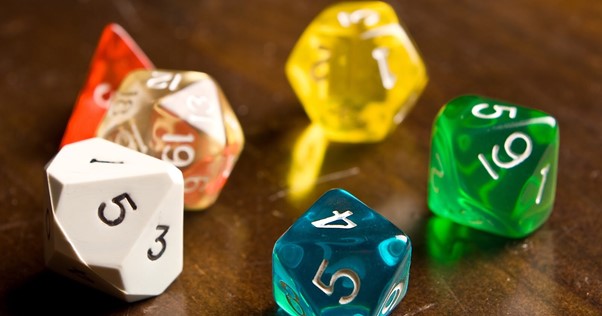
Mankind has been playing numbered cubes since before recorded history, and throughout the centuries, hundreds of games with dice were created. In Ancient Egypt, dice games were played before 3000 BC and up to the 2nd century AD, and even twenty-sided dice, or icosahedrons, were used. Different excavations in Middle Eastern settlements related to the Bronze Age unearthed a variety of game sets containing dice made from animal bones, with some findings dating back to 3100 BC. Other games involving dice are also mentioned in ancient Indian, Buddhist and biblical texts.
In ancient Greece, there was a game of skill played with dice that evolved into what we know today as knucklebones, or jacks. In the Roman Empire, gamblers used dice to play different games, in what was known as aleam ludere (to play at dice). There were two sizes of Roman dice: tali, which was a large die inscribed with 1, 3, 4 and 6 on four sides, and tesserae, a smaller die with all sides numbered 1 to 6.
Today, dice are used mostly as random number generators in a plethora of games, including tabletop games, board games, role-playing games, games of chance, and, of course, dice games. Whether we’re playing at a casino or at home with our friends, dice are a big part of our gaming lives.
However, despite being based on the same object, dice games can be really different from each other, varying a lot from region to region, influenced by local history and culture, and even by the environment. In this article, we present some of the most popular dice games in the world, and a few of their many intricacies.
Craps

Craps is certainly one of the most popular table games in the world today, being played at casinos in Asia, Europe and the United States. Based on an English game called Hazard, which may date back to the Crusades, Craps was originally a street game played in colonial Louisiana, and it was introduced by a young gambler, son of wealthy landowners, who learned Hazard in England, simplified its rules, and taught it to the local underclass.
Players bet on the outcome of dice throws – a player is designated the “shooter” to throw two dice – and there are different types of bets available. Playing Craps at a traditional casino can be really hard and intimidating to novice players, due to its many possible bets and outcomes. However, the game is offered by several online gaming operators, and playing online Craps is much easier, since most games feature a list of bets, screen guides and visual aids to help players get a better understanding of the game. Usually, these websites offer tables with different bet limits and payouts.
Sic bo
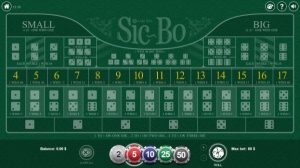
Sic bo, also known as tai sai, dai siu, or hi-lo, is a traditional Chinese game played with three dice. Sic bo means “precious dice”, and tai sai and dai siu mean “big or small”. Its origins are somewhat obscure, but it’s known to be over thousands years old, and an ancient variant was played by warriors during their relaxation period.
Just like Craps, Sic bo is also a casino game, and it’s very popular in Asia, especially in Macau, where the game is offered in almost every casino. In the United States, it was introduced by Chinese immigrants by the start of the 20th century, and since 2002, it can be found at casinos in the United Kingdom as well.
In Sic bo, players lay their wagers on different areas of a table divided into scoring boxes. Bets are made on different dice combinations, and the bets available vary from one casino to another. The dice are kept in a small chest that is shaken by the dealer before being opened to reveal the outcome. Sic bo is strictly a game of chance and there’s no strategy involved.
Dudo
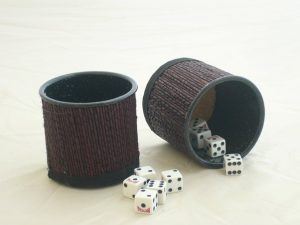
Dudo, also known as cacho, perudo, or pico, is a popular game in South America, played with five dice and a dice cup. It is thought to have originated in Spain and then taken to America by conquistadors and taught to the Incas. Dudo is a part of the family of dice games known as Liar’s Dice.
Each player starts the game with five dice and a cup that is used to shake and conceal the dice from the other players. After shaking the cup at the start of rounds, each player must guess how many dice on the table, including other players’ dice, are showing a certain number. The player who loses the round loses one die, and the last player to still have dice is the winner.
Follow Canada News Media
Get the day's top Canadian stories and our two daily 60-second news videos wherever you scroll.
X Threads Facebook Instagram LinkedIn TikTok YouTube Pinterest Reddit Substack Flipboard Newsletter RSS