


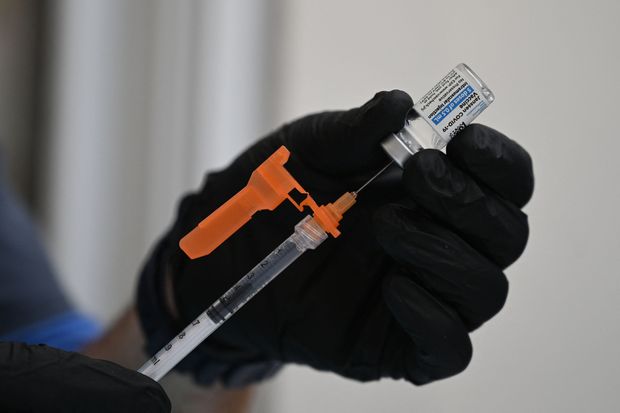

Johnson & Johnson stock is up 1.8% this year. Here, a syringe filled with the company’s Covid-19 vaccine.
Robyn Beck / AFP via Getty Images
An advisory panel of the Food and Drug Administration will meet later this week to consider whether the agency should authorize boosters of both the Moderna and Johnson & Johnson vaccines for Covid-19.
The FDA’s vaccines advisory committee is scheduled to consider the Moderna (ticker: MRNA) booster on Thursday and the
Johnson & Johnson
(JNJ) booster on Friday.
Committee members also will hear a presentation on a so-called mix-and-match booster, or a dose of a vaccine different from the original one.
The Centers for Disease Control and Prevention has scheduled meetings of its own vaccines advisory committee for Oct. 20 and 21 to consider the Moderna and Johnson & Johnson boosters.
The timing suggests the boosters could be rolled out late next week if both committees and their respective agencies line up in favor of the shots.
Currently, only the vaccine from
Pfizer
(PFE) and
BioNTech
is authorized for a booster, and only those who received that vaccine initially are eligible. The FDA authorized the booster dose on Sept. 22; the CDC director followed up with a recommendation two days later.
Under the CDC and FDA guidance, those who are eligible for a Pfizer booster must have received the second dose at least six months ago and must be 65 or older, or have underlying medical conditions, or work in a high-risk setting such as a hospital.
Of the 187.3 million fully vaccinated people in the U.S., 103.1 million received Pfizer’s vaccine as their initial dose, according to CDC figures. That leaves tens of millions who either received the Moderna or Johnson & Johnson vaccine and can’t receive a booster, even if they would qualify otherwise.
The exception is for people with certain immunocompromising conditions that leave them less likely to fully respond to the vaccine. They can take a third dose of the Pfizer or Moderna vaccine as part of their initial vaccination series.
In September, the CDC panel members talked of being conflicted about allowing only Pfizer recipients to receive boosters.
“I just don’t understand how …we can say to people 65 and older, you’re at risk for severe disease and death, but only half of you can protect yourselves right now,” Dr. Sarah Long, a professor of pediatrics at Drexel University College of Medicine, said at the time. “It doesn’t sound like a good public health policy.”
The FDA committee voted overwhelmingly against a broad rollout of the Pfizer vaccine before eventually signing off on a more limited rollout for seniors and anyone at high risk of severe illness. In an informal poll at the end of their meeting, the members indicated they supported boosters for healthcare workers as well.
The FDA ended up authorizing boosters for healthcare workers. The CDC committee members, in a tight vote, voted against allowing boosters for younger people based on their occupation, but the CDC’s director, Dr. Rochelle Walensky, overturned their decision.
In the end, the booster rollout looks far more like the broad campaign that the Biden administration had proposed than the one based on the initial FDA advisory committee votes.
In August, the White House laid out a plan—endorsed by both the CDC director and the acting FDA commissioner—that allowed all Americans to receive a booster beginning in late September.
The World Health Organization, meanwhile, has called for a moratorium on booster doses until the end of the year, pointing to the wide gap in vaccination rates between poor and developed countries.
Shares of the vaccine makers are up this year, although Moderna and BioNTech have dropped since Merck (MRK) announced last week that its oral antiviral performed well in a trial of high-risk adults with mild-to-moderate cases.
So far this year, Moderna is up nearly 200% and BioNTech is up just over 200%; Pfizer is up 14.4%.
Johnson & Johnson is up 1.8%, though the company is selling its vaccine at a not-for-profit price, and sales have no bearing on near-term earnings.
Write to Josh Nathan-Kazis at [email protected]

Follow Canada News Media
Get the day's top Canadian stories and our two daily 60-second news videos wherever you scroll.
X Threads Facebook Instagram LinkedIn TikTok YouTube Pinterest Reddit Substack Flipboard Newsletter RSS