


By the Numbers:
7818
People confirmed to be infected by the novel coronavirus
170
People who have died of novel coronavirus infection
19
Number of countries reporting novel coronavirus infections, including China
Source: World Health Organization Jan. 30, 2020 situation report
A novel coronavirus originating in Wuhan City, China has sickened more than 7,800 people and killed 170 since scientists first discovered it in December. The virus has spread to 18 countries outside of China and in 4 of those countries—including the US—there have been cases of human-to-human transmission. On Thursday, the World Health Organization declared the outbreak a public health emergency of international concern in hopes of helping nations stop the spread of the virus.
As research teams worldwide race to characterize the virus, called 2019-nCoV and also known as the Wuhan coronavirus, governments have taken drastic action to contain its spread. The residents of Wuhan City have been quarantined. Airlines have canceled some flights in and out of China, and several countries, including the US, have imposed an isolation period for anyone returning from the affected region. On Friday, the US government decided to quarantine 195 people who were evacuated from Wuhan to the US.
Here is what we know—and don’t know—about 2019-nCoV.
Where did 2019-nCoV come from?
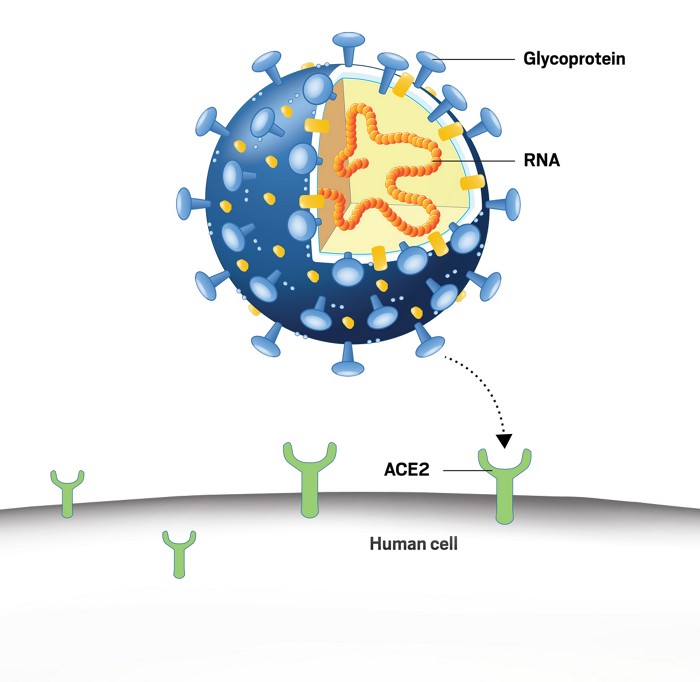
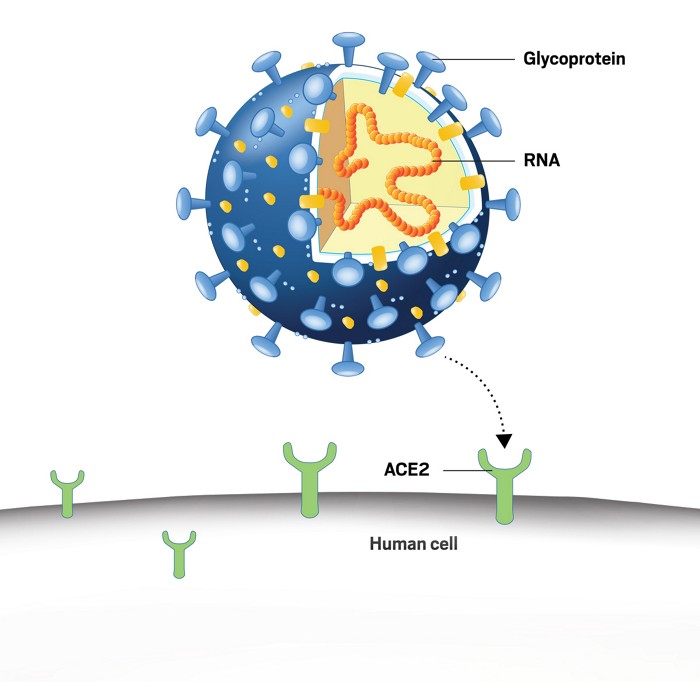
Coronaviruses are endemic to several species, and until 2019-nCoV popped up, there were five that could infect humans, says Tracey Goldstein, a wildlife infectious disease expert at the University of California, Davis. These spherical, 120–nm-wide viruses have an RNA genome that is relatively unstable, and mutates frequently.
Coronavirus infection
Credit: Scientificanimations.com/C&EN/Shutterstock
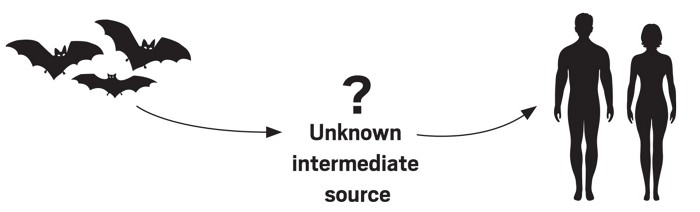
Goldstein says that 2019-nCoV is similar to the coronavirus that caused severe acute respiratory syndrome (SARS) in 2003, so it’s likely that transmission of the Wuhan virus is similar. Bats are the original reservoir for these viruses. Mutations to the viral genome allow a virus to infect a secondary animal, further mutations enable it to infect humans, and possibly more mutations allow it to quickly spread from human to human. The intermediate animal in the spread of the SARS virus was a cat-like creature called the civet. Researchers are still trying to figure out what the intermediate animal is for the Wuhan virus.
This novel coronavirus is thought to have originated in a “wet” market in Wuhan City where live and dead animals are sold. Scientists report that live animals available at the market just before the outbreak included seafood, hedgehogs, badgers, snakes, and birds (bioRxiv 2020, DOI:10.1101/2020.01.24.919183). These animal markets are considered a hot spot for cross-species transmission of viruses.
“The danger of zoonotic transmission was clear, so I was not completely surprised by the outbreak,” says Rolf Hilgenfeld, a researcher at the University of Lubeck who is currently in China to develop small-molecule inhibitors for coronaviruses. “But the timing was not predictable, and the magnitude is surprising.”
SARS also made its zoonotic jump to people in a Chinese “wet” market. Peter Hotez, an infectious-diseases expert at Baylor College of Medicine, says that the Chinese government had an opportunity to prevent this outbreak. “After SARS happened, the government’s plan was to outlaw them, but clearly that law was not enforced,” he says.
Hilgenfeld says that the SARS coronavirus and 2019-nCoV are similar. The part of the glycoprotein that binds human cells on the Wuhan coronavirus appears to be identical to the binding site of the SARS coronavirus glycoprotein, he says. Hilgenfeld and others think that the Wuhan virus likely attaches to the same cell-surface molecule as the SARS virus does, angiotensin-converting enzyme 2 or ACE2 (bioRxiv 2020, DOI: 10.1101/2020.01.26.919985).
Mode of transmission
Credit: C&EN/Shutterstock
What are the characteristics of the disease?
According to the Centers for Disease Control and Prevention, coronaviruses, in general, cause respiratory illness, with fevers, runny noses, coughs, and sore throats. This new coronavirus appears to be no different. Disease severity for 2019-nCoV has been variable, with some people requiring hospitalization and others reporting mild symptoms.
The World Health Organization reported that the novel coronavirus’ R0, which is a number that describes a disease’s spread, is between 1.4 and 2.5, meaning every infected person will, on average, infect about two more people. A team of researchers in China calculated the R0 as between 2.24 and 3.58 (bioRxiv 2020, DOI: 10.1101/2020.01.23.916395v2). The R0 of seasonal flu is about 1.4, but varies. For measles, it’s between 12 and 18.
The Chinese government is reporting spread between humans who are not showing symptoms of the disease, so some virus carriers might be missed in these calculations.
Some infected people are being treated with interferon and a combination HIV drug called Kaletra (iopinavir and ritonavir) sold by AbbVie. Researchers from the Chinese Academy of Sciences have published a list of drugs they say could work against the coronavirus’ main protease, including the antibiotic colistin, several antitumor drugs, and perphenazine, an antipsychotic. Knocking out the virus’s protease prevents it from successfully replicating. Hilgenfeld hopes to collaborate with local Chinese researchers to test his inhibitor of the coronavirus main protease inhibitor on cells in culture. This alpha-keto amide compound works against the SARS virus, so he thinks it will also work on the Wuhan coronavirus. He would still need to do clinical trials with the compound, so he has no illusions that his compound will be deployed during this outbreak.
Chemical & Engineering News
ISSN 0009-2347
Copyright © 2020 American Chemical Society
Advertisement

Follow Canada News Media
Get the day's top Canadian stories and our two daily 60-second news videos wherever you scroll.
X Threads Facebook Instagram LinkedIn TikTok YouTube Pinterest Reddit Substack Flipboard Newsletter RSS