

As 2021 comes to a close, the story of the year in real estate in Kawartha Lakes remains high prices and low inventory in a hot market.
“Sales number have probably been an all-time high and obviously prices as well” for the year, says Eugene McDonald, president of the Kawartha Lakes Real Estate Association, although he adds that the past month has seen a slight plateau, consistent with the time of year.
“It would seem that anything coming on the market that is reasonably priced and in reasonable condition is sold within a week.”
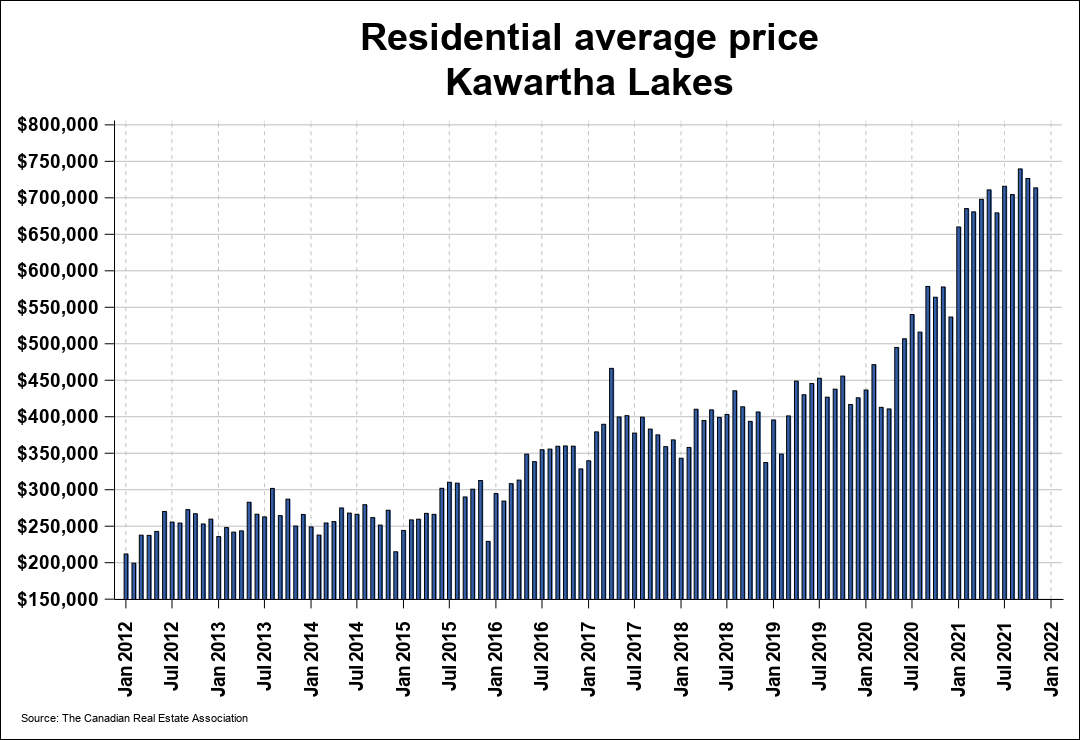
According to the most recent data available through the Canadian Real Estate Association, 1,460 homes have been sold in Kawartha Lakes in the first 11 months of the year, an increase of more than 13 per cent over the same period last year.
The MLS Home Price Index composite/single-family benchmark price for Kawartha Lakes homes in November sat at $658,700, up almost 34 per cent from the same month in 2020.
The total dollar value of homes sold set a record in November at $69.9 million, up more than 15 per cent from November 2020.
Meanwhile, the number of active residential listings in Kawartha Lakes plummeted to just 67 units by the end of November, the lowest for the month in more than three decades and down more than 42 per cent from November 2020 and more than 65 and 76 per cent below five- and ten-year averages respectively.
Months of inventory, or the time it would take to sell current inventory given market conditions, ended the month at just 0.7, compared to the long-run average of 3.5 at this time of year.
The competitive market continues to drive many potential buyers to submit offers with no conditions and still go up against multiple offers on most properties. McDonald says that many agents continue to hold offers for between four to seven days as a competitive strategy.
“It’s safe to say that a lot of them are going for $100,000 over asking,” says McDonald, adding that one farm property in the Oakwood/Little Britain area recently went for $1 million more than the asking price.
Out-of-town buyers are often coming in looking for a secondary getaway home for a few weeks a year, says McDonald, and using the property as an investment through short-term rentals for the rest of the year, especially waterfront properties because it is a very profitable business.
“They are coming in with cash offers and more money,” he says, noting that the scales have tipped toward seeing more buyers from outside the marketplace than from within it.
“It’s almost impossible for a first-time homebuyer unless they have $700,000 or $800,000, to come into the market.”
McDonald estimates that about 60 per cent of buyers in the current market do not live in Kawartha Lakes.

Another concern with the fast-paced local market, according to McDonald, is that he is seeing two to four properties bounce back onto the market every week or two because the winning buyer ultimately was unable to secure financing.
“The banks aren’t appraising them at the value they are offering,” he says, meaning that when buyers get carried away in a bidding war and end up offering much more on a house than the bank appraisal of the property, it becomes difficult to obtain financing, as the lender wants the difference covered to bridge the value gap.
Ultimately, given the extreme competitiveness of the current market, with conditions being thrown out the window, McDonald says having a good local real estate agent who knows the area on your side through the process is key, on both sides of the sale.
“As a seller, you want somebody that will protect your home and enforce the (COVID) protocols, and as a buyer, you want someone who will notice if something is wrong because they have that experience.”
Looking forward to 2022, McDonald says the market may be more of the same for a while.
“What we’ll probably see within the first six months is a similar market to what we have, and we’ll probably see it slow down for the rest of the year.”
McDonald notes that there are some international indications that interest rates may be going up in the coming year, causing some mortgages to move out of affordable range for some and financial institutions to be pickier when it comes to lending. If inflation doesn’t flatten out, McDonald predicts seeing higher interest rates kick in by April.