


After launching on Christmas, the James Webb Space Telescope is closing in on its new home 1 million miles from Earth. A gravitationally stable pocket known as the second Lagrange point, or L2, will keep the telescope in orbit for a planned five- to 10-year mission. The powerful infrared observatory is designed to study the origins of the universe, capture the formation of stars and look for chemical signatures that could signal life in other planetary systems.
Much of what astronomers have learned in the past three decades has come from the Hubble Space Telescope, the space-based observatory that has made more than 1.4 million observations since its deployment in 1990.
The Webb Telescope is designed to build on these observations.
Here’s an overview of the $10 billion Webb Telescope, what to expect as it prepares for its mission and some of the ways it compares with the Hubble.
The telescope’s namesake, James E. Webb, was NASA’s second administrator. The telescope was built by NASA with support from the European Space Agency and the Canadian Space Agency. The observatory’s Mission Operations Center is at the Space Telescope Science Institute (STScI) in Baltimore.
How Webb compares with Hubble
Though NASA prefers to call Webb the successor to Hubble – not a replacement – it’s difficult to not draw comparisons. Hubble data has been used in thousands of papers published in academic journals.
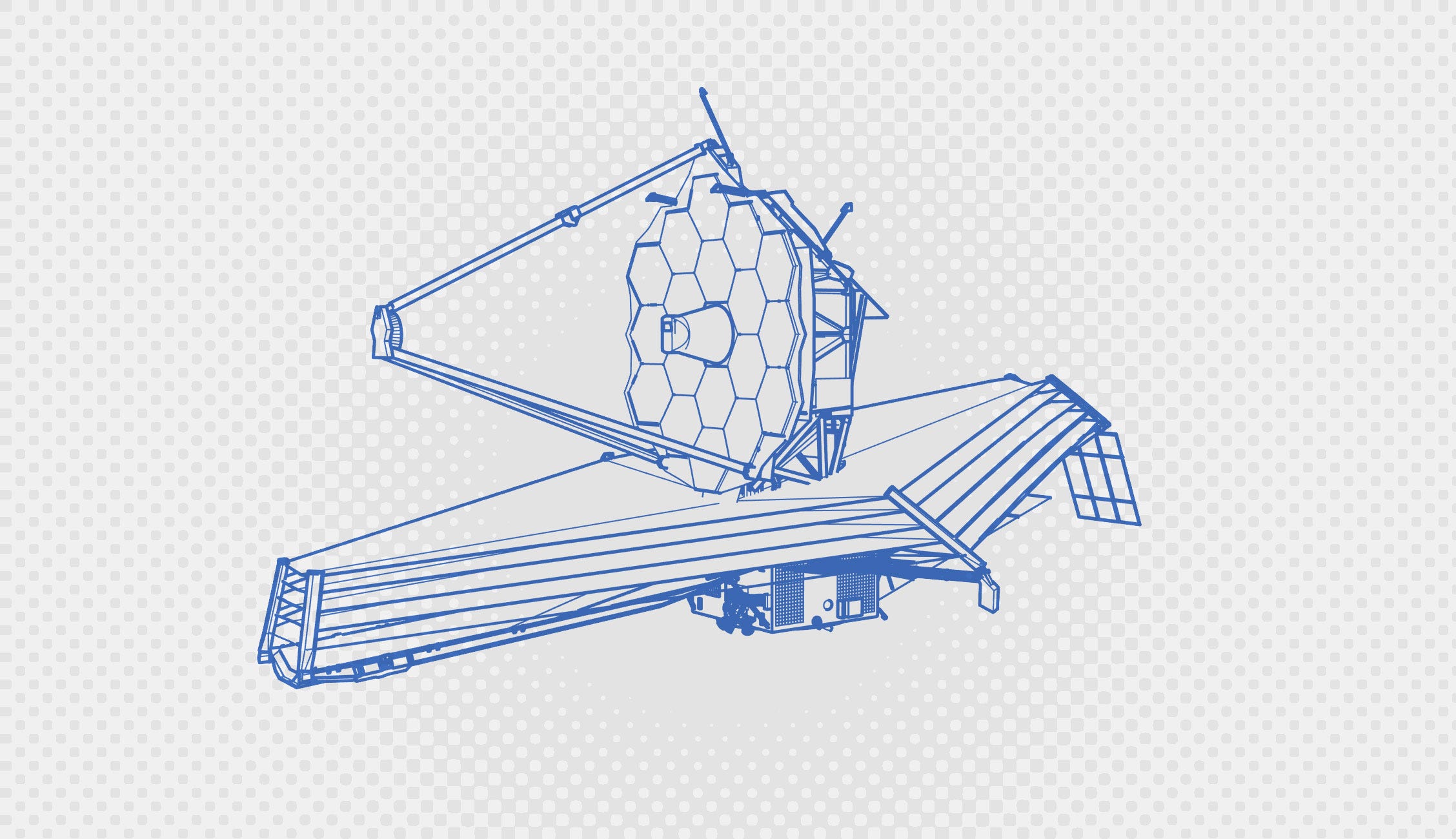
Roughly the size of a tennis court and three stories high, the Webb Telescope is the largest telescope ever sent into space.
Hubble is capable of reaching into a small piece of the infrared range of the electromagnetic spectrum – light from which is invisible to optical telescopes. The Webb Telescope is designed to perceive light from a large swath of the infrared. The Webb’s infrared capabilities will help astronomers peer into star-forming dust clouds and collect ancient, faint heat from galaxies that formed 100 million years after the Big Bang.
Because the Webb is designed for infrared research to detect the faintest of heat signatures emanating from distant galaxies, it needs to be kept cool. The mirrors and instruments are protected by a solar shield that blocks harmful light from the sun, Earth and the moon.
The temperature difference between the two sides is significant – the solar shield absorbs heat from the sun that warms the surface to about 230 degrees Fahrenheit, while the side with the instruments drops to around -390 degrees.
Webb’s mirror – made of 18 gold-coated hexagonal mirrors that fit together to form a single large mirror more than 21 feet high – is much larger than Hubble’s primary mirror and can collect more light.
The Webb’s vantage point
Unlike Hubble, which orbits 340 miles above the Earth, the Webb Space Telescope will orbit the sun, settling into a pocket a million miles from Earth called the second Lagrange point, or L2. This point balances the gravitational pull of the sun and Earth and will keep the Webb directly in line with the Earth as both orbit the sun.
To put itself into proper orbit, the last milestone for Webb’s journey is a mid-course insertion burn maneuver that will employ small on-board thrusters and propellant to overcome the initial thrust from the Ariane 5 rocket used in the launch and put the observatory into position in L2.
Though the remote positioning and its sunshield free the telescope from light and heat interference from the sun, Webb is too far away to manually service and upgrade. Hubble, by comparison, has been repaired and updated by astronauts on five separate servicing missions while in orbit.
What’s next?
After arriving in L2, Webb will turn on instruments and cool down to its cryogenic operating temperature in a roughly five-month process called commissioning. During this time, the Webb team will align the telescope’s optics and calibrate instruments.
[embedded content]
Published
2:11 pm UTC Jan. 16, 2022
Updated
2:11 pm UTC Jan. 16, 2022