



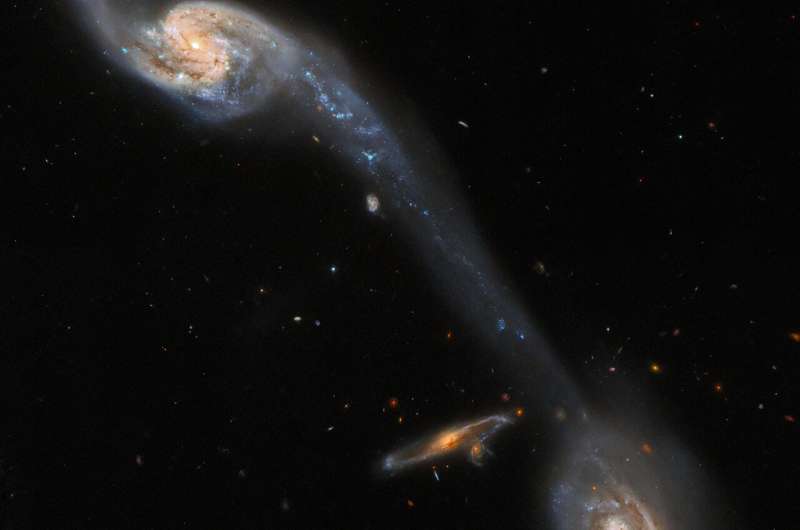
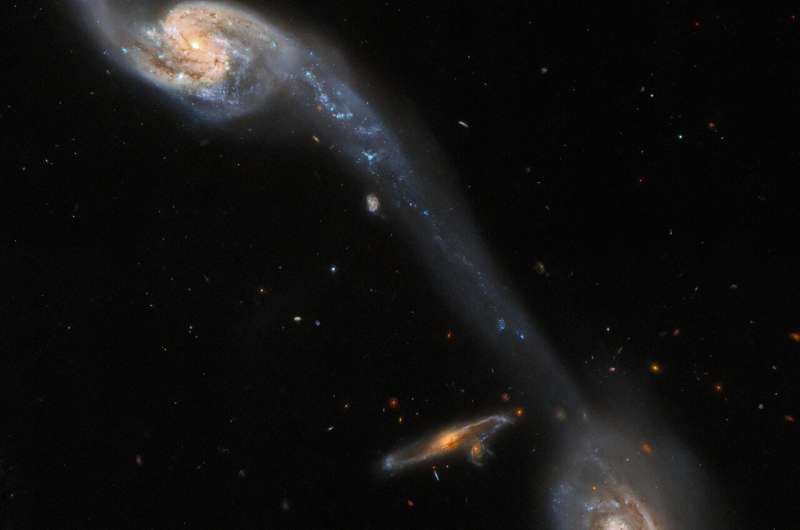
This image from the NASA/ESA Hubble Space Telescope shows two of the galaxies in the galactic triplet Arp 248—also known as Wild’s Triplet—which lies around 200 million light-years from Earth in the constellation Virgo.
The two large spiral galaxies visible in this image—which flank a smaller, unrelated background spiral galaxy—appear connected by a luminous bridge. This elongated stream of stars and interstellar dust is known as a tidal tail, and it formed by the mutual gravitational attraction of the two foreground galaxies.
This observation comes from a project which delves into two galleries of weird and wonderful galaxies: “A Catalogue of Southern Peculiar Galaxies and Associations,” compiled by astronomers Halton Arp and Barry Madore, and the “Atlas of Peculiar Galaxies,” compiled by Halton Arp. Each collection contains a menagerie of spectacularly peculiar galaxies, including interacting galaxies such as Arp 248, as well as one- or three-armed spiral galaxies, galaxies with shell-like structures, and a variety of other space oddities.
Hubble’s Advanced Camera for Surveys scoured this assortment of eccentric galaxies in search of promising candidates for future observations with the NASA/ESA/CSA James Webb Space Telescope, the Atacama Large Millimeter/submillimeter Array, and Hubble itself. With the wealth of astronomical objects to study in the night sky, projects such as this, which guide future observations, are a valuable investment of observing time.
Provided by
NASA’s Goddard Space Flight Center
Citation:
Hubble inspects two galaxies connected by a luminous bridge (2022, November 7)
retrieved 7 November 2022
from https://phys.org/news/2022-11-hubble-galaxies-luminous-bridge.html
This document is subject to copyright. Apart from any fair dealing for the purpose of private study or research, no
part may be reproduced without the written permission. The content is provided for information purposes only.