

:format(jpeg)/cloudfront-us-east-1.images.arcpublishing.com/tgam/FJP4JZQPLVFITJHXBYMSVGHLNM.jpg)
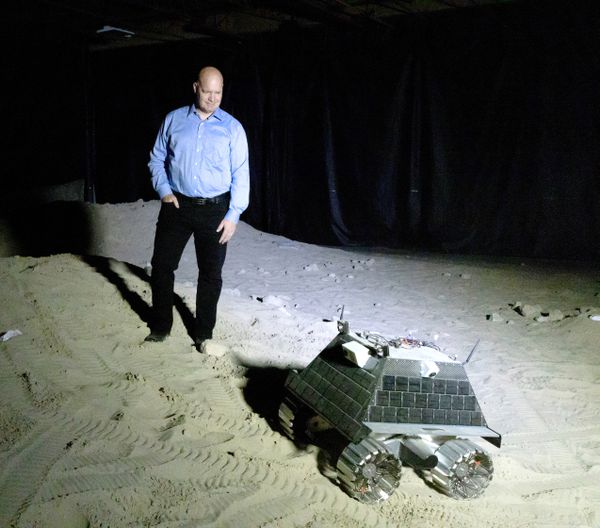
Christian Sallaberger, president and CEO of Canadensys Aerospace, with a prototype moon rover inside their lunar test environment in Stratford, Ont. on Aug. 15.Patrick Dell/The Globe and Mail
Canadensys Aerospace Corporation has been given the green light to build a lunar rover for Canada – a key step in the country’s first effort to lead a space science mission on another world.
The $43-million contract with the Bolton, Ont.-based company will cover the main design and building phase of the rover. The four-wheeled vehicle, which could launch as early as 2026, is designed to be operated remotely from Earth and carry a suite of science instruments to a landing site somewhere near the moon’s south pole.
“We’re breaking new ground,” said Caroline-Emmanuelle Morisset, planetary senior mission scientist at the Canadian Space Agency in Saint-Hubert, Que., after the selection was announced Monday. “And we really want the public to become as excited as we are about this mission.”
Dr. Morisset said the rover will face significant challenges once it is roaming around on the moon’s surface. Chief among them is the mission requirement that the rover survive at least one lunar night – a 14-day stretch in total darkness during which the solar-powered rover will be living on battery power, while enduring temperatures of about -200 C.
The hope, she added, is that the rover will perform the feat a few times, leading to a mission that lasts a few months and sets the stage for more ambitious follow ups.
Christian Sallaberger, president and chief executive officer of Canadensys, said that the chance to build a Canadian lunar rover was an opportunity the company has been working toward for years by building up its expertise in developing hardware – including motors, cameras and electronics – that can withstand the rigours of deep space.
Moon struck: How one Canadian company is helping to drive humanity’s lunar journey
The project “will impact virtually all of our staff,” he said. “I think this bodes well for the future, for having this kind of high-tech activity and industry in Canada.”
The rover mission is part of a larger effort by the U.S. space agency, NASA, and its international partners, including Canada, to focus human space exploration efforts on the moon over the next decade. NASA’s Artemis I mission, which is a test of a new rocket and capsule system designed to bring astronauts down to the lunar surface, is set to lift off early Wednesday morning.
A subsequent mission will include a Canadian astronaut when it makes its first crewed flight around the moon, though it will not include a lunar landing. Meanwhile, the Canadian rover is part of a parallel NASA program in which technology and science missions involving private sector partners will be sent to the moon on commercial launchers. In exchange for a ride to the moon, one of the six science instruments the rover carries will be provided by NASA.
That instrument has yet to be determined. Canada’s five science contributions to the rover include instruments that can assess the composition of lunar minerals in situ, measure radiation levels and attempt to assess the quantities and distribution of water trapped as ice in permanently shadowed areas – particularly near the moon’s south pole, where deep crater and the low angle of the sun creates many such areas.
“There are a lot of really neat science questions that we hope to address in that south polar region,” said Gordon Osinski, a professor of planetary science at Western University in London, Ont., and principal science investigator with the newly awarded rover mission.
Dr. Osinski said the minerals found in the extreme south of the moon are expected to be different from those near the equator, where U.S. astronauts landed and gathered samples more than 50 years ago. Of particular interest is the first half billion years of lunar history, when the moon was undergoing heavy bombardment from asteroids.
The same would have been true on Earth, he added, but that early period has long since been obliterated from the planet’s geological record – leaving the moon as the best place to search for clues to Earth’s earliest chapters.