





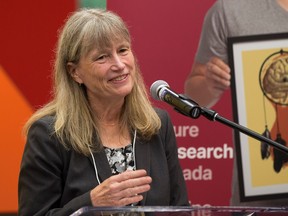
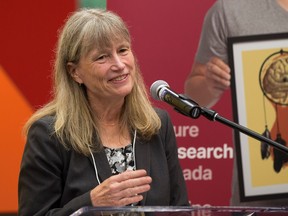
Jarvis spoke Wednesday as the Alberta Women’s Health Foundation (AWHF) released a new report showing how “taboos” in women’s health contribute to real medical issues being dismissed or misdiagnosed.
“In terms of research in women’s health, there is a disturbing lack of knowledge and care from many, but not all, doctors.”
The report, Surveying the Silence: Exploring the Taboos in Women’s Health, surveyed 2,200 Albertans, the vast majority of whom identify as women. The report notes that the health issues being examined also applies to transgender men and non-binary people who were assigned female at birth.
Data was collected over several weeks last summer, with participants being invited to take part through an online panel.
Women and Children’s Health Research Institute executive director Dr. Sandra Davidge said there can be a perception that “women’s health” is limited to the time around pregnancy, but there are so many more issues that can affect quality of life.
Nearly two-thirds of the survey respondents said they find it difficult to talk to health providers about their pelvic and gynecological concerns, and only about one-quarter said they find their doctor “very knowledgeable” about gynecological and reproductive health.
The report describes how the continuing social unacceptability of speaking openly about things like periods and menopause leads to not only a general lack of awareness, but normalizing symptoms that could actually be cause for concern.
“Many women have had their symptoms dismissed by loved ones and health professionals as, ‘Just part of being a woman,’ driving them towards isolation and hopelessness and even leading some to consider suicide,” the AWHF document says.
“The key to this is breaking down these stigmas and enhancing education for women so they know pathways to care,” she said, adding there also needs to be further support for research, as well as good education for health-care providers.
Jarvis said doctors need to ensure they’re equipped to provide good care, but she said it’s important to fight against the ingrained stigma in their own communities.
“Believe yourself. Believe what you’re feeling, what you’re seeing, what you’re noticing,” she said.
“You have to be a very active advocate. The reality is no one can advocate for you better than you. So you have to be the one to stand up and ask the questions.”


