





(Bloomberg) — The Federal Reserve held the line on interest rates while the European Central Bank pushed on, and both of the central banking heavyweights signaled a likelihood of further hikes.
Here are some of the charts that appeared on Bloomberg this week on the latest developments in the global economy:
US
Fed officials paused following 15 months of interest-rate hikes but signaled they would likely resume tightening to cool inflation, projecting more increases than economists and investors expected. Fresh quarterly Fed forecasts showed borrowing costs rising to 5.6% by year end, according to the median projection. That’s higher than the 5.1% in the previous round of projections.
Europe
The ECB lifted interest rates by another quarter-point, with President Christine Lagarde describing a further hike in July as “very likely.” The deposit rate was raised to 3.5% on Thursday — the highest level in more than two decades. Fresh quarterly projections from the ECB suggested inflation will moderate more slowly than previously envisaged. Economic expansion in the 20-nation euro zone is seen a little weaker following recent data revealing a mild winter recession.
British wages shot up and unemployment fell unexpectedly in April, the latest signs that the resilient UK economy continues to defy efforts to cool demand and dampen inflationary pressures.
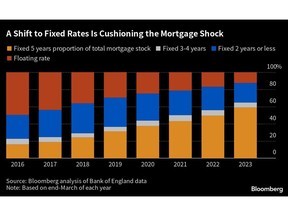
A shift in Britain’s mortgage market is delaying the impact of higher interest rates on the economy, increasing the risk of the Bank of England fumbling its decision on how much more it needs to do to curtail inflation.
Asia
China’s weakening economy prompted the central bank to cut interest rates for the first time since August, and expectations are growing for more stimulus targeted at ailing industries including the property sector. Official data showed a slump in real estate, a worrying decline in business investment and record joblessness among young people.
China’s indebted local governments are increasingly imposing controversial fines on residents in a bid to generate revenue, stoking anger among social-media users. Guangxi alone made 13 billion yuan ($1.8 billion) from fines last year, according to an analysis of government data by Caijing Industry Research Center — equivalent to about 14% of its tax income, rising from 9% in 2021.
New Zealand led the world in raising interest rates to combat the post-pandemic inflation wave. Now it’s officially in recession in a possible harbinger of what lies ahead for others. Gross domestic product fell 0.1% from the fourth quarter, when it dropped a revised 0.7%.
Just 30 miles (50 kilometers) offshore from Caracas lie the Western Hemisphere’s second-largest reserves of natural gas. Yet Venezuela has never exported a molecule of that fuel. Now, with the nation’s oil industry in tatters, President Nicolas Maduro is kicking off a long-shot bid to tap those vast deposits to revive an economy devastated by defaulted debt, rampant inflation and crippling US sanctions.
World
The Fed and ECB headlined this week’s central bank meetings. The Bank of Japan decided to stick with ultra-low rates, and Taiwan’s central bankers kept their key rate on hold for the first time since 2021.
—With assistance from Andrew Atkinson, Diederik Baazil, Matthew Brockett, Sophie Caronello, Rebecca Choong Wilkins, Lucille Liu, Yujing Liu, Yoshiaki Nohara, Reade Pickert, Jana Randow, Tom Rees, Garfield Reynolds, Zoe Schneeweiss, Alexander Weber, Lucy White, Erica Yokoyama, Xiao Zibang and Fabiola Zerpa.


