

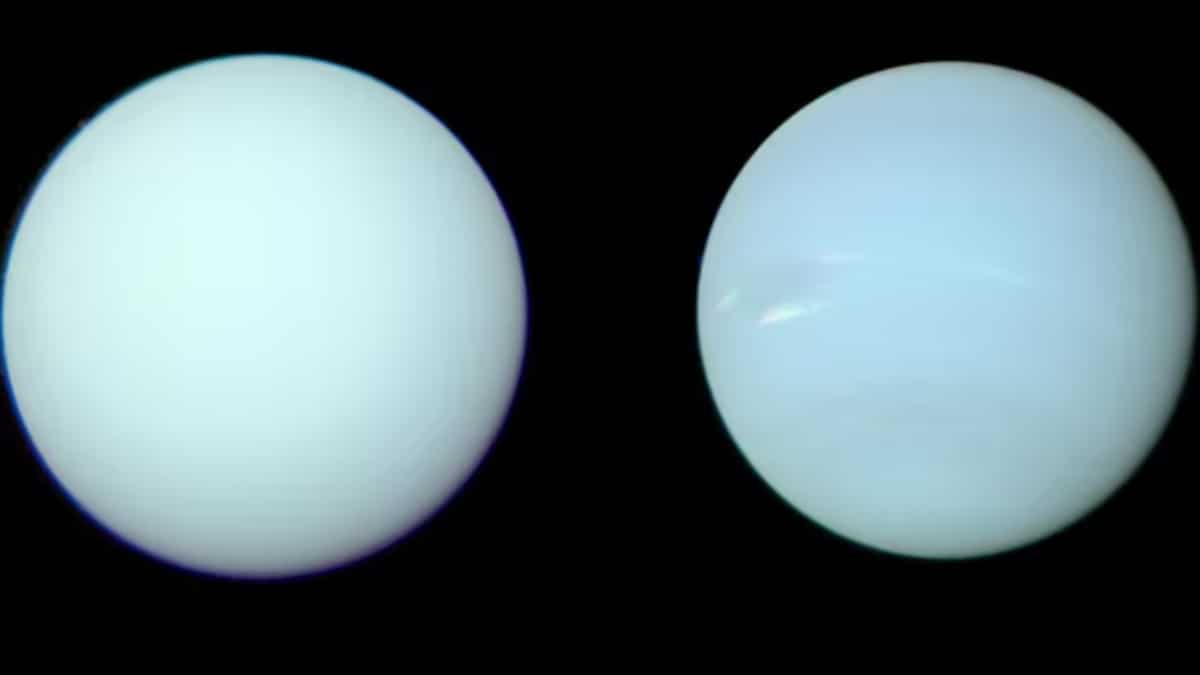

In a new revelation, the researchers have found that the true colours of Neptune and Uranus are very similar and not starkly different as was believed earlier.
NASA’s Voyager 2 mission, which had carried out flybys of Uranus in 1986 and Neptune in 1989, was able to capture the first detailed images of the two ice giants in our solar system. Voyager 2 is the only spacecraft which has flow near both planets.
In the image captured, Uranus had a pale cyan colour and Neptune was seen having a striking deep blue colour. The images of each planet were captured by Voyager 2 in separate colors and the researchers combined single-colour images to create composites. Meanwhile, Neptune’s images were enhanced to display the white clouds and winds in the atmosphere of the planet.
trending now
Speaking about the research, the first author of the study at the University of Oxford Prof Patrick Irwin said, “Uranus is still bland and rather boring looking, but Neptune looks fairly washed-out as well when you do the full true colour reconstruction.”
‘Most accurate representation of planets’
It has been known for long that the colour of the ice giants is a result of the high amount of methane present in the atmosphere of the planet. Methane is known to absorb green and red light. It was previously suggested in research by Irwin and colleagues that Neptune was slightly bluer in comparison to Uranus because the aerosol present in one of the layers of its atmosphere was more transparent.
Watch: All about NASA’s PACE mission to study Earth’s clouds & oceans
However, the images of the planets, which were created from data collected during flybys conducted by the NASA Voyager 2 spacecraft in the 1980s, have created a misconception about the true colours of the planets. In those images, Neptune has been depicted as being deep blue since the images were contrast-enhanced to highlight its fainter features.
“Although the familiar Voyager 2 images of Uranus were published in a form closer to ‘true’ colour, those of Neptune were, in fact, stretched and enhanced, and therefore made artificially too blue. Even though the artificially-saturated colour was known at the time among planetary scientists—and the images were released with captions explaining it—that distinction had become lost over time. Applying our model to the original data, we have been able to reconstitute the most accurate representation yet of the colour of both Neptune and Uranus,” said Professor Irwin.
(With inputs from agencies)