
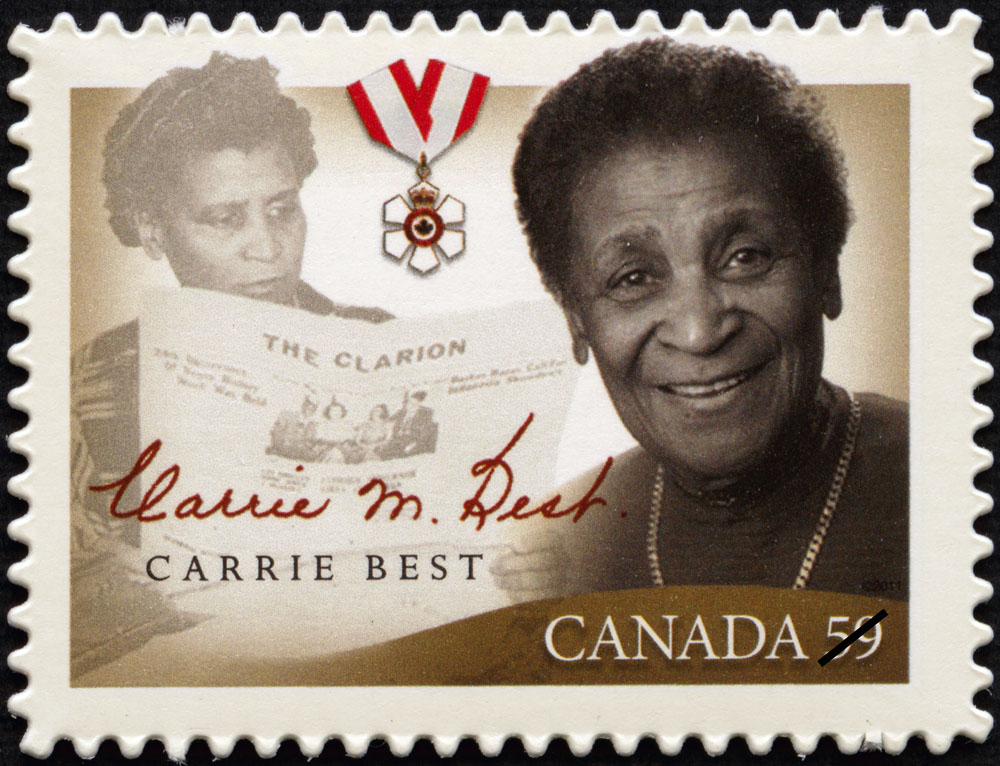
As we commemorate Black History Month in 2025, it is vital to honour the trailblazers who have fought for civil rights and the empowerment of Black Canadians. Among these notable figures is Carrie Best, an indomitable force who dedicated her life to advancing human rights and racial equality in Canada. Born on March 4, 1903, in New Glasgow, Nova Scotia, Carrie Best emerged as a fearless advocate, journalist, and community leader, whose legacy continues to inspire generations.
Carrie Best was the daughter of James and Georgina Ashe Prevoe and grew up in a Canada deeply marked by systemic racism. Her life’s work stands as a testament to the courage, resilience, and passion she carried into the many battles she fought on behalf of Black Canadians. Her story is one of resistance against segregation and a relentless drive to amplify the voices of marginalized communities.
Defying Segregation: The Roseland Theatre Incident
Carrie Best’s activism came to the forefront in the 1940s during one of the most blatant displays of segregation in her hometown. Best and her son, J. Calbert Best, were arrested for challenging the whites-only seating policy at the Roseland Theatre in New Glasgow. Both mother and son were charged with disturbing the peace, convicted, and fined. Despite the personal cost, Carrie Best’s act of defiance in the face of racial discrimination was a precursor to her lifelong commitment to fighting injustice.
“I had to take a stand for what was right, even if it meant being persecuted,” Best once said. “Our fight for equality couldn’t wait for someone else to come along.”
Establishing The Clarion: The First Black-Owned Newspaper in Nova Scotia
Determined to have a platform to speak out against racial injustices, Carrie Best founded The Clarion in 1946, the first Black-owned and published newspaper in Nova Scotia. Through The Clarion, Best became a voice for the Black community, shedding light on the systemic issues affecting Black Canadians and providing an outlet for stories that were often overlooked or intentionally ignored by mainstream media.
The Clarion tackled topics such as racial segregation, discriminatory laws, housing issues, and employment inequalities. The paper served as a crucial tool for raising awareness about the rights of Black Canadians and advocating for social change. Best’s bold reporting and editorial leadership made her a central figure in the fight against racial injustice.
“People like Carrie Best were the pioneers, using whatever platforms they had to speak truth to power,” says Dr. Sheila Brooks, a historian specializing in Black Canadian history. “Her newspaper was more than a publication—it was a rallying cry for equity and justice.”
Expanding Her Voice: Radio and Columns
In 1952, Carrie Best expanded her reach by launching her own radio show, The Quiet Corner, which aired for 12 years. The program was broadcast across Canada’s Maritime Provinces on four different radio stations, further amplifying Best’s influence. The show provided a space for thoughtful reflection and discussions on race relations, human rights, and the experiences of Black Canadians in the broader society.
Best’s voice was not confined to print and radio alone. In 1968, she became a columnist for the Pictou Advocate, where she continued to challenge racism and advocate for the advancement of civil rights. Her column, titled Human Rights, ran until 1975, cementing her reputation as a champion for social justice.
In her writings, Best often highlighted the systemic barriers Black and Indigenous communities faced in Canada. Her work wasn’t just about reporting the news—it was about creating a space for marginalized voices to be heard.
“The way she used media to confront injustice is incredible,” says journalist Ayanna Johnson. “Carrie Best understood the power of storytelling in fighting oppression. She’s a role model for all of us working to make our society more equitable.”
Recognized for Her Tireless Efforts
Carrie Best’s impact on Canadian society did not go unnoticed. Over the course of her life, she received numerous awards and honours for her work in race relations and civil rights advocacy. These accolades include:
- Member of the Order of Canada (1974): Best was recognized for her lifelong dedication to human rights and her commitment to improving race relations in Canada.
- Officer of the Order of Canada (1979): This further cemented her position as one of Canada’s most influential civil rights leaders.
- The Queen Elizabeth Medal (1977): A prestigious award highlighting her significant contributions to Canadian society.
- Honorary Doctor of Civil Laws (D.C.L.) from the University of King’s College, Halifax (1992): Recognizing her trailblazing work in journalism and advocacy.
Beyond these recognitions, Carrie Best founded the Kay Livingstone Visible Minority Women’s Society of Nova Scotia in 1975, continuing her mission to uplift underrepresented communities.
Legacy of Carrie Best: A Role Model for Future Generations
Carrie Best’s life was one of extraordinary achievement, but perhaps her most enduring legacy is the path she paved for future generations of Black Canadians, especially Black women, who seek to fight for equality and justice. Her determination to challenge racism and systemic oppression resonates deeply with those who continue the fight today.
“Carrie Best was an inspiration to so many of us growing up in Nova Scotia,” says activist and educator Dr. Wanda Thomas Bernard. “She showed us that, despite the obstacles, we could make a difference and push for real change in our communities. Her courage and conviction are a reminder that we must continue the work she started.”
In celebrating Carrie Best during Black History Month 2025, we are reminded that her story is not just one of individual achievement, but of collective progress in the ongoing fight against racism. Her work has had a lasting impact on Canadian journalism, civil rights, and social justice. As we reflect on the struggles and triumphs of Black Canadians, Best’s life serves as a reminder that the fight for equality is far from over.
Looking Forward: Continuing the Work in 2025 and Beyond
As Black History Month 2025 unfolds, the story of Carrie Best is as relevant as ever. The struggles she faced and overcame are echoed in the ongoing challenges confronting Black Canadians today, from systemic racism to inequities in education, employment, and housing.
“It’s important that we continue to uplift stories like Carrie Best’s,” says Toronto-based activist Marsha McGregor. “Black Canadians have contributed so much to this country, but our histories are often sidelined. By celebrating Carrie Best, we honour not only her legacy but the countless others who have fought—and are still fighting—for justice.”
As we continue to confront issues of racism, representation, and equity in Canada, the example set by Carrie Best will remain a guiding light. Her courage, leadership, and commitment to change have left an indelible mark on Canadian society, and her story will continue to inspire future generations in the pursuit of justice and equality.
Carrie Best’s Most Important Achievements:
- Member of the Order of Canada (1974)
- Awarded the Queen Elizabeth Medal (1977)
- Officer of the Order of Canada (1979)
- Honorary Doctor of Civil Laws (D.C.L.) from the University of King’s College (1992)
- Founded the Kay Livingstone Visible Minority Women’s Society (1975)
- Inducted into the Nova Scotia Black Wall of Fame (1980)
- Received the Harry Jerome Award (1986)
- Awarded the Black Professional Women’s Group Award Certificate (1989)
- Received the Nova Scotia Human Rights Commission Award (1991)
Carrie Best passed away in July 2001 in New Glasgow, but her legacy lives on as we continue to celebrate her life and work as part of Black History Month 2025.