
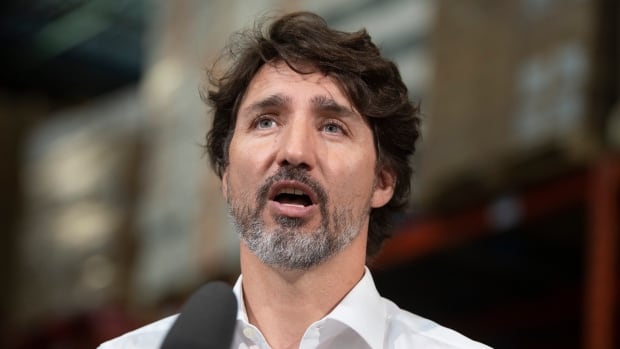

The federal government will provide $19 billion to the provinces and territories to help fund a “safe restart” of the Canadian economy, Prime Minister Justin Trudeau said today.
The direct transfers will help those governments cover some of their budgetary costs over the next six to eight months as they reopen their economies and prepare for a possible second wave of COVID-19.
“COVID-19 isn’t just a health crisis. It’s an economic crisis, too,” Trudeau said at a press conference on Parliament Hill.
“When we talk about the recovery phase, it’s not just about making sure we can detect, control and prevent future outbreaks. It’s also about helping people, businesses and entire communities adjust to our new normal.”
Trudeau said the money will focus on seven priority areas, including enhanced COVID-19 testing and contact tracing, the purchase of personal protective equipment (PPE) for front line workers and businesses, funding for municipalities, a national sick leave plan and child care so that parents can get back to work.
Some of the money will go toward improving the state of long-term care, and to fund mental health services and tackle homelessness.
Provinces agree to conditions for spending
The deal comes after weeks of at-times testy negotiations between the Liberal government and the provinces and territories. In those negotiations, which were led by Deputy Prime Minister Chrystia Freeland, the federal government wanted specific amounts earmarked for certain priorities, while the provinces wanted fewer strings attached to the funding.
Trudeau said the provinces agreed to conditions that will prevent them from taking money designated for one priority area and spending it on another.
“We managed to get to an agreement where the money that is designated for safe child care spaces, for example, the money that is designated for PPE, the money that is designated for testing and contact tracing, actually will get spent in those areas,” said Trudeau.
Trudeau said the federal government recognizes that there may a need for more funding beyond the next six to eight months, especially given that the development of a vaccine could be far off.
“We will continue to work hand in glove with the provinces and territories to make sure that, every step of the way, Canadians are supported in both their health needs but also in the relaunching of the economy,” Trudeau said.
Trudeau previously pledged $14 billion — but many premiers said that amount was not nearly enough to cover their needs.
The Canadian Federation of Municipalities said in April that cities alone are facing a $10 to $15 billion shortfall due to a loss of revenue from property taxes, utility charges and transit fees.
Trudeau also confirmed that the agreement to restrict travel across the Canada-U.S. border will be extended into August.

Follow Canada News Media
Get the day's top Canadian stories and our two daily 60-second news videos wherever you scroll.
X Threads Facebook Instagram LinkedIn TikTok YouTube Pinterest Reddit Substack Flipboard Newsletter RSS