



The latest:
What you need to know today in Alberta:
Alberta has placed two orders for 1.7 million masks, valued at a total of $4.2 million, with Old Navy and IFR Workwear.
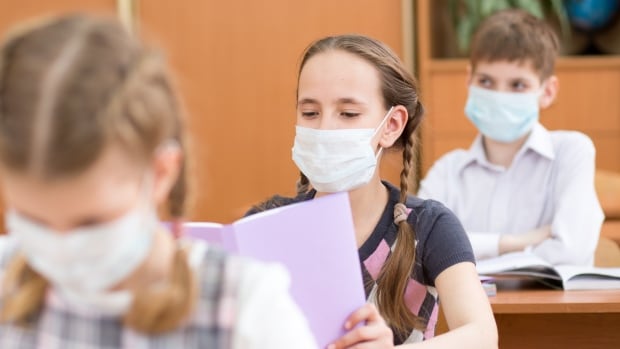
Last week, the Alberta government announced that masks will be mandatory for all school staff and most Alberta students when they return to school in September.
Students from Grades 4 through 12 will be required to wear masks in all public spaces and can choose to wear them while seated in the class. Masks will be optional for younger students.
Education Minister Adriana LaGrange said in an emailed release on Saturday that “some have recently questioned the ability” of the provincial government to purchase the needed number of masks in time, adding that the government approached “experienced, established vendors” to ensure the masks would arrive before classes resume.
The Alberta government has announced $48 million in funding for shelters and community organizations that have been serving homeless people during the COVID-19 pandemic.
A bylaw passed on Tuesday makes face coverings compulsory on most of Jasper’s downtown sidewalks and in outdoor public places where a two-metre distance can’t be maintained. Jasper joins Banff in making masks mandatory in some outdoor areas.
We’ve curated a list of towns and cities in the province, outlining their corresponding policies on masks. We’ll try to keep it updated regularly.
Here’s a regional breakdown of active cases across the province as of Aug. 7:
- Calgary zone: 368 cases.
- Edmonton zone: 329 cases.
- Central zone: 224 cases.
- North zone: 111 cases.
- South zone: 90 cases.
- Unknown: 3 cases.
What you need to know today in Canada:
Ontario has reported its sixth-straight day of fewer than 100 new cases of COVID-19, with 70 new cases reported Saturday and one new death.
The province has seen nearly 40,000 cases of the virus and 2,784 deaths. Hospitalizations and ICU admissions also continue to decline in the province.
The federal government has entered into two agreements to secure millions of doses of potential COVID-19 vaccines. Public Services and Procurement Minister Anita Anand announced that the Government of Canada has agreements with Pfizer and Moderna.
New data shows thousands of Canadians were hospitalized or died after deliberately harming themselves last year, and experts fear the numbers will climb due to stress brought on by the pandemic.
Physical distancing and mask-wearing could be necessary for two or three years even with vaccine, according to Canada’s chief public health officer, Dr. Theresa Tam.
Survey results released on Tuesday from the non-profit Angus Reid Institute found half of Canadians say they have no reservations and are ready to get a COVID-19 vaccination as soon as it’s available.
But 32 per cent — roughly a third of respondents — say they’d likely wait a while. Another 14 per cent don’t want to get a vaccine at all.
The number of large Canadian businesses seeking protection from creditors hit its highest point in more than a decade in May and June, and experts say the trend will likely continue because of COVID-19.
The Canada-U.S. border could be closed for months. The federal government has already announced that the border will remain closed at least until Aug. 21, but several experts told CBC News that they predict the border won’t open until sometime next year.
According to a Leger Marketing poll of 1,500 Canadians conducted last month, 86 per cent of respondents said they were opposed to the idea of reopening the border at the end of July.
As Quebec begins to allow as many as 250 people to gather at indoor public events, up from 50, doctors are circulating a petition to reverse what they say is an unnecessary, dangerous move. Public health experts in Quebec say a second wave is coming.
As of 10:15 a.m. ET on Sunday, Canada had 119,404 confirmed and presumptive coronavirus cases. Provinces and territories listed 103,715 of those as recovered or resolved. A CBC News tally of deaths based on provincial reports, regional health information and CBC’s reporting stood at 9,017.
Self-assessment and supports:
Alberta Health Services has an online self-assessment tool that you can use to determine if you have symptoms of COVID-19, but testing is open to anyone, even without symptoms.
The province says Albertans who have returned to Canada from other countries must self-isolate. Unless your situation is critical and requires a call to 911, Albertans are advised to call Health Link at 811 before visiting a physician, hospital or other health-care facility.
If you have symptoms, even mild, you are to self-isolate for at least 10 days from the onset of symptoms, until the symptoms have disappeared.
You can find Alberta Health Services’ latest coronavirus updates here.
The province also operates a confidential mental health support line at 1-877-303-2642 and addiction help line at 1-866-332-2322, both available 24 hours a day.
Online resources are available for advice on handling stressful situations and ways to talk with children.
There is a 24-hour family violence information line at 310-1818 to get anonymous help in more than 170 languages, and Alberta’s One Line for Sexual Violence is available at 1-866-403-8000, from 9 a.m. to 9 p.m.