


The latest:
- Rising COVID-19 cases sparks debate over what appropriate response to second wave should be.
- B.C. chief provincial health officer says she’s received death threats during pandemic.
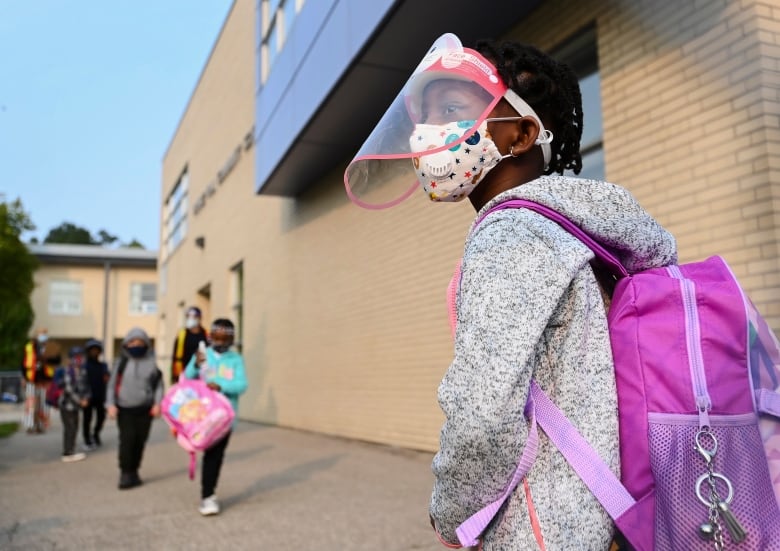
- One in 10 students in Hamilton public schools aren’t wearing masks, Hamilton Wentworth-District School Board says.
- Pandemic slashes worldwide income from work by a tenth, International Labour Organization finds.
- U.K. government defends strategy for combatting a second wave from criticism that restrictions don’t go far enough.
The recent surge in COVID-19 is sparking debate around what the appropriate response is to a coronavirus second wave and how to keep the economy open while reducing community spread of the virus.
With Ontario reporting its highest daily number of COVID-19 cases since early May on Tuesday, there are mounting calls for the government to take more actions to slow the spread of the virus now, in an effort to avoid a full-scale lockdown later.
The province is facing rapid growth in coronavirus infections. The average number of new cases reported daily over the past week was 383, double what it was just nine days earlier. The daily case count has exceeded 400 on four of the past five days.
On Wednesday, the province reported 335 new COVID-19 cases, marking a considerable drop from the previous two days.
“The premier and I are both very concerned about the rapid increase in numbers, as I know the people of Ontario are, but we do have a plan,” Health Minister Christine Elliott said Tuesday.
But Elliott and Premier Doug Ford did not announce any new public health measures yesterday to try to rein in those numbers.
WATCH | New lockdowns possible if Canada’s COVID-19 surge continues, say health officials:
They did unveil one element of Ontario’s promised COVID-19 fall preparedness plan — the province’s upcoming flu vaccination campaign. The government intends to roll out the rest of its fall plan piece-by-piece over the coming days. The ostensible reason for the gradual reveal is that the plan is so big that the public wouldn’t be able to absorb it all at once.
Meanwhile, Toronto city councillors say they are committed to avoiding tax hikes or service cuts in the face of a bleak new report on the city’s financial health, though averting those measures will require major funding from the provincial and federal governments.
A new city report that analyzed the first half of 2020 projects a shortfall of $1.34 billion by the end of the year. The figure is largely attributed to a combination of lost revenue and increased spending to combat the novel coronavirus during the spring and summer.
The report and measures to lift the city out of its dire financial situation are expected to be discussed Wednesday at Mayor John Tory’s executive committee.
WATCH | Jump in COVID-19 cases ‘very alarming,’ says respirologist:
“I think we are going to get through it, but it is going to be a very long, hard road ahead,” said Coun. James Pasternak, who sits on the executive committee.
And in Quebec, a similar problem is presenting itself as the province sees large spikes in cases: that is, how to keep things open while stopping the virus’s spread in the community?
On Tuesday, the province recorded 489 new cases today, and the number of hospitalizations increased by 20.
In response to the rising numbers, more regions in Quebec will be facing stricter restrictions as new cases and hospitalizations rise in the province.
WATCH | Why Outaouais is now an orange zone in Quebec’s COVID-19 rating system:
Quebec’s Laval and Outaouais regions will be under “moderate alert,” or the orange alert level, said Quebec Health Minister Christian Dubé at a news conference Tuesday. The Centre-Quebec region will move from green alert to yellow alert, he said.
“Primarily, the situations responsible for outbreaks are private gatherings, like parties, family dinners or weddings. These gatherings are closely linked to outbreaks that affect many communities in Laval and undermine the health and safety of our most vulnerable populations,” said Dr. Jean-Pierre Trépanier, regional director of Laval public health.
Dr. Karl Weiss — who heads the infectious diseases department at Montreal’s Jewish General Hospital where there has been a recent surge in hospitalizations related to COVID-19 — said the second wave will “really be something different.”
“What we will have is outbreaks everywhere. We will have outbreaks in schools. We will have outbreaks in bars, associated with private parties, religious gatherings.”
As a result, Weiss said, the challenge will be in ensuring these outbreaks are quickly controlled.
What’s happening in the rest of Canada
As of 11:15 a.m. ET on Wednesday, Canada had 147,469 confirmed or presumptive coronavirus cases. Provinces and territories listed 127,162 of those as recovered or resolved. A CBC News tally of deaths based on provincial reports, regional health information and CBC’s reporting stood at 9,274.
About one in 10 students in Hamilton public schools aren’t wearing masks, according to the Hamilton Wentworth-District School Board (HWDSB).

HWDSB spokesperson Shawn McKillop said that roughly 3,800 students are exempt from wearing masks or face coverings. With some 39,848 students in the public board registered for in-person learning, that means just under 10 per cent of students aren’t wearing masks or face coverings.
The Catholic school board said it didn’t have numbers on mask exemptions yet.
Mask wearing has been a contentious issue for the unions and the school board. The number of exemptions also comes as local schools are starting to see their first cases of COVID-19.
The exemption is for children with medical issues that would prevent them from using a face covering or mask or have difficulty breathing in one.
The chief provincial health officer in British Columbia says she’s received death threats during the COVID-19 pandemic.
Dr. Bonnie Henry says she has also received abusive letters and her staff has been harassed, all of which has caused concern for her personal safety.
“There are many people who don’t like what I do or don’t like the way I say it or don’t like my shoes and feel quite able to send me nasty notes, to leave phone calls, to harass my office staff,” she said during a panel presentation at the Union of B.C. Municipalities.
“I’ve had to have security in my house. I’ve had death threats. How do we deal with that?”
Henry says she believes the attacks are partly because she is a woman in a high-profile position, and people feel comfortable targeting her in ways they would not necessarily target a male leader.
WATCH | Dr. Bonnie Henry speaks about death threats and added security:
Two patients have died, and 14 other patients and six staff members have tested positive for COVID-19 as outbreaks continue to spread at Foothills hospital in Calgary.
A total of 88 staff members are now in isolation, Alberta Health Services said Tuesday. But the hospital remains fully staffed as it uses overtime and reassignments to cover shifts as needed.
Alberta Health said the outbreak is currently the largest in the province.
Two cardiac units and the hospital’s general unit are affected. The first case in one of the hospital’s cardiac units was detected Friday, and a case in the general unit was detected the next day.
What’s happening around the world
According to Johns Hopkins University, the global total of confirmed coronavirus cases stands at more than 31.6 million. More than 971,400 people have died, while over 21.7 million have recovered.
Income earned from work worldwide dropped by an estimated 10.7 per cent, or $3.5 trillion US, in the first nine months of 2020, compared to the same period a year ago, the International Labour Organization (ILO) said on Wednesday.
The figure, which does not include income support provided by governments to compensate for workplace closures during the pandemic, is equal to 5.5 per cent of global gross domestic product (GDP) for the first three quarters of 2019, it said.
“Workplace closures continue to disrupt labour markets around the world, leading to working hour losses that are higher than previously estimated,” the ILO said in its sixth report on the effects of the pandemic on the world of work.
Workers in developing and emerging economies, especially those in informal employment, had been affected to a much greater extent than in past crises, the United Nations agency said. It added that a decline in employment numbers had generally been greater for women than men.
The United Kingdom government is defending its strategy for combatting a second wave of coronavirus infections from criticism that new restrictions didn’t go far enough to stop the exponential spread of the virus.
British Prime Minister Boris Johnson unveiled a slate of new rules on Tuesday to stem the renewed outbreak, including a 10 p.m. local time curfew on bars and restaurants, increased use of face masks and again encouraging people to work from home.
Foreign Secretary Dominic Raab told Sky News on Wednesday that the government’s approach was “focused, balanced and proportionate.” He says that if everyone complies with the measures, they will be enough to prevent a second national lockdown “with all the impact on society and families but also the damage it would do to businesses.”

India added 83,347 new coronavirus cases in the past 24 hours, showing some decline after a record 97,000 a week ago.
The past six days have shown some drop in the new cases. Wednesday’s increase reported by the Health Ministry raised the nation’s total to more than 5.6 million, which is on pace to pass the U.S. total within weeks.
The ministry said 1,085 more people died in the past 24 hours for a total of 90,020.
Confirmed daily coronavirus cases in the Netherlands hit a record high on Wednesday, with 2,357 confirmed over the previous 24 hours, according to data published by health authorities.
The country has had 100,597 confirmed cases since it began registering them in late February, according to data made available by the National Institute for Health (RIVM).
Cases have risen rapidly since late August amid a broader European second wave, leaving the country short of tests and prompting Prime Minister Mark Rutte to urge citizens to recover a sense of “urgency” about social distancing to slow the spread of the virus.