


These Montreal Museum of Fine Arts exhibitions were available online in recent months, but can be viewed in person as of Thursday.

Postmedia may earn an affiliate commission from purchases made through our links on this page.
Article content
***
Advertisement
Story continues below
This advertisement has not loaded yet, but your article continues below.
Article content
In art, the young Chaki found a way to help deal with his loss and displacement. A three-year spell in Paris saw him meet Montrealer Grace Aronoff, who was studying at the Sorbonne; the pair came to Montreal in 1963 and married that same year.
“As an art student (in Israel), I was the youngest in my class and was surrounded by people who either had numbers on them or had experienced the Holocaust,” Chaki told the Montreal Gazette in an email interview. “I remember walking home from school with one of my teachers who was a Holocaust survivor. Despite their dark past, the people there were not depressed and always came to class with a strong energy to make art. In that context, I tried to translate the perceptions that were gleaned from the stories of the people around me.”
Advertisement
Story continues below
This advertisement has not loaded yet, but your article continues below.
Article content
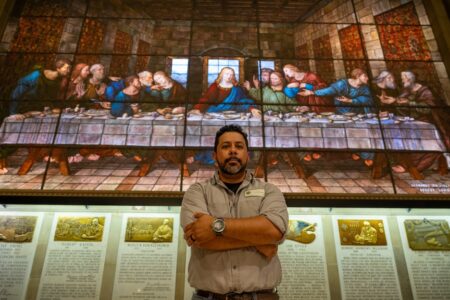
Just how deeply Chaki took that mission to heart is powerfully manifest in an installation, decades in the making and first presented in 1999, that is now mounted at the Montreal Museum of Fine Arts to mark 75 years since the liberation of Auschwitz. (Originally scheduled to open in October before new lockdown measures took effect, the exhibition was made viewable on the MMFA’s website in December.) Mi Makir: A Search for the Missing consists of hundreds of portraits rendered in acrylic, India ink and latex, each one bearing a number in the top left corner, obtained from the United States Holocaust Memorial Museum in Washington, signifying a specific Holocaust victim. Their effect is emphasized by a sculpture of a pile of books, evoking the Nazi book burnings of the 1930s. The show is a remarkable act of remembrance and tribute.
Advertisement
Story continues below
This advertisement has not loaded yet, but your article continues below.
Article content
“The idea,” said curator Iris Amizlev, “is that people are going to walk into this space and be transported into this world, this other dimension where you have no choice but to contend with what happened.”
The faces of Mi Makir are, to varying degrees, indistinct and obscured in a dark, sombre background, but despite this their characters manage to shine through — something Chaki himself underlined.
“I have noticed that after drawing and painting hundreds of faces, they became familiar to me, as I established a certain rapport (with) each one of them. At the same time, the people depicted became familiar to one another and formed a congregation. In Mi Makir, the people’s portraits are seen together in this ‘congregation,’ but they are also individually entrapped.”
Advertisement
Story continues below
This advertisement has not loaded yet, but your article continues below.
Article content
For the 82-year-old artist, Mi Makir is both the culmination of a lifelong mission and another project in a wide-ranging artistic practice that has placed him among the Canadian elite with both private and corporate buyers.
Asked where he would place Mi Makir in the context of his life’s work, Chaki replied: “It is difficult to take a step back and see the larger context, since I am constantly totally absorbed by whatever I am creating in the moment.”
It’s a creative practice Chaki continues with vigour, even in the face of Parkinson’s disease.
“Despite my condition, I am blessed with not having had to stop working,” he said. “I go to the studio at least six days a week. I still feel most comfortable when in the studio and am lucky to be surrounded by wonderful friends and family to help.”
Advertisement
Story continues below
This advertisement has not loaded yet, but your article continues below.
Article content
***

Manuel Mathieu: Survivance showcases the first Haitian-Canadian artist to have a work acquired by the Montreal Museum of Fine Arts.
The paintings — large, colour-saturated canvases occupying an ideal point between the abstract and the figurative — can be taken as instalments in a single, loosely connected ongoing narrative, or appreciated as stand-alone works. They owe some of their inspiration to a pair of serious traffic accidents suffered by the artist — one in London, the other in Montreal. Mathieu used his recovery time to reflect on his artistic mission, part of which is to fight against the forces conspiring to erase the history of his native country. Place yourself in front of a Mathieu canvas for a few minutes and you’ll see details emerging in real time. As with all the best art, the rewards are directly proportional to the attention given.
Advertisement
Story continues below
This advertisement has not loaded yet, but your article continues below.
Article content
***

It’s not every day you get to stand in front of a leaf from the 1455 Gutenberg Bible. And that’s just one item among the 90-plus on display in Grafik! Five Centuries of German and Austrian Graphics, a printmaking show of stunning historical and stylistic range. It includes a who’s who of seminal artists, from Renaissance giant Albrecht Dürer to the iconic Viennese secessionist Gustav Klimt.Fans of German expressionism and the Bauhaus school will be especially well served; these genres have never stopped looking modern in the century since their heyday, and they are represented by Emil Nolde, Otto Dix, Wassily Kandinsky and others. Asked to choose two must-sees from a show of must-sees, curator Hilliard Goldfarb picked Dürer’s The Beast With Two Horns, from the series The Apocalypse (1496-1497), and Erich Heckel’s Männerbildnis (Portrait of a Man; 1919).
AT A GLANCE
Mi Makir: A Search for the Missing continues through March 14.
Manuel Mathieu: Survivance continues through March 28.
Grafik! Five Centuries of German and Austrian Graphics continues through May 2.