



Article content continued
Others are schoolkid legends or viral factoids that are not quite true, like Miguel de Cervantes and William Shakespeare, who did technically both die on April 23, 1616, but in different countries, Spain and England, which were using different calendars, so in fact they died 10 days apart.
Some simultaneous exits are curious coincidences, like Signe Anderson and Paul Kantner who both died on Jan. 28, 2016, 50 years after she left the psychedelic rock band Jefferson Airplane, which they co-founded.
Some death partnerships seem to elevate each other in solidarity with a common cause
Others seem not to be coincidences at all, but somehow causally related as expressions of intense emotional intimacy, as in the occasional married couple who make headlines for dying sweetly together in ripe old age, or the parents of former star CFL quarterback Doug Flutie, Dick and Joan, who had heart attacks in short sequence on Nov. 18, 2015.
Some just seem ominous. On the day John F. Kennedy was assassinated, Nov. 22, 1963, C.S. Lewis died of ill health in Oxford, and Aldous Huxley died of cancer in Los Angeles, tripping on LSD.
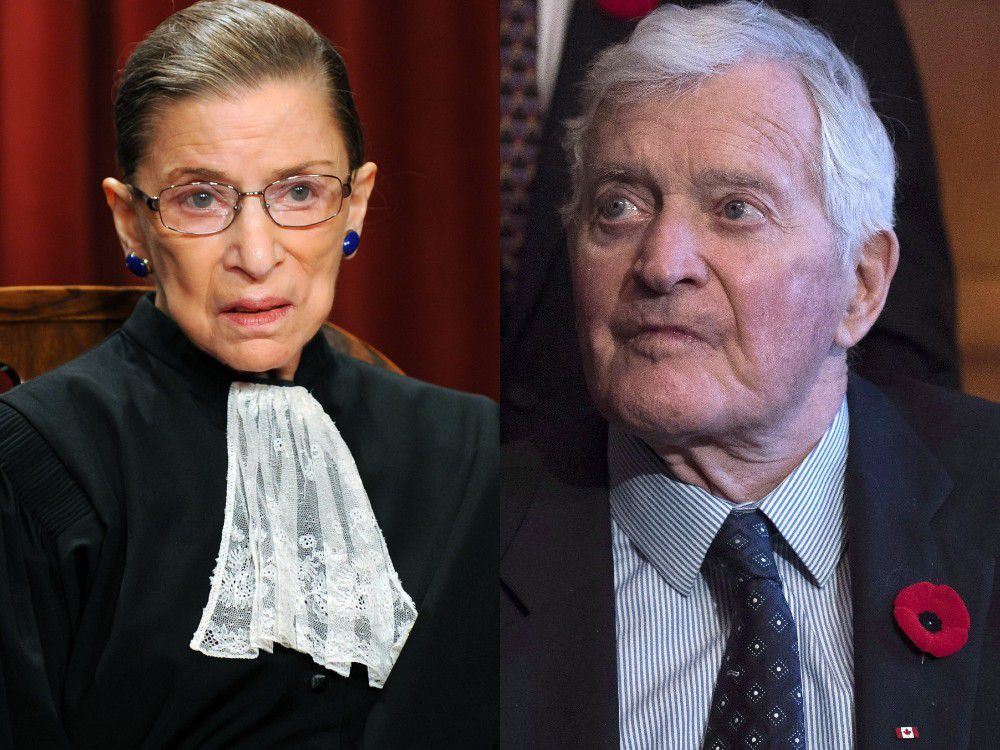
Few such death partnerships carry the political heft of the latest one between Bader Ginsburg and Turner.
The main contrast is how differently they matter to the wider public. Turner’s death casts the mind back to the past. Bader Ginsburg’s death does the same, but it also inspires urgent thoughts of the future.
Turner’s death has been treated in Canada as an opportunity to reflect on history, on the Liberal Party’s changing fortunes. Former prime ministers are under a newly critical eye. No one gets the saintly treatment any more, even in death. But Turner is someone who can be mourned at ease. He was not prime minister very long, less than three months in 1984. He had not been in the news lately, and had seemed frail in public appearances.