

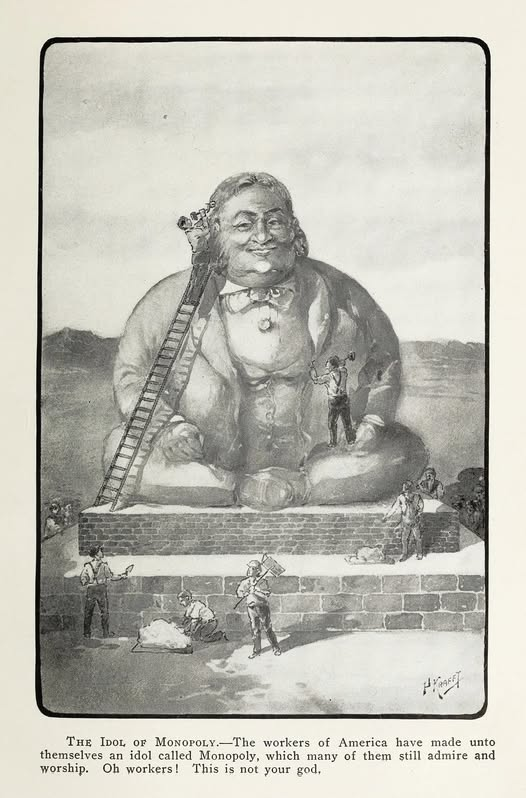
“The idol of Monopoly – The Workers of America have made unto themselves an idol called Monopoly, which many of them still admire and worship. Oh Workers! This is not your God.”
William Schuler Harris ‘Capital & Labour 1907.
Society has attempted to end the spectre of monopolies, but to no avail or success. The energy Industry continues to fix prices and drive fuel prices higher and higher. In Canada, the five grocery chains command control of food prices, offering Canadian little competition for the value. Higher Learning continues to drive Canadians into debt annually while cutting the services offered.
Our own governments are in themselves monopolies, servicing the public with sole services and products, with the added power of taxation. Monopolies are not going anywhere any time soon.
What is a monopoly? Exclusive ownership through legal privilege, commanded supply or joined concerted action. An individual firm or group can gain control of an industry or business sector.
Price Fixing: A firm or group of firms(often within a monopoly) sets prices within a few percentage points of each other, driving prices and profits upwards. An example of this would be Bread Price fixing by a group led by Loblaws. The group managed to make over 2 billion in added profits but was fined, forced to pay a few million back to their customers ($49.11 ea).
North American Business has a strict and cozy relationship with the idea of monopoly. The business model is often set dependent upon local. A rural city or town with a single source of employment or supply chain can have a monopoly. The ideal of a corporate town was developed in North America where employees depend upon the corporate store for their livelihood. The American Three (GM, Ford & Chrysler) had a managed monopoly long before foreign vehicles could be sold on this continent.
The idea of a monopoly is often seen by the public authorities in a negative light, yet industry, commerce and business interests have an undue influence upon our elected officials. Near monopolies are often allowed. Hydro Firms appear independent, yet they are dependent upon a central producer and supplier whose influences affect pricing policy. Monopolies are often legally and financially more capable of defending their rights against the public need for fairness and justice. Furthermore governments will not entangle themselves in corporate monopolies for fear of legal and financial retribution. The public domain wishes to attract businesses at any cost, not drive them away.
Monopolies will be more prevalent as corporations merge with each other over time. Less competition, greater profit margins. As corporations merge, the influence the public has over them will dwindle and fade away. Corporations hold upon the public sector will grow even into possible private ownership.
Steven Kaszab
Bradford, Ontario
Follow Canada News Media
Get the day's top Canadian stories and our two daily 60-second news videos wherever you scroll.