



More Canadians are struggling with the higher cost of mortgage debt, and anxiety is rising for those who face renewal on the horizon, says a new survey.
The Bank of Canada has raised interest rates 10 times in its battle against inflation from a low of 0.25 per cent starting in March 2022 to 5 per cent, a 22-year high.
While the Bank is widely expected to hold its rate tomorrow, the poll by the Angus Reid Institute reveals more Canadians are struggling with their monthly mortgage payments at the level they are now.
Homeowners on a variable-rate mortgage have seen their payments climb steadily, but those who took out a mortgage between 2018 and 2020 on a low fixed-rate also have reason for anxiety.
As renewal approaches, they face the possibility of big jumps in their monthly payments, a worry shared by four in five homeowners with a mortgage in the survey. Almost 60 per cent of those who must renew in the next 12 months were “very worried.”
Overall the survey found that Canadians are increasingly negative about their financial situation and prospects. Half say they are in worse financial position than a year ago and 35 per cent expect to be in worse shape a year from now. Both these percentages tie with the worst seen in 13 years of data collecting by the Angus Reid Institute.
The rising cost of living is now the top issue facing the country for two-thirds of Canadians, and housing affordability has outpaced climate change as a leading concern.
All this is costing Canadians in other ways, said the survey. Two thirds of the people polled say they view their household debt level as a minor or major source of stress. For Canadians who have a mortgage the percentage rises to 81 per cent.
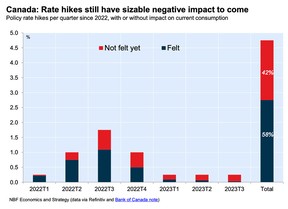
It takes a while for interest rate increases to affect the economy, which means the weakening in consumer spending and confidence that we are already seeing will likely get worse. The Bank of Canada’s estimate for the full impact of rate hikes to set in is eight quarters, and based on that National Bank of Canada economists calculate that 42 per cent of the impact is still left to come.
“For this reason, it would be perilous for the central bank to focus on the resilience of core inflation in its rate decision [Wednesday], as this indicator reacts with a lag to the economic situation which looks set to be moribund over the next 12 months,” said economists Matthieu Arseneau and Alexandra Ducharme.
_______________________________________________________
Despite years of looking at underlying fundamentals and understanding risk, portfolio manager Martin Pelletier still finds it confusing that tech stocks are rallying despite higher interest rates, the escalating Middle East conflict and increasing worries over the global economy. He prefers to look at cash-flow yields and what is required to achieve those yields measured against lower-risk alternatives offering up near-similar returns. Find out more at FP Investing