

Exploring the peaks, valleys and hardscrabble streets that helped shape the man now known as CR7
Article content
Reviews and recommendations are unbiased and products are independently selected. Postmedia may earn an affiliate commission from purchases made through links on this page.
FUNCHAL, Portugal — In the steep western hills above the capital city of the island of Madeira, in a working-class parish called Santo António, there is a small parking lot where a two-room house once stood. Cristiano Ronaldo grew up in that house.
Beside the empty lot sits Quinta do Falcão, a small, hard-surfaced soccer court that pays homage to the man now known as CR7. It’s built over the dirt tracks where he and his friends once chased a ball across whatever pocket of level ground the grade allowed. Their scramble for space was not unique to football. Flat ground has always been this island’s scarcest resource.
Article content
Article content
Advertisement 2
Article content

This summer, 41-year-old Ronaldo is playing in what will likely be his last World Cup. Portugal’s group games fall in the United States, so he may not cross into Canada, even with Toronto and Vancouver among the host cities. But his homeland already shares a deep history with this country, forged by the same unyielding geography that shaped him.
Madeira’s landscape may be gorgeous, but its history includes periods of severe hardship. During the Salazar dictatorship (1932–1968), agricultural policies required many Madeirans to give up a large share of their crops to landlords. These conditions contributed to widespread poverty and pushed residents to emigrate.
Many chose Canada. The first wave of Portuguese landed at Halifax’s Pier 21 in May 1953. Most of them were Azorean, but Madeirans arrived alongside them. Some landed in Ontario pursuing heavy construction work. The men poured concrete and laid brick, eventually carving out their own neighbourhoods in Toronto. Kensington Market and Little Portugal exist largely because of their generation’s grit.
Advertisement 3
Article content
Fire and forest

The same terrain that drove Madeirans away now draws visitors in. When 15th-century Portuguese sailors found the island smothered in forest, they named it for what they saw: Ilha da Madeira, island of wood.
Much of that forest still stands. The interior contains one of the largest surviving tracts of laurisilva. This subtropical laurel woodland once covered much of southern Europe before the Ice Age and has since vanished almost everywhere else on the continent. My wife, Anisha, and I encountered it near Fanal, where gnarled laurels grow squat and twisted from centuries of wind, and mist lifts from the gullies below.
Supplying water to such a vertically inclined island took ingenuity. Beginning in the 1500s, Madeirans cut the levadas, narrow stone channels running more than two thousand kilometres across the island’s flanks to carry rainfall from the wet north to the farms. Following one above Funchal, we tracked the water past banana plots and vine terraces, a rock wall on one side, a sheer drop on the other.

Travel Time
Article content
Advertisement 4
Article content

A 4×4 is the best way to reach the wild northwest. We climbed to the bare moorland of Paul da Serra, dropped through those laurel woods and came down to the coast at Seixal and Porto Moniz, where lava cooled into natural pools at the water’s edge. We chose one for a midday swim, the Atlantic breaking white just beyond the basalt rim.
To catch Madeira’s legendary above-the-clouds sunrise, we set out before dawn for a lookout near the summit of 1,818-metre Pico do Arieiro and watched the ridges catch fire over a fluffy cumulus floor. From there, we crossed the Stairway to Heaven, the narrow path running along the arête (ridge) toward Pico Ruivo, the island’s highest peak. Fierce winds and sheer drop-offs on both sides kept us intensely focused.

For all its chilly summits, Madeira still earns its reputation as the Island of Eternal Spring. The water stays warm enough to keep sperm whales remaining resident offshore in every season, a rarity in the Atlantic. It’s also calm enough to put a boat on almost any evening. We took ours from the Marina do Funchal at dusk, the dropping light turning the fishing harbour of Câmara de Lobos gold as we made for the towering face of Cabo Girão, one of Europe’s highest sea cliffs.
Advertisement 5
Article content
Atlantic table
Distance from the mainland gave Madeira a cuisine of its own: fresh Atlantic seafood, skewered beef and local takes on mainland Portuguese staples.
In Funchal, we shared oxtail ravioli and crisp tuna tartare at chef Júlio Pereira’s Michelin-listed Kampo. Its sibling, Akua, served codfish tacos, Jaipur curried prawns and braised tuna with island-grown sweet potatoes. Best of all was the smoked black scabbardfish, a Madeiran specialty that tasted like it had been caught that afternoon. A third Michelin-listed kitchen, César Vieira’s Audax located behind the Savoy Palace, turned poncha — the island’s rum-and-honey staple — into a tasting-menu course.

Up in the mountains, culinary reinvention reverts to older traditions. We pulled over after the jeep tour for espetada, a Madeiran favourite of beef rubbed with garlic, coarse salt and bay leaves, skewered on a stick cut from a bay laurel branch and roasted over coals until the outside chars. It arrived, hung on an iron stand at our table, fat still dripping into the embers.
Advertisement 6
Article content
Even Madeira wine started as an accident of isolation. Centuries ago, local merchants noticed that casks left baking in ships’ holds on long crossings came back tasting better than when they’d left. Blandy’s has bottled the fortified result in Funchal since 1811, heating and oxidizing it on purpose to approximate the conditions of those voyages. In their cellar, a former monastery near the harbour, we tasted the result: a rich amber sweet wine that keeps for months once opened, far longer than ordinary wine.
Son of the land

For centuries, Madeira’s indestructible wine was its defining export. Now that title belongs to CR7.
Before escorting us to Quinta do Falcão, Graça Lopes, a local guide and Ronaldo specialist, met us at his waterfront museum, its walls lined with photos and its cases packed with the hardware of an unmatched career.
“Football for the Portuguese is very important,” Graça said. “They say Portugal is fado, the national song; Fátima, the religion; and football.”
Advertisement 7
Article content
The boy now at the centre of that secular religion grew up in that Santo António house with his mother who cooked school lunches, two siblings, and a father who managed equipment part-time at the Andorinha club. His father struggled with alcoholism and died in London in 2005, before his son’s career reached its height.
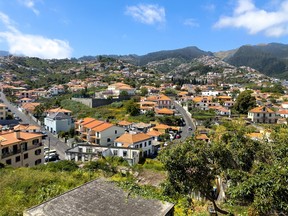
From the museum, Graça drove us up into Santo António’s steep streets, past the parish church where Ronaldo was christened. His father and godfather turned up half an hour late to the ceremony, she told us, stuck at a football match on the far side of the island.
“That was an omen, no?” she said, laughing.
Higher up, we reached the old Andorinha playing ground, where preteen Cristiano Ronaldo first starred. Its dirt surface has been turned into a public park, surrounded by narrow cobblestone alleys. It was this former patch of green, on this remote volcanic outpost, surrounded by a tight-knit blue-collar community, that produced one of the most decorated footballers in history.
Advertisement 8
Article content
Down the street, on a mural by British street artist Richard Wilson covers the civic centre wall, Ronaldo looks out toward Andorinha. Wilson painted it after Portugal’s Euro 2016 win, and the neighbours who watched the boy grow up suggested its name: Filho da terra, son of the land.
At this year’s World Cup, Cristiano Ronaldo gets a last try at the one trophy that has eluded him. When he plays, the cafés on College Street in Toronto, the ones the Madeirans built, will be full. But the boy behind the legend remains here, in the hardscrabble streets where he was born, on the Quinta do Falcão field where he first kicked a ball, and in four words painted on its wall: Born here, known everywhere.
If you go

Getting there: TAP Air Portugal offers direct flights from Toronto Pearson to Lisbon, with onward connections to Funchal’s Cristiano Ronaldo International Airport. Travellers booking on TAP can add a free stopover of up to 10 days in Lisbon or Porto on international itineraries.
Advertisement 9
Article content
Where to stay: The Savoy Palace sits in central Funchal and is the island’s flagship luxury address. The property has multiple pools, direct access to the city’s lido, and Audax Restaurant, one of Funchal’s most elegant dining rooms.
CR7 Museum: Located on the Funchal waterfront beneath the Pestana CR7 hotel, it is fronted by a bronze statue of him mid-free kick. Inside, the largest Ronaldo collection anywhere holds more than 200 trophies, plus signed shirts and a life-size wax likeness.
Recommended outfitters: Green Devil Safari runs 4×4 tours and guided levada walks. Madeira Adventure Kingdom specializes in small-group hiking, including the Stairway to Heaven. Happy Hour Madeira offers private sunset sails from the Funchal marina.
When to go: Madeira’s climate makes it genuinely year-round. May through October offer the best conditions for hiking and whale watching; the island’s famous Flower Festival falls in late April or early May. Expect warm, dry weather on the south coast and atmospheric mist in the interior at any time of year.
Mark Sissons was a guest of Visit Madeira, which did not preview this story before publication.
Read More
-

Yes, Amalfi is overwhelmed. Here are 6 quieter Italian beach gems
-
I found heart-pounding wildlife moments at this new safari lodge in Botswana


Article content
Related Products
Follow Canada News Media
Get the day's top Canadian stories and our two daily 60-second news videos wherever you scroll.
X Threads Facebook Instagram LinkedIn TikTok YouTube Pinterest Reddit Substack Flipboard Newsletter RSS