

Microsoft has removed an article that advised tourists to visit the “beautiful” Ottawa Food Bank on an empty stomach, after facing ridicule about the company’s reliance on artificial intelligence for news.
But an unnamed Microsoft spokesperson later blamed the article’s publication on “human error,” rather than “unsupervised AI.”
Published last week and titled “Headed to Ottawa? Here’s what you shouldn’t miss!” the article listed 15 must-see attractions for visitors to the capital.
The list was rife with errors. It featured a photo of the Rideau River in an entry about the Rideau Canal, and a photo of the Rideau Canal in an entry about Parc Omega near Montebello, Que. It advised tourists to enjoy the pristine grass of “Parliament Hills.”
But the Ottawa Food Bank entry earned the most mockery in technology publications and on social media. The article called the food bank one of Ottawa’s “beautiful attractions,” before putting it third on the list.
Most of the entry simply describes what the food bank does, but it closes with a bizarre recommendation:
“Life is already difficult enough. Consider going into it on an empty stomach.”
That appears to be an out-of-context rewrite of a paragraph on the food bank’s website. “Life is challenging enough,” it says. “Imagine facing it on an empty stomach.”
‘It’s pretty obvious that a robot wrote this’
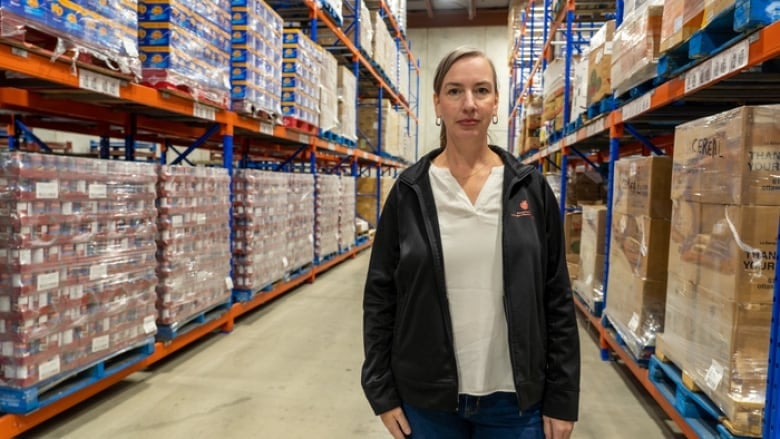
The food bank is located in an unremarkable industrial area in east-end Ottawa. It does not even directly serve the public, but operates as a distribution warehouse for supplying partner agencies who do. CEO Rachael Wilson said the article attracted shock, eye-rolls and some laughter among staff there.
“We were quite surprised to see that we had made this list,” she said. “Thankfully everyone so far has realized that this clearly was not an article that we were a part of and it’s pretty obvious that a robot wrote this.”

The article carried the byline “Microsoft Travel.” There is nothing on the page that identifies it as the product of artificial intelligence, but the company later acknowledged that it was generated by algorithms subject to human review. It suggested that it was the human review, not the algorithm, that fell short.
CBC reached out to WE Communications, which handles media relations for Microsoft. It said an investigation is complete and shared the following statement from an unnamed Microsoft spokesperson:
“This article has been removed and we have identified that the issue was due to human error. The article was not published by an unsupervised AI. We combine the power of technology with the experience of content editors to surface stories. In this case, the content was generated through a combination of algorithmic techniques with human review, not a large language model or AI system. We are working to ensure this type of content isn’t posted in future.”
Microsoft laid off dozens of journalists in 2020 in a move to rely more on artificial intelligence, according to multiple news reports at the time. Those journalists were responsible for selecting content for Microsoft platforms, including MSN and the Edge browser.
Wilson said no one at Microsoft called her to discuss the story, either before or after it was published. She said the episode underlines the importance of keeping “human beings to review things before we put them out.”
She said she can understand how a robot scouring the internet with search terms and algorithms but no context could mistake the food bank for a “cool thing to do” in the capital, given how pressing of an issue food security has become in Ottawa.
“We, unfortunately, are very top of mind right now. Food insecurity is a huge issue here in Ottawa,” she said. “So it is a little bit disconcerting that a robot picked up the fact that food insecurity is such a hard issue.”
Article called ‘inappropriate and very distasteful’
The strangeness of the Microsoft Travel article was first highlighted by an X user called Paris Marx, who posted that “Microsoft is really hitting it out of the park with its AI-generated travel stories!”
Microsoft is really hitting it out of the park with its AI-generated travel stories! If you visit Ottawa, it highly recommends the Ottawa Food Bank and provides a great tip for tourists: “Consider going into it on an empty stomach.” <a href=”https://t.co/7bvGemDad2″>https://t.co/7bvGemDad2</a>
—@parismarx
That was followed by an article in the Verge, a website focused on technology and science news. The Microsoft Travel article was soon removed, though it remains accessible on an internet archive.
Beyond the geographic errors and the inexplicable recommendation to fast before enjoying the food bank, the article exhibited an unusual writing style. It advised tourists that Winterlude offers them the chance to experience “North America’s largest snow,” while calling the Rideau Canal “naturallyfrozen.”
The article also offered the following insight:
“The Canadian Parliament Buildings are the buildings that house the Parliament of Canada.”
But Wilson said the article wasn’t completely off point.
“It did get a lot of things right in terms of how much fresh food we put out,” she said. “We’re very focused on providing healthy and nutritious food — but any sort of comment around showing up with an empty belly was really inappropriate and very distasteful.”