
Reviews and recommendations are unbiased and products are independently selected. Postmedia may earn an affiliate commission from purchases made through links on this page.
Article content

The federal government’s foreign homebuyer ban was designed to improve housing affordability, but a major flaw in the legislation is causing more harm than good, according to the Canadian Imperial Bank of Commerce.
The ban, which blocks non-Canadians from buying residential property — either directly or indirectly — for two years, came into effect on Jan. 1. The Prohibition on the Purchase of Residential Property by Non-Canadians Act, as it is officially known, was meant to take some pressure off home prices amid an affordability crisis only made worse by the rising cost of living brought on by inflation and elevated interest rates. But, there’s a problem: The language used in the Act is causing issues, and it’s stopping real estate development — necessary to boost housing supply and address affordability — in its tracks, Benjamin Tal of CIBC economics said in a note.
“The language of the Act appears straightforward until you show it to a lawyer,” he said.
“The entire area of downtown Toronto falls under that category,” Tal said.
Further, the definition of “non-Canadian” is also a source of problems. Corporations are considered non-Canadian under the Act if they have foreign ownership of at least three per cent. But though the Act excludes companies listed on a Canadian stock exchange from being affected, it fails to exclude real estate investment trusts (REITs) — important builders of residential property such as apartments. That means most publicly traded Canadian REITS are therefore considered “foreign entities,” the note said. As a result, many REITs risk being blocked from building much-needed new housing.
The end result has brought upheaval to the real estate industry and caused even commercial deals, with no ties to residential homes, to be cancelled or held back.
“The damage is real,” Tal said. “Developers that are partly foreign owned or rely on foreign equity cannot proceed with purpose built developments that, in our view, are the most effective tool to tackle Canada’s housing affordability crisis.”
Tal urged the government to take action to rectify all the problems the wording in the legislation has unintentionally created.
“Policymakers should immediately take another look and amend the Act in a way that is consistent with what it was intended to achieve — focusing only on single units being purchased by foreigners while exempting development of new supply from the impact of the new legislation,” he said.
_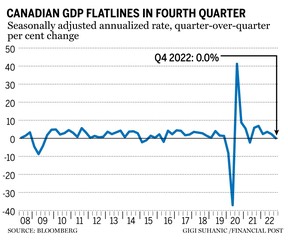
The 0.0 per cent growth reading in fourth-quarter gross domestic product capped five consecutive quarterly increases and missed analysts’ average forecast of a 1.5 per cent rise. It was also well below the Bank of Canada’s forecast for 1.3 per cent annualized GDP growth in the quarter.
That might mean Canada is headed for recession after all, writes Kevin Carmichael. The data will also be welcome news for Bank of Canada governor Tiff Macklem. Read Carmichael’s analysis here.