


Rather than physically removing the protesters who are blocking a Canadian National rail line on Montreal’s South Shore, Longueuil police say they would rather continue discussions with the group.
Clad in black riot gear and ski masks, police gave protesters a deadline of 5 p.m. to evacuate the blockade in Saint-Lambert, Que.
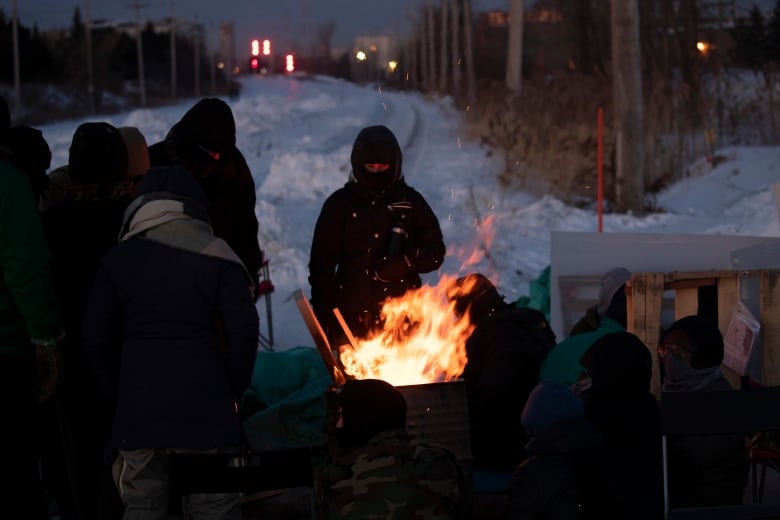
Though some demonstrators left, the rest remained hunkered behind a snow fort or milling about the makeshift encampment while police stood in a half-moon formation nearby.
Earlier in the afternoon, police closed St-Georges Street, which crosses the train tracks near the rail blockade. They said it was to “ensure the safety of the demonstrators as well as that of the citizens who circulate in the sector.”
Media were pushed back from the site and the cold air became tense as police and protesters stood their ground.
But nothing physical happened and the riot police eventually left the scene despite Quebec Premier François Legault’s Wednesday promise to “dismantle the blockade” once the injunction was served.
Legault said Longueuil police would be in charge and use force if necessary.
The number of protesters blocking commuter trains on the Mont-Saint-Hilaire line near Saint-Lambert station has dwindled since an injunction was served Thursday evening.
By Friday evening, as the sun set, roughly 30 protesters remained on site in a show of solidarity for Wet’suwet’en hereditary chiefs in BC, who are against a pipeline passing through traditional territory. Unlike most other rail blockades, the one in Saint-Lambert is not on Indigenous territory.
Longueuil police have been keeping watch on the blockade but have not moved in to dismantle it or try to remove the protesters by force, as suggested by the premier.
Police said they would give a reasonable amount of time for protesters to leave on their own after being handed the injunction on Thursday evening. They didn’t specify when they planned to move in and enforce the injunction.
‘We’re trying to be pacifists’
Saint-Lambert resident Henri-François Girard told CBC News he decided to join the protesters because he supports their cause.
“I was just passing by and I saw ‘Hey, these guys are doing the right thing,'” he said.
He feels their protest has been portrayed negatively in the media, but in person, “they’re all good people over there in the camp.”
Girard said he was moved to join them because he feels the climate crisis is an issue that can’t be ignored. He hopes the stand-off between protesters and police won’t lead to violence.
“We’re trying to be pacifists, we’re not trying to cause trouble,” he said.
The Mont-Saint-Hilaire line is the second commuter train route to be disrupted in the greater Montreal region. A blockade in Kahnawake, on Montreal’s South Shore, has forced Exo to cancel travel on its Candiac line since Feb. 10.
Legault said the Kahnawake blockade will not be dismantled by the Quebec government, because it is on Mohawk territory.
Many of the protesters in Saint-Lambert are young people and students, the majority of which are not Indigenous.

A special case in Saint-Lambert
Saint-Lambert Mayor Pierre Brodeur emphasized this distinction in an interview with Radio-Canada’s Tout Un Matin Friday morning.
He said that “it’s frustrating to watch a small group of people who are depriving the citizens of Longueuil of access to commuter trains,” adding that the protest isn’t taking place on Indigenous land, nor is it led by Indigenous people.
“These are people who have nothing to do with Indigenous people,” he said.

In his view, the protest happening in Saint-Lambert is “completely different” from those taking place in other parts of the region.
Brodeur said it’s not fair that commuters in his area should be impacted by the solidarity protest, saying “we are just waiting for the green light” and that he is “impatient to get started dismantling these barricades.”
Ghislain Picard, chief of the Assembly of First Nations of Quebec and Labrador, told CBC Montreal’s Daybreak that “this is so much bigger than an issue of land rights out in BC. It affects everyone,” he said.
Picard said if police remove Saint-Lambert protesters by force, it might mobilize more groups of people to take action in solidarity.
“People are talking and trying to find ways to be supportive,” he said.
He said this crisis provides an opportunity for Prime Minister Justin Trudeau to prove his commitment to building relationships with Indigenous people in Canada and resolving the conflict peacefully will be a key part of that.
On Friday, Trudeau said the blockades “need to come down now,” but said he would not be sending in the army to do so.

Follow Canada News Media
Get the day's top Canadian stories and our two daily 60-second news videos wherever you scroll.
X Threads Facebook Instagram LinkedIn TikTok YouTube Pinterest Reddit Substack Flipboard Newsletter RSS