


Realtor Trent Rodney has a knack for selling West Coast modern homes that were built in the 1950s and ’60s.
He sent it out to 10,000 people on his database of West Coast modern aficionados. The goal: To save a small house on a big lot in North Van.
“Since it’s on a corner lot on Forest Hills Drive, one of the best streets, and is close to Edgemont Village, this is prime developer bait,” said Rodney.
In this case, the 9,660 square foot lot was occupied by a 1,363 sq. ft house. The zoning allowed for a new structure up to 5,500 sq. ft. The price: $2.3 million.
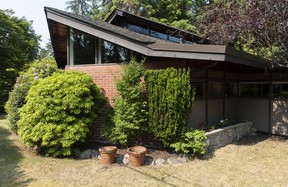
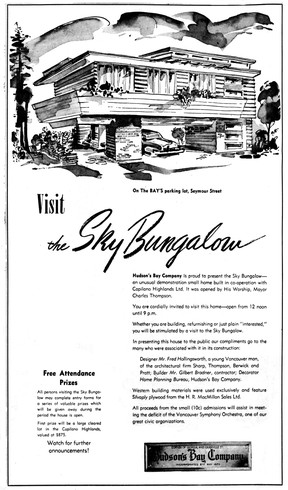
What made this house special is it was designed by the local West Coast modern architect Fred Hollingsworth as part of his “Flying Arrow” series in 1950. Rodney said only six Flying Arrows were built; this could be the only one left.
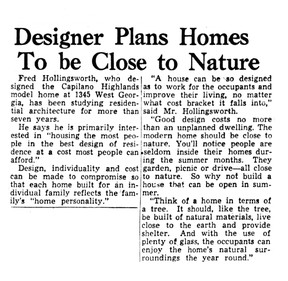
Hollingsworth had studied with architectural legend Wright in Arizona, who had an ambitious plan to build cheap but cool “Usonian” houses for the masses. Hollingsworth came back to B.C. and started designing his own homes for the middle or working class, called Neoteric or Flying Arrow houses. The Neoterics had flat roofs, the Flying Arrows had pitched roofs.
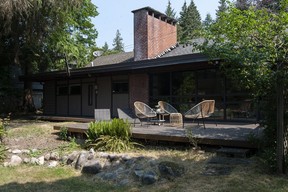
The houses were small but felt much bigger because they had an open-concept and floor-to-ceiling windows.
“The intention when it was built was to be indoor-outdoor living, living as much outdoors as you do inside,” said Rodney. “So they cared more about access to light, access to nature.”

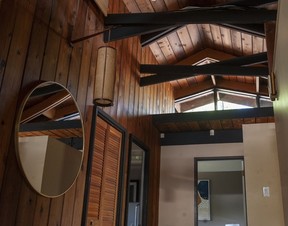
The Flying Arrow homes had high angled ceilings (probably 15 feet in points) and a stylish “scissor truss” system of wooden beams that held up the roof.
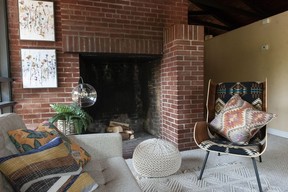
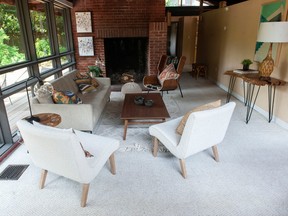
Hollingsworth designs also featured brick walls, which gave them warmth, and large fireplaces that tended to be the architectural showpiece of the home.
In this case, the fireplace was five feet high and three feet wide. In a 1952 Western Living magazine story on the house, it said the original owner, Jim Atkins, burnt three-foot-wide logs in the fireplace.
“This was more of a forested lot, back in the day,” said Rodney. “The owner would go out and cut their own logs for the fireplace.”
The lot still has plenty of green space, including a handful of seven-storey-tall Douglas firs. The lot also feels very private, because the big windows are at the back, the front has smaller windows that are at eye level.
But the house was designed for the postwar era, when developers were building modest homes for people with a limited budget. The house has only two bedrooms, one bathroom and has a galley kitchen, which is out-of-step with the large contemporary homes in the neighbourhood.
Some owners of Hollingsworth homes expand them — there is a Hollingsworth next door where they added a second floor. But builders tend to knock small houses like this down and build as big as the zoning allows.
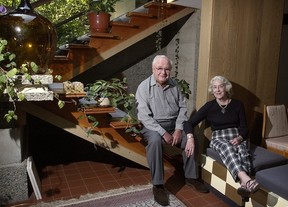
In this case, though, the house quickly sold for the asking price to a couple who loved the house. In fact, they had just sold a Hollingsworth Neoteric house they’d lived in for 18 years.
“There is a sense that you’re within a very tangible and thoughtfully designed piece of art, made specifically to ground its occupants to the land and trees that surround it.”
The Gilmours did an addition to their first Hollingworth house to make room for their family of four. Their two boys have grown up and moved out, and they were looking for something smaller.